

🔎 TL;DR
- The Chicxulub crater was formed 66 million years ago by a 10–15 km asteroid impact — the event that ended the Cretaceous period.
- The ~180 km crater's northern rim sits under Progreso's coast. You cannot see it directly, but the ring of cenotes inland follows the rim.
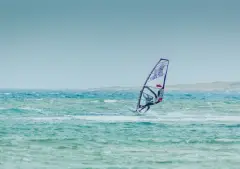
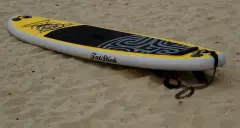
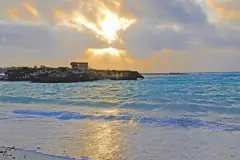
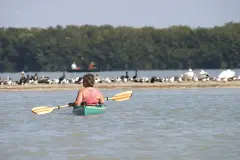
- SUP from Chicxulub town offers a flat coastal route over water that literally covers the crater.
- It is geology tourism as much as a SUP session.
The science in 2 paragraphs
The Chicxulub impactor hit the Yucatán shelf 66 million years ago, gouging a multi-ring crater ~180 km in diameter. Debris and climate collapse caused the K-Pg extinction event (non-avian dinosaurs, 75% of species). The crater's existence was confirmed in 1991 by geophysicists Penfield and Camargo working for PEMEX on oil exploration data.
Today, the crater is buried under ~1 km of marine sediment. Its northern rim lies offshore, south of Progreso. The "Ring of Cenotes" visible in the Yucatán Peninsula is a groundwater signature of the buried crater rim — cenotes concentrate in a semicircle around it.
The SUP route
Launch from Chicxulub Puerto (5 km east of Progreso). Paddle east along the coast past the fishing jetty and sand beaches. The water is shallow, flat, and between 20–50 m covers sediments directly over the crater rim. The route is ~3–5 km round-trip.
Paddle over the crater. Book Progreso SUP →
Frequently asked questions
Can I see anything of the crater?
Not visually. It is buried. What you paddle over is 66-million-year-old sediment covering the impact zone. It is conceptual tourism + nice SUP.
Where is the Chicxulub museum?
Museum of Science on the Chicxulub Crater is in Progreso town — worth pairing with the paddle.
Distance from Mérida?
35 km north. Day trip from Mérida is straightforward.
Book Chicxulub SUP
Date + interest (geology vs leisure) — we match guide + route.