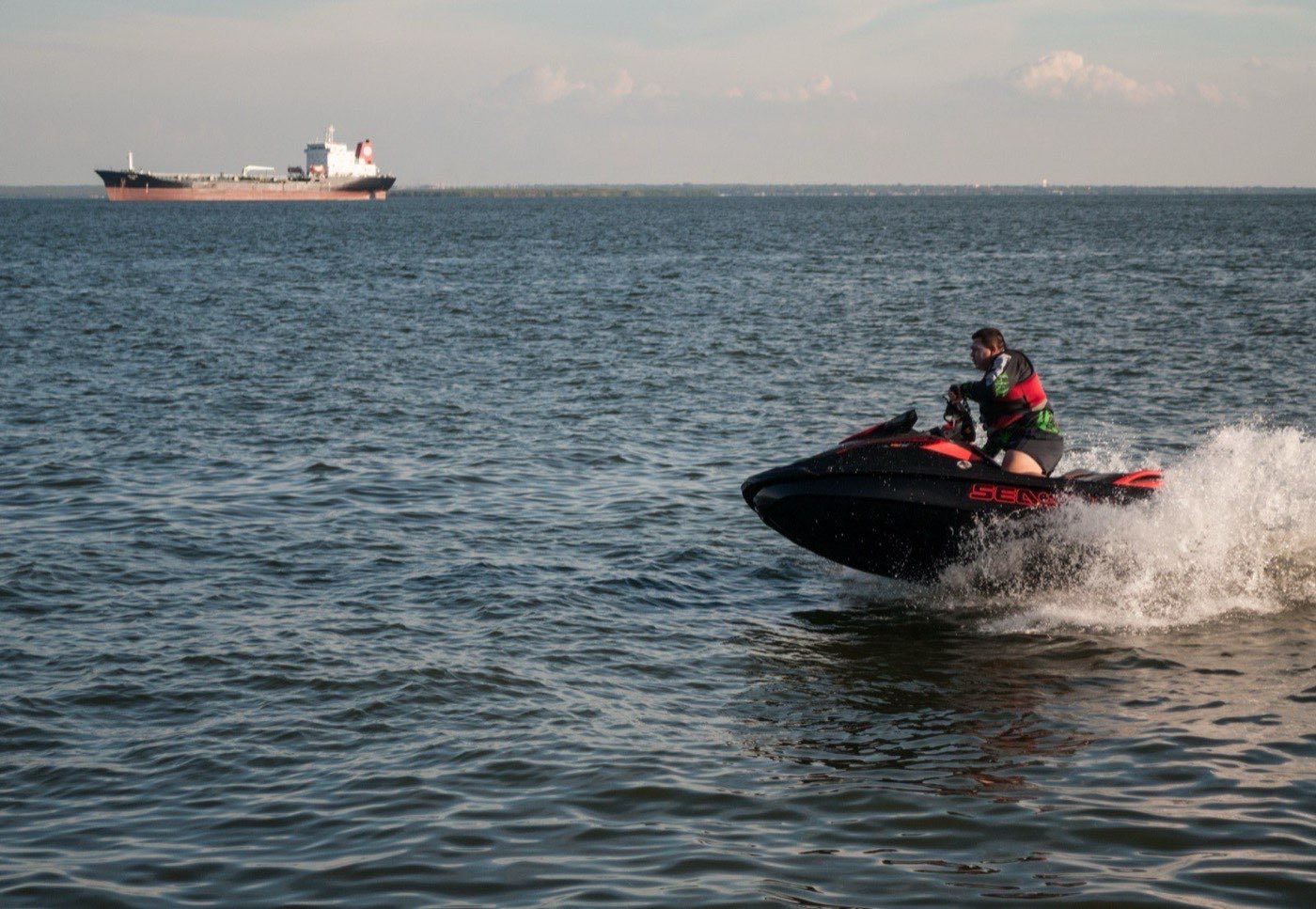
🔎 TL;DR
- The Yucatán Gulf coast has a hard four-season pattern that no other Mexican waverunner destination shares — Nortes (Nov–Mar), transition (Apr), summer glass (May–Aug), and hurricane risk (Aug–Oct) — and a Progreso ride that ignores the calendar is a ride that gets cancelled at the dock.
- The single best window for the full Malecón–Chicxulub crater route is late May through early August — sustained light easterlies, dawn glass on the Gulf shelf, and 28–30 °C water — confirmed in the climatological summaries published by CONAGUA / SMN for the Yucatán north coast.
- The Nortes season (Nov–Mar) shuts the Gulf down on a 4–7 day cycle: a high-pressure cold front pushes down from the central United States, the Gulf wind clocks from south-east through north-west, and 20–35 knot winds with 2–3 m seas can sit on Progreso for 36–60 hours. Operators cancel; the SEMAR Capitanía de Puerto closes the port.
- Hurricane season runs 1 June to 30 November, but real Yucatán north-coast risk concentrates August–October, when warm Atlantic basin water and a recurved track make Gulf systems possible — see the NOAA National Hurricane Center climatology for the western Caribbean and the southern Gulf.
- The cruise calendar overlays the weather calendar. Tuesdays, Wednesdays and Saturdays in high season (Nov–Apr) bring two and sometimes three ships into Puerto de Altura — the waverunner corridor in front of the Malecón tightens, briefings run longer, and afternoon launches push to the late slots.
- Booking rule of thumb: target 06:30–10:00 launches from October through April; any pre-noon slot works from May through July; watch the 5-day NHC tropical outlook from August through early October before committing non-refundable transport from Mérida.
Why the Yucatán Gulf needs its own calendar
People who have ridden waverunners in Cancún, Cabo or Puerto Vallarta sometimes show up in Progreso assuming the same patterns apply. They do not. The Yucatán Gulf coast is a fundamentally different body of water — a shallow carbonate shelf that drops only a few metres in the first ten kilometres offshore, oriented east–west, fully exposed to weather systems sliding south out of North America, and far from the trade-wind regulation that smooths Caribbean conditions. The result is a sea that flips between glassy mirror and industrial-grade chop faster than any other Mexican waverunner zone.
The Servicio Meteorológico Nacional (CONAGUA-SMN) climatological tables for Progreso show the structure clearly. Mean wind speed in January is 14–18 knots from the north quadrant; in July it is 8–11 knots from the east. Mean significant wave height climbs from 0.6 m in summer to 1.6 m in winter. Surface water temperature drops from a remarkable 29 °C in August to 23–24 °C in February — cool enough that a long Chicxulub ride in January is uncomfortable in a swimsuit, comfortable in a 1.5 mm shorty. Knowing the month tells you almost everything about whether the ride will be relaxing or punishing.
This guide breaks the year into the four operational seasons that actually run waverunner operators in Progreso, with the data behind each call and the booking rule that follows from it.
Season 1: Nortes (November–March) — the season that cancels
A Norte is the local name for the strong north-to-north-west wind that follows a cold front pushing down from the Great Plains, across the Gulf of Mexico, and onto the Yucatán north coast. It is a Mexican-meteorology category, not a tourism marketing term — CONAGUA issues formal frente frío advisories with numbered front identifiers, and SEMAR closes the Capitanía de Puerto Progreso based on them. From the operator side, the rule is simple: when a Norte is on the way, the next 48 hours of waverunner bookings get rescheduled.
Mechanically, a Norte builds like this. A continental high pushes south, the pressure gradient over the Gulf compresses, the surface wind turns north-east then north then north-west, sustained at 20–30 knots with gusts to 40, and the shallow Gulf shelf piles up short-period 2–3 m wind seas in less than 12 hours. Air temperature drops 8–12 °C in a few hours. The cruise pier closes to anchoring. Pangas inside the Ría de Yucalpetén shelter and wait. Waverunner operators pull craft from the beach and store them. A typical Norte runs 36–60 hours from first wind shift to final clean-up, then the Gulf calms, then 4–7 days later the next one arrives.
The frequency is what makes Nortes the dominant calendar fact of November through March. The 2023–24 season recorded 51 numbered cold fronts crossing Mexico — typical of the past decade per CONAGUA-SMN summaries — with the strongest concentration between mid-December and late February. In a representative January in Progreso, you can expect 3–4 separate Norte events, each closing the water for 1.5–2.5 days, plus the recovery day after each one. That is roughly half the month with reduced or zero waverunner operations.
How to book around a Norte
- Watch the 5-day forecast. CONAGUA's Pronóstico Meteorológico General and the regional Yucatán bulletin name incoming fronts 4–5 days out. Your operator should already be moving bookings.
- Take the early morning slot. If a Norte is forecast for Thursday afternoon, the Thursday morning ride often still runs — the wind builds through the afternoon. By Friday morning the seas are unrideable.
- Build a flex day into the trip. If your only window is Tuesday and a Norte hits Tuesday, you miss the ride. A 3-day stay in Progreso gives the operator one slot to reschedule into.
Season 2: Transition (April) — the short shoulder
April on the Yucatán north coast is a transitional month. The continental cold-front machine winds down — the last numbered Norte typically arrives in early-to-mid April and is weaker than the December–February events. The dominant easterly trade pattern is not yet established. Air temperature climbs to 30–34 °C, water comes up to 25–27 °C, and wind is variable: some days flat and glassy, some days a moderate easterly that builds 1 m chop by mid-afternoon. The cruise calendar is still active until late April.
April is the under-rated month for the Chicxulub run. Mornings are reliably calm — the easterly does not really fire up until 11:00–12:00 — and the water is warm enough to swim at the anchor stop. The downside is unpredictability: the forecast model often gets April wrong because the system is between regimes. Operators bookmark this as the "go now, decide morning-of" month.
The other April thing to watch is the spring algae bloom. Warmer water and longer days drive a brief plankton bloom on the Yucatán shelf, mostly harmless but occasionally enough to tint the water green-brown near the Yucalpetén cut. It clears as soon as the easterly trades establish in May.
Season 3: Summer glass (May–August) — the operator's golden window
If you came to Progreso for the long Chicxulub crater route, you came for these months. From mid-May through early August the Yucatán north coast settles into its most stable regime: easterly trade winds at 8–12 knots, dawn glass on the Gulf, building to 1.0–1.5 m wind chop by mid-afternoon, no cold-front activity, water at 28–30 °C, air at 31–35 °C during the day. SEMAR Capitanía closures during summer are rare and tied to local convective storms rather than synoptic-scale wind.
Two things make this the peak ride window. First, the diurnal pattern: 06:00–09:00 is glass, 09:00–12:00 is light chop, 12:00–17:00 is moderate chop, 17:00–19:00 sometimes lays back down for a sunset ride. The morning slot delivers the smoothest ride and the best Gulf visibility for the eastbound seagrass corridor. Second, the thermal water: 29 °C is warm enough to swim comfortably at the Chicxulub anchor stop without a wetsuit, and warm enough that an unexpected dunking is a non-event rather than a hypothermia risk.
The trade-off is heat. Air temperature on the Malecón at 12:00 in July can hit 36 °C with limited shade. Sunscreen, hydration, and a UV rash guard matter; the cruise pier has no shade, the launch corridor has no shade, and the open Gulf reflects everything. Dawn departures (06:30 briefing, 07:00 launch) avoid both the heat and the building chop, and they are the standard summer product for the long-format Chicxulub ride.
Late August inflection
Around the third week of August the easterly trade weakens and warm Atlantic water inflates the convective potential. The afternoon thunderstorm pattern starts: clear morning, building cumulus by 13:00, isolated thunderstorm cells by 15:00, occasional waterspout near the Chicxulub coast. None of this prevents a morning ride, but it shifts the day's safe operating window earlier.
Season 4: Hurricane risk (August–October) — read the NHC
Atlantic hurricane season officially runs 1 June to 30 November, but Yucatán north-coast risk is concentrated between mid-August and mid-October. The relevant authority is the NOAA National Hurricane Center, whose 5-day tropical weather outlook for the Atlantic basin shows the probability and rough track of each developing system. The Mexican equivalent is the CONAGUA-SMN tropical cyclone bulletin, which translates NHC data into local Capitanía closures.
Most Yucatán-north-coast tropical impacts come from systems that develop in the western Caribbean, cross the Yucatán channel north of Cancún, and either curve into the Gulf or weaken over land. A direct hit on Progreso (e.g. Hurricane Isidore, September 2002) is rare but historically devastating; the more typical pattern is a system passing 300–500 km north or east of Yucatán that nonetheless drives 4–6 days of large swell and elevated winds onto the Progreso coast. The Capitanía closes the port even when the storm itself never makes landfall in Yucatán.
Booking logic during the August–October window:
- Check the NHC 5-day outlook before paying for non-refundable transport from Mérida. If the outlook shows a 40%+ formation chance in the western Caribbean or southern Gulf, expect 3–5 days of operator cancellations.
- Tropical waves are not hurricanes. Many "system" mentions in the NHC outlook are tropical waves that drive a day of rain and gust but no operational closure. The shorthand: yellow X on the NHC map = ride probably fine, orange or red = call your operator.
- The post-storm recovery day is unrideable. Even after a storm passes the system, residual swell on the Gulf shelf can take 24–48 hours to clean up because the shallow water re-radiates wave energy slowly.
Plan your Progreso ride around the calendar — we book the right month and the right slot. Book Progreso waverunner →
Month-by-month operations table
The table below summarises typical Yucatán north-coast conditions and ridability for the standard Progreso products. Wind and wave figures are averaged from CONAGUA-SMN climatological tables for Progreso (estación 31022) and reconciled with NOAA Ocean Service Gulf shelf data; cancellation likelihood is the operator-reported percentage of pre-booked rides that ultimately did not launch on schedule.
| Month | Mean wind (kn) | Mean wave (m) | Water temp (°C) | Ridable rate | Best slot | Notes |
|---|---|---|---|---|---|---|
| January | 14–18 N/NW | 1.4–1.8 | 23–24 | ~55% | 06:30–09:00 | Nortes 3–4 per month |
| February | 13–17 N/NW | 1.3–1.7 | 23–24 | ~60% | 06:30–09:00 | Cruise peak; cold mornings |
| March | 11–15 N/E | 1.0–1.4 | 24–25 | ~70% | 07:00–10:00 | Last Nortes; spring break |
| April | 9–13 E | 0.8–1.2 | 26–27 | ~80% | 07:00–11:00 | Transition; algae bloom |
| May | 8–11 E | 0.6–1.0 | 27–28 | ~92% | 06:30–10:30 | Operator favourite |
| June | 8–11 E | 0.6–1.0 | 28–29 | ~90% | 06:30–10:30 | Hurricane season opens |
| July | 9–12 E | 0.7–1.1 | 29–30 | ~88% | 06:30–10:00 | Hottest air; dawn ride |
| August | 8–11 E/SE | 0.7–1.2 | 29–30 | ~80% | 06:30–09:30 | Thunderstorms PM |
| September | 7–11 var | 0.9–1.4 | 28–29 | ~60% | watch NHC | Peak hurricane risk |
| October | 10–14 NE | 1.1–1.5 | 27–28 | ~65% | 06:30–10:00 | Late-season storms |
| November | 12–16 NE/N | 1.3–1.7 | 26–27 | ~55% | 07:00–09:30 | First Nortes arrive |
| December | 14–18 N/NW | 1.4–1.8 | 24–25 | ~50% | 07:00–09:00 | Christmas cruise peak |
"Ridable rate" is approximate operator-side data — what fraction of pre-booked, paid-for waverunner slots actually launched on the booked date, including reschedules to other slots same day. It is not a guarantee. If your travel window is 48 hours and the season is January, build a contingency into the day; if your window is a week in June, you are extremely likely to ride.
The cruise-ship calendar overlay
Progreso is the closest commercial cruise port to Mérida and one of the busiest Mexican Gulf-coast ports, served principally by the deep-water Puerto de Altura terminal at the end of the 6.5 km pier. Cruise traffic concentrates Tuesdays, Wednesdays and Saturdays in high season (November through April), with up to three ships in port on peak days. Each ship lands 2,000–4,500 passengers who arrive at the Malecón waterfront via shuttle buses to the inner Malecón Tradicional.
For waverunner operations, cruise days mean three things:
- The corridor in front of the cruise pier tightens. Tender boats run constantly between the ships and the inner terminal. SEMAR enforces the 5-knot no-wake zone strictly. Briefings run longer.
- Beach concession capacity is split. Cruise-day demand for short 15-minute rentals competes with reserved long-format Chicxulub bookings. Operators prioritise the long bookings but the launch area is crowded.
- The Malecón itself is busy. Foot traffic at the launch point is 5× a normal Monday, restaurant wait times for the post-ride lunch lengthen, parking is harder. Plan accordingly.
None of this affects ride quality once you clear the cruise pier. But it does affect launch logistics, and the long-format Chicxulub run is best scheduled on a non-cruise day (typically Mondays, Thursdays, Fridays, and Sundays during the November–April peak season). The cruise schedule is published by Administración Portuaria Integral de Progreso and is worth a glance two weeks out.
When to ride which route
The three Progreso waverunner products — Chicxulub eastbound, Chuburná westbound, and the offshore Gulf extension — have different calendar-fit because they expose the rider to different conditions.
- Chicxulub crater run (32 km round-trip): needs flat-to-light chop, low wind, and a 2.5–3 hour weather window. Optimal months: late May through mid-August on a dawn departure. Acceptable: March, April, October mornings. Avoid: December–February afternoons.
- Chuburná westbound (24 km round-trip): protected behind the sand bar; more forgiving. Optimal: April through October. Acceptable on light-Norte days too — the bar shelters the route. Avoid: Norte days with sustained wind over 22 knots.
- Offshore Gulf extension (6–10 km north): tightest weather window of the three. Only book May through July, dawn launch, with a registered escort panga. See the routes guide for the safety logic.
If you are planning a multi-day trip to Yucatán and want a waverunner experience as part of it, the priority order for choosing your travel dates is: summer over winter (broader operating window) → weekday over cruise-day (less corridor congestion) → morning over afternoon (smoother water). Get those three right and the chance of a smooth ride is very high.
Comparing Progreso to other Mexican waverunner coasts
Travellers who can choose between destinations sometimes ask whether Progreso's seasonal volatility makes it the wrong pick. The honest answer: it depends on whether you want the Gulf or the Caribbean experience. Progreso's summer glass and shallow seagrass shelf is a different product from Cancún's Nichupté lagoon system, and the offshore extension over the Chicxulub crater has no direct equivalent anywhere on the Caribbean coast. The trade-off is winter cancellation risk. Our companion piece on Progreso vs Cancún walks the comparison in detail.
If your dates lock you into mid-December through late February, Cancún's Nichupté lagoon is the more reliable booking — protected lagoon water, year-round operation, no cold-front shutdown. If your dates are May through early August, Progreso is the more interesting product because the routes are longer, the geology is unique, and the morning Gulf is genuinely calm. Use the calendar to choose.
Frequently asked questions
What is the single best month for a Progreso waverunner ride?
Late May through early July is the operator favourite. Easterly trade wind is steady but light, dawn glass on the Gulf is reliable, water temperature is 28–29 °C, and you are inside the hurricane season but before the peak risk window of late August through September. Book a 07:00 launch on a weekday with no cruise ship in port and you have the highest probability of a smooth long-format Chicxulub ride.
If a Norte hits during my trip, can the operator reschedule me?
Legitimate Malecón operators reschedule within the trip window at no charge. The standard practice is to move the booking forward 24–48 hours after the front clears, which is usually possible if your stay in Progreso is at least 3 nights. If your only ride window is one day and a Norte sits on top of it, expect a refund per the operator's weather-cancellation policy — most refund 100% when the Capitanía has closed the port.
Is the Chicxulub run rideable in November or December?
Yes, on the right day. November and December have roughly 50–55% operating days; the trick is taking the morning slot on the day after a Norte clears, when the wind has dropped but the next system is 3–4 days out. Operators schedule this dynamically. Booking blind for an afternoon slot in mid-January is the recipe for cancellation; booking flexible across a 4-day window in November and letting the operator pick the day works.
How does hurricane season actually affect my booking?
August–October has roughly the same baseline conditions as summer — light easterlies, warm water — except a developing system can shut the coast down for 4–6 days. Most travellers who book Progreso in September never see a hurricane; the few who do see their trip rescheduled by the operator or refunded. The practical risk is logistical: if a storm threat develops 5 days out, you may end up cancelling Mérida-to-Progreso transport you already paid for. Watch the NHC 5-day outlook.
Does the water ever get too cold to swim?
For a quick anchor-stop dip, no — even at the February minimum of 23 °C the water is comfortable enough for a 5-minute splash. For a 30-minute beach-swim at the Chicxulub anchor, anything below 25 °C feels chilly and most riders stay on the craft. A 1.5 mm shorty wetsuit makes the December–March ride markedly more comfortable, but no operator will require it.
How far in advance should I book?
For the long Chicxulub product, 2–3 weeks for May–August, 4–6 weeks for the December–April cruise season because operator capacity gets booked by cruise-day groups. Last-minute (24–48 hours out) is usually only possible on weekday off-season slots. If your dates are locked, book first and let the operator move you if weather demands.
Want help picking the right month?
Tell us your travel window — we tell you which days have the highest probability of a clean Progreso waverunner ride and book the operator with the best weather-cancellation policy.