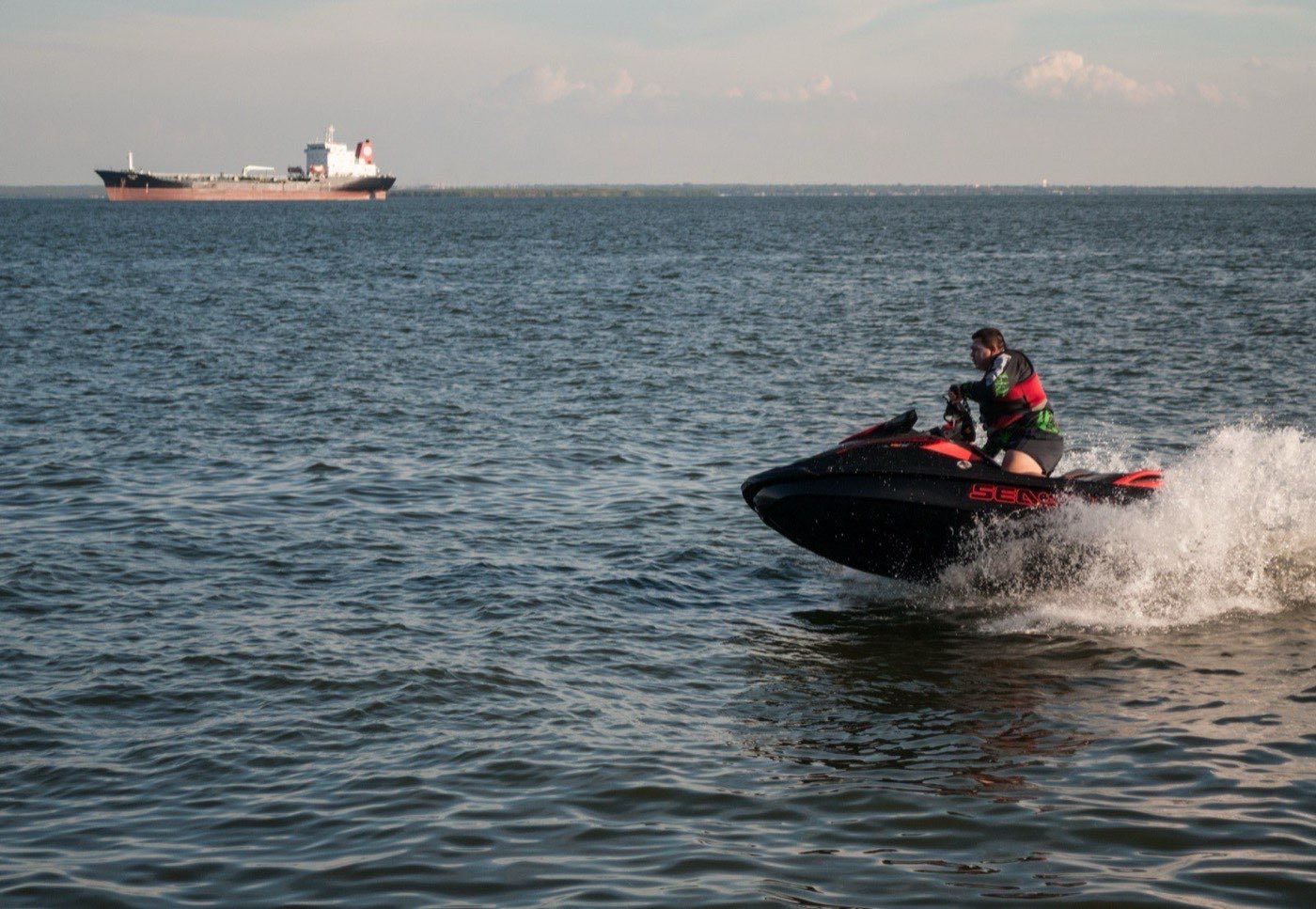
🔎 TL;DR
- Every legal waverunner ride in Progreso operates under three overlapping frameworks: federal SEMAR Capitanía de Puerto rules, the federal aviation/maritime coordination overseen by AFAC, and state-level coastal-reserve management coordinated with CONANP.
- Mexico does not require a recreational boating licence for short jet-ski rentals — but every concession holder is required to run a mandatory pre-launch briefing, verify a valid government ID, and have you sign a liability waiver. Operators that skip this are unlicensed.
- The mandatory 5-knot no-wake corridor covers the first 200 m offshore, the area in front of the cruise pier, and the entrance to the Ría de Yucalpetén. SEMAR enforces these with harbour-patrol boats — fines for speeding inside the no-wake zone start around 50 UMA and craft can be impounded.
- Manatee-protected zones under NOM-059-SEMARNAT cover the inland lagoons west of Progreso and parts of the Ciénaga reserve; waverunners are excluded from these zones entirely. The open Gulf corridor is permitted, but the briefing covers what to do if you encounter manatees on the route (very rare offshore, possible at the Yucalpetén cut).
- Solo-rider minimum age is 16 with valid government ID at most Malecón operators; passenger minimum is roughly 5 years old with a properly-fitted lifejacket. Most operators require a credit-card damage deposit of 200–500 USD.
- Alcohol is a hard no. SEMAR rules treat motorised recreational craft like vehicles — visibly intoxicated guests are refused at the dock, and an incident under the influence voids the operator's insurance and exposes the guest to federal sanction.
Who actually regulates a Progreso waverunner ride
To understand what is legal and what is not on the Progreso waterfront, it helps to map the agencies. Four bodies share jurisdiction, and the lines between them are not always intuitive.
The Secretaría de Marina (SEMAR) is the federal naval and maritime authority. Through its local Capitanía de Puerto de Progreso, SEMAR issues and revokes concessions for motorised water-sports operations, enforces no-wake zones, runs harbour-patrol inspections, closes the port during severe weather, and investigates incidents. SEMAR is the agency the rest of the local enforcement defers to.
The Administración Portuaria Integral de Progreso (API Progreso) manages commercial-port infrastructure, including the 6.5 km Puerto de Altura cruise pier. It coordinates with SEMAR on cruise-tender corridors, port closures, and beach-concession boundaries. API does not directly license waverunner concessions, but it sets the physical zones in which concessions can operate.
The Agencia Federal de Aviación Civil (AFAC) coordinates low-altitude flight and the maritime/aviation interface — relevant on the Yucatán north coast because the route between Progreso and Chicxulub passes under approach corridors for small aircraft and the Yucalpetén port has a published heliport. AFAC coordination is operator-side, not guest-side, but it is part of the legal framework that lets the offshore extension run safely.
Finally, the Comisión Nacional de Áreas Naturales Protegidas (CONANP), along with the Yucatán state government, manages the Reserva Estatal Ciénagas y Manglares de la Costa Norte de Yucatán and applies NOM-059-SEMARNAT (the federal species-protection norm) and NOM-022-SEMARNAT (wetland protection) to the mangrove and lagoon systems west of Progreso. CONANP rules are why waverunners stay out of the inland channels.
Verifying that your operator is real — the concession check
Mexican federal law requires every motorised water-sports operator to hold a current SEMAR concession registered to specific physical equipment. A real Malecón concession holder will be able to show you:
- A current SEMAR concession permit (concesión or autorización) naming the operator entity and the specific beach zone where they are authorised to launch.
- Vessel registration (matrícula) for each waverunner, with the registration number visible on the hull, matching the paperwork.
- Liability insurance certificate covering passenger injury and third-party damage, dated and current.
- A captain's licence or equivalent for any escort vessel used on the long-format Chicxulub run.
A legitimate operator displays this paperwork in the concession kiosk or makes it available on request before launch. An operator that cannot produce concession documentation is not legal — and the practical consequence is that if anything goes wrong on the ride (collision, injury, mechanical failure offshore), there is no insurance, no incident response, and federal liability falls on the unlicensed operator and potentially the guest.
The shortcut for verifying legitimacy is to ask explicitly: "¿Me muestra la concesión SEMAR y la matrícula de la moto?" A real operator answers yes and produces the documents. An informal operator deflects. Walk away from any deflection.
The same logic applies to "private beach" pickups offered along the coast east of the Malecón toward Chicxulub or west past Yucalpetén. Those are unlicensed by definition because the concession registry covers only the named Malecón beach zones. Cruise passengers and resort guests are sometimes pitched these arrangements; they are unsafe and illegal.
What the briefing must cover — the SEMAR-required content
Mexican concession rules require every operator to deliver a pre-launch briefing covering specific content before the engine starts. A short, casual briefing that skips items is itself a sign that the operator is cutting corners.
The full mandatory briefing covers:
- Craft handling. Throttle, steering, neutral, kill-switch lanyard, emergency stop. On modern Yamaha and Sea-Doo craft this includes the slow-speed mode for the no-wake corridor and the trim controls if equipped.
- Personal protective equipment. Lifejacket fitting, leash for the kill switch, optional eye protection. Lifejackets are mandatory — riders without them are not allowed to launch.
- Route briefing. The specific corridor, buoy lines, speed zones, anchor points, and the escort vessel's call sign and radio frequency if applicable.
- Weather and abort protocol. What happens if a Norte arrives mid-tour, what the captain's authority is to call the abort, where the return point is.
- Wildlife protocol. Manatee encounter rules (kill engine, drift, observe at distance), seagrass and mangrove protection, and the no-anchor zones over seagrass beds protected under NOM-059-SEMARNAT.
- Emergency procedures. What to do if the engine quits offshore, how to signal the escort, what the recall protocol is.
A real briefing runs 10–15 minutes for the standard Chuburná loop and 20–25 minutes for the Chicxulub long-format ride. A 90-second "throttle here, brake here, follow me" briefing is the marker of an operator skipping the legal requirement. The briefing is partly there to satisfy the regulator and partly there to make the ride survivable.
No-wake zones and speed enforcement
The SEMAR-buoyed no-wake corridors in Progreso are clearly marked but easy to ignore if no one explains them. The four main no-wake segments:
- 200 m parallel to the swim line — the entire beach strip. 5-knot maximum. This is the corridor every craft travels along on departure and return.
- The cruise pier corridor — 500 m east of the cruise pier base in either direction, 5-knot maximum, enforced as a hard zone when a ship is in port and tender traffic is active.
- The Yucalpetén entrance — the artificial cut between the open Gulf and the Ría de Yucalpetén lagoon. 5-knot for the cut itself, no-wake for 200 m on either side, because pangas and small commercial vessels transit constantly.
- The Chicxulub Puerto anchorage — 100 m offshore from the Chicxulub beach, 5-knot maximum, because the local pangas anchor here and people swim from the beach.
SEMAR enforces these with harbour-patrol craft that tie up at the inner Malecón pier. Patrols happen daily; spot-checks intensify on cruise days. A captain caught speeding in a no-wake zone receives a verbal warning on first instance, an administrative sanction on second instance, and a concession review on third. Riders who speed are warned and pulled in by their own captain — but ultimately the operator is responsible for keeping the corridor speeds correct.
The financial penalties are calibrated to UMA (Unidad de Medida y Actualización), the Mexican federal sanction unit, which sits around MXN 113 per UMA in 2026. A no-wake violation typically starts at 50 UMA and escalates to several hundred UMA for repeat or aggravated violations. Craft impoundment is on the table for repeat offenders.
Book with a concession holder we have already vetted — paperwork in order, briefing in regla. Book Progreso waverunner →
Rules table — what applies where
The table below summarises the regulatory layer applicable to each common Progreso waverunner situation. Where multiple layers overlap, the strictest applies. UMA values are 2026 federal levels and update annually with the national Unidad de Medida y Actualización.
| Situation | Primary rule | Authority | Sanction range |
|---|---|---|---|
| Launch from non-concession beach | Illegal — concession only | SEMAR Capitanía | Operator: concession revocation; guest: ride uninsured |
| Speeding in 5-kn no-wake corridor | 5-knot maximum | SEMAR | 50–200 UMA per event |
| Cruise-pier corridor when ship in port | 5-knot maximum, tightened zone | SEMAR + API | 50–200 UMA + corridor closure |
| Riding into Ría de Yucalpetén interior | 5-knot in cut; lagoon restricted | SEMAR + state | 50–500 UMA; possible craft impound |
| Riding inside mangrove channels (Chuburná) | Prohibited — non-motor only | State reserve + CONANP | 500+ UMA; NOM-059 sanction |
| Anchoring on seagrass meadow | Prohibited under NOM-059-SEMARNAT | SEMARNAT + CONANP | Up to 1,000 UMA + ecological remediation |
| Approaching manatees within 50 m | Prohibited under NOM-059 | SEMARNAT + CONANP | 500–1,000 UMA + species violation |
| Offshore beyond inshore band, no escort | Requires registered escort vessel | SEMAR + AFAC | Concession review; ride uninsured |
| Rider under 16 driving solo | Prohibited | Operator policy + SEMAR | Operator sanction; guest refused launch |
| Visible alcohol intoxication | Refused launch — operator liability | SEMAR | Concession review; guest banned |
| Returning after Capitanía closure declared | Mandatory return to launch | SEMAR Capitanía | Operator sanction; SAR if delayed |
The table is not exhaustive — federal and state environmental law has many more sub-rules — but it covers the cases that actually arise on a recreational ride. The headline: most rules are enforced through the operator, not directly against the guest, but the guest pays in lost insurance and refused incident response when the operator is cutting corners.
Manatee zones and NOM-059-SEMARNAT
The northern Yucatán coast is the residual range of the West Indian manatee (Trichechus manatus manatus), classified as en peligro de extinción (endangered) under NOM-059-SEMARNAT-2010. Mexican federal law restricts motorised craft activity in designated manatee zones; in Yucatán these are concentrated in the brackish inland lagoons west of Progreso — Sisal, Celestún, the inner channels of the Reserva Estatal Costa Norte — and not in the open Gulf corridor where waverunner routes run.
That said, manatees occasionally transit between lagoons through the Yucalpetén cut and along the seagrass shoals near Chuburná. Operator briefings must cover what to do if you encounter one:
- Kill the engine immediately. Engine cavitation and propeller-equivalent jet pump are the primary threat. Drift in neutral.
- Hold position at 50+ m. Observe from distance. Do not chase, do not approach, do not feed.
- Notify the escort captain. The operator reports the encounter to CONANP for monitoring purposes.
- Resume slowly when the animal has moved 100+ m. Idle out of the area, then resume normal operation.
Encounters on the open-Gulf Chicxulub corridor are very rare. Encounters at the Yucalpetén cut are uncommon but documented. The legal posture is precautionary: the species is endangered, the rule is strict, and a documented collision with a manatee is a serious federal incident that the concession holder will not survive.
The seagrass meadow itself is also protected. Thalassia testudinum beds throughout the Yucatán shelf are protected under NOM-059 as critical habitat, and anchoring on or running shallow at speed over seagrass is sanctionable. This is one reason operators hold the corridor tight on the Chicxulub run — the route is deliberately routed over the lower-density seagrass channels to minimise impact.
Age, alcohol and ID — the guest-side rules
The guest-side rule set is straightforward and consistent across Malecón operators.
Age: solo-rider minimum is 16 years old with valid government ID. Some operators set 18. Passenger minimum is roughly 5 years old with a child-sized lifejacket, accompanied by a parent or guardian on the same craft. Children under 10 generally do not ride the long-format Chicxulub product because the 3-hour duration is too much; the shorter Chuburná loop is the kid-friendly product.
ID: a valid passport, Mexican INE/IFE, or driving licence is required at check-in. Operators photograph or photocopy the ID for the concession registry. No ID, no launch.
Alcohol: SEMAR rules treat recreational waverunners like motor vehicles. Visibly intoxicated guests are refused at the dock — the operator faces concession review if they let an intoxicated guest launch, and the operator's insurance does not cover an incident under the influence. The rule is enforced more strictly on the long-format ride because the guest is offshore where an incident is harder to respond to.
Damage deposit: most operators require a credit-card hold of USD 200–500 as damage deposit, refunded after return if the craft is undamaged. Damage cost can run into the thousands for jet-pump or hull repairs.
Waiver: a signed liability waiver is mandatory. It does not relieve the operator of insurance obligation, but it confirms that the briefing was delivered and understood. Read it; it usually summarises the no-wake zones, the wildlife protocol, and the cancellation policy.
Weather closures and the abort protocol
SEMAR Capitanía de Puerto Progreso has the authority to close the port partially or fully when weather conditions cross thresholds. The thresholds are roughly:
- Recreational small-craft restriction: sustained wind > 20 knots, significant wave height > 1.5 m, visibility < 1 nautical mile.
- Full port closure for small craft: sustained wind > 25 knots, significant wave height > 2.0 m, lightning within 5 nautical miles.
- Total port closure: tropical storm warning or stronger, gale warning, or storm surge advisory from CONAGUA-SMN.
When the Capitanía declares a closure, every concession on the Malecón stops operations, craft are pulled, and any rides currently underway are recalled. The recall protocol is straightforward: the escort vessel calls riders via radio or visual signal, the group regroups, and the captain leads the group back to the launch point at safe speed. SEMAR rules require return; an operator that ignores a closure faces concession revocation.
Riders who refuse to abort when called are not common but they happen — and the legal posture is that the captain has authority over the craft. A rider who refuses to return when the abort is called can be reported to SEMAR, the rental is terminated, and any damage that follows is the rider's responsibility. The captain's call is final on the water.
For the cancellation refund logic from the guest side, see our conditions calendar, which covers the typical Norte cycle and the operator reschedule pattern.
If something goes wrong — incident reporting
Most Progreso waverunner rides end uneventfully. When they do not, the reporting chain matters because federal investigation kicks in for any incident involving injury, environmental damage, or wildlife.
The operator-side protocol:
- On-water response. The escort captain stabilises the situation — first aid, towing the disabled craft, retrieving riders. The captain calls SEMAR via VHF on Channel 16 if injury or vessel loss.
- Return to launch. The group returns and the operator reports the incident to the Capitanía within hours. Required for any injury, vessel damage, or wildlife encounter.
- Capitanía investigation. SEMAR opens an administrative file. If injury or environmental damage is involved, the file goes to the federal prosecutor and to CONANP for environmental review.
- Insurance claim. The operator's liability insurance handles guest medical costs and craft damage. The guest's signed waiver does not relieve the operator of this coverage.
From the guest side, the practical actions are: cooperate with the Capitanía investigation, do not give statements under stress without consulting your travel insurance representative, and keep any documents the operator provides (concession ID, vessel matrícula, insurance certificate). If the operator was running legal, the system works — the guest is medically covered and the craft damage is on the operator's insurance. If the operator was running unlicensed, the system fails and the guest is exposed personally.
Frequently asked questions
Do I need a Mexican boating licence to rent a waverunner in Progreso?
No. Mexican federal law does not require a recreational boating licence for short jet-ski rentals. What you do need is a valid government ID (passport or driving licence), a signed liability waiver, and the in-person briefing before launch. Some operators ask for a credit-card hold as damage deposit. The licence question matters more for chartering your own boat — for an operator-led waverunner rental, the operator carries the licence and you carry ID.
What is the legal minimum age?
Solo riding age is 16 years old with valid ID at most Malecón operators; some set 18. Passenger minimum is roughly 5 years old with a properly-fitted child lifejacket, accompanied by a parent on the same craft. Children under 10 typically ride only the shorter Chuburná loop because the 3-hour Chicxulub route is too long.
Can I refuse to wear a lifejacket?
No. SEMAR Capitanía rules require a properly-fitted lifejacket for every rider and passenger, and operators do not launch craft with riders without them. The rule is non-negotiable — both for the rider's safety and because the operator's insurance is void without compliance.
What happens if a Norte arrives during my ride?
The captain calls the abort and the group returns to the Malecón at safe speed. SEMAR rules require return when wind crosses 20–25 knots sustained or significant wave height crosses 1.5–2.0 m. The recall is the captain's call and is final on the water. Operators reschedule or refund per their cancellation policy — most refund 100% when the Capitanía has formally closed the port.
Is the Chicxulub long route actually legal?
Yes — for a registered concession holder with a registered escort vessel running a SEMAR-authorised route. The long-format ride to Chicxulub is permitted because the operator carries the offshore safety infrastructure (escort, VHF, life raft) that single waverunners cannot. A rental that sends you on the long route solo, without an escort, is operating outside the rule.
What if I see a manatee during the ride?
Kill the engine immediately, drift in neutral, hold position at 50+ metres distance, and signal the escort captain. The operator reports the encounter to CONANP. Resume slowly only after the animal has moved at least 100 m away. Encounters in the open-Gulf Chicxulub corridor are very rare but encounters at the Yucalpetén cut do happen, and NOM-059-SEMARNAT treats approach within 50 m as a federal species violation.
Can I drink at lunch before the afternoon ride?
One beer with lunch is typically fine; an operator will refuse a visibly intoxicated guest at the dock. The rule is enforced more strictly on the long Chicxulub route. The safer practice is to ride first and drink after — both because the operator's insurance does not cover incidents under the influence and because Gulf chop is harder to read with alcohol on board.
Want us to vet the operator for you?
We pre-verify SEMAR concession, vessel matrícula, insurance certificate and briefing protocol before we book. Tell us your dates and we handle the paperwork side.