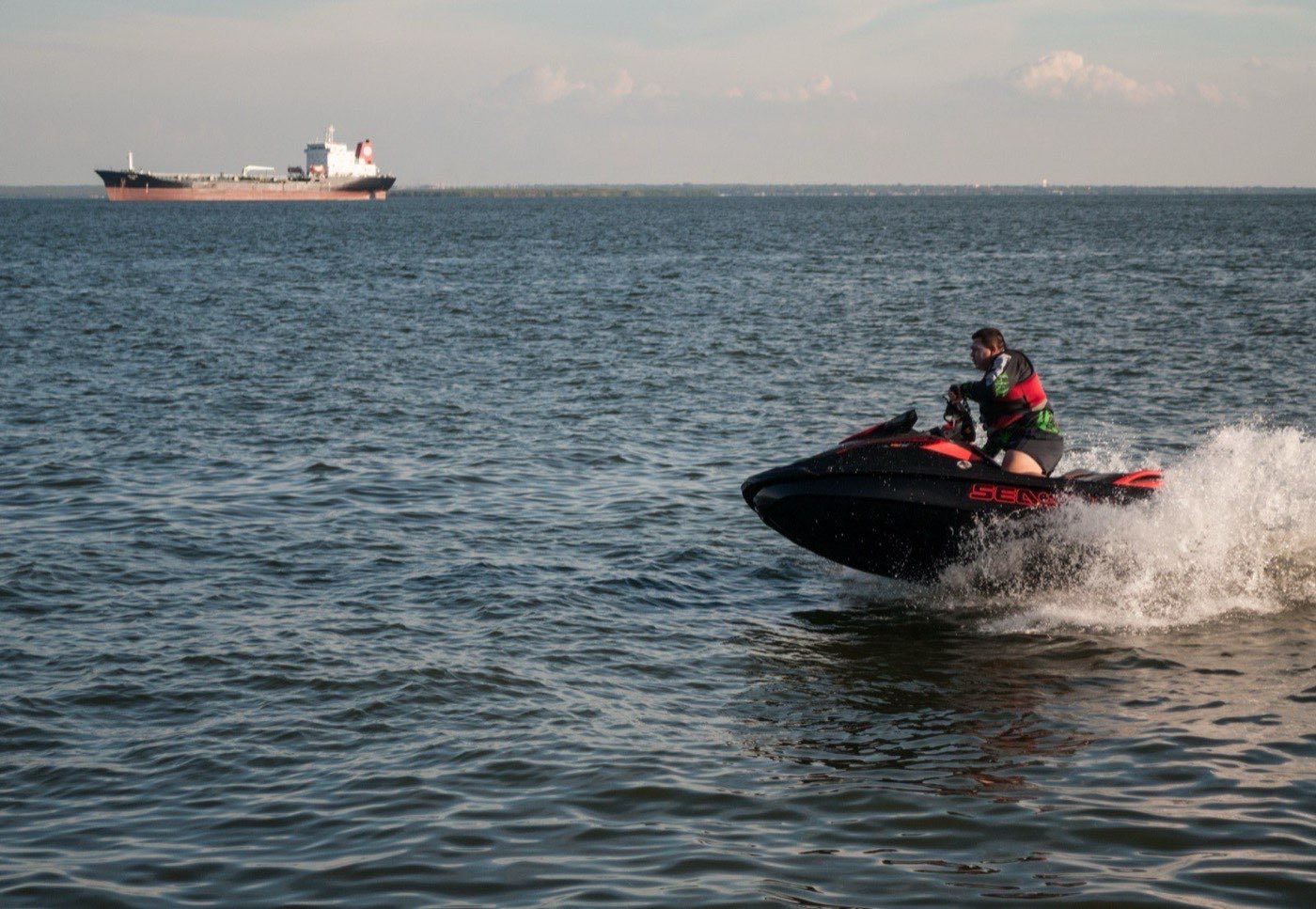
🔎 TL;DR
- Standard waverunner launch in Cabo San Lucas is from Médano Beach, the only beach with concession-approved jet-ski operations on the bay; do not believe brochures that promise launches from "private" beaches.
- The signature 1-hour route runs Médano → Pelican Rock → The Arch → Lover's Beach → Land's End → return, about 8–10 nautical miles round-trip on a Yamaha WaveRunner or Sea-Doo.
- The Pacific side of Land's End — Divorce Beach and beyond — is officially off-limits for recreational jet-skis. The CONANP-managed marine park boundary plus rough Pacific swell make it a hard line, not a guideline.
- Sunset rides launch ~45 minutes before official sunset and must return before nautical twilight ends, per SEMAR capitanía de puerto rules.
- Fuel range on a stock Yamaha VX or Sea-Doo GTI at touring throttle is ~60 km / 35 nm; the bay route uses 25–30%, leaving margin for photo stops at anchor.
- Anchor stops happen at Lover's Beach only on the Cortez side — the Pelican Rock dive area is no-anchor under CONANP rules.
Where you launch — Médano Beach is the only real option
Every legitimate Cabo San Lucas waverunner tour launches from Playa El Médano, the 2-kilometre arc of sand that runs from the marina entrance east toward the Hotel Riu and beyond. Médano is the only stretch of Cabo bay coastline where the municipality and the Secretaría de Marina (SEMAR) — through the local capitanía de puerto — issue concessions for motorised water-sports operations. Concession holders set up canopies, register craft, brief riders, and launch from a marked corridor.
If a tour operator tells you they will pick you up at "a private beach" inside the marine park or somewhere south toward the Hilton or Sheraton Hacienda del Mar, walk. Those launches are unlicensed, and Mexican authorities have been stepping up enforcement against unregistered jet-ski operations since 2023, especially after collisions in the Pelican Rock dive area. We cover the regulatory side in detail in our Los Cabos waverunner rules guide.
Médano itself has roughly a dozen active concessionaires. Most operate Yamaha VX Cruiser, Yamaha FX HO, or Sea-Doo GTI 130/170 craft — three-seat hulls that handle the 1–2 m chop the bay gets in afternoon thermal winds. Premium operators run newer Sea-Doo GTX Limited or Yamaha FX Cruiser SVHO, which are more comfortable but cost roughly 20–30% more per hour.
The corridor from Médano to the marina mouth
From the launch area on Médano, the first 800 metres of every Cabo waverunner ride run inside a marked corridor parallel to the swim line. There is a 5-knot no-wake zone within 200 metres of the swim line — buoyed by SEMAR — and a similar low-speed band as you pass in front of the Cabo San Lucas marina entrance, where cruise ship tenders, sport-fishing boats, and panga taxis crisscross constantly. Captains who know the bay treat this stretch as a single slow-roll segment until they round the breakwater and clear the marina traffic. After that, the throttle opens.
The standard route — Médano → Pelican Rock → Arch → Lover's Beach → Land's End
Almost every guided waverunner tour in Cabo runs the same loop, with minor variations on how long you linger at each stop. The route is short — about 8–10 nautical miles round-trip from Médano — which means a 1-hour tour gives you genuine time at each landmark and a 2-hour tour adds Lover's Beach beach-time and a longer Pelican Rock photo stop. This is the route you came to Cabo for, so let's walk it.
Stop 1: Pelican Rock (5–7 minutes from Médano)
Five minutes south-west of Médano, you arrive at the orange-streaked rock that pelicans use as a perch. This is the entry to the Cabo San Lucas Marine Park — the same CONANP-managed federal protected area where scuba divers head for the Sand Falls, covered in our sister article Los Cabos Sea of Cortez diving — Pelican Rock. Waverunners cannot anchor here and must hold to a slow-pass speed; the guide signals you to drop to idle, drift past the rock, and take photos. Underwater the rock drops past 30 metres into the Cabo Submarine Canyon, which is why dive boats and snorkel pangas cluster here — keep an eye on the water for divers' surface markers.
Stop 2: The Arch / El Arco (8–10 minutes from Médano)
The route bends south past Pelican Rock and tracks toward the south-west tip of the peninsula. Within five minutes you are looking at the rock arch you have seen in every Cabo postcard — El Arco, the natural sea arch carved at Land's End. The arch sits exactly on the boundary between the Pacific Ocean and the Sea of Cortez, a geological line confirmed by NOAA hydrographic data on the southern Gulf of California. Captains slow to no-wake here. You will pass close to the arch but not through it — the passage underneath is open only to non-motorised craft and on calm days, and the swell that pushes through the gap from the Pacific side is dangerous for jet-skis.
Stop 3: Lover's Beach / Playa del Amor (10–12 minutes from Médano)
Tucked behind the arch on the Cortez side is a small sand crescent locals call Playa del Amor — Lover's Beach. It is accessible only by boat (water taxis from the marina also stop here). On 2-hour tours, captains anchor offshore in the designated panga moorings and let riders swim in for 20–30 minutes of beach time. On 1-hour tours, you usually do a slow drive-by with photos and continue. Note that there is no shade, no facilities, no lifeguard — bring water and never leave personal items on the beach.
Stop 4: Land's End and the sea lion rock (12–15 minutes from Médano)
Round the south face of the arch and you are at the very tip of Baja California. The next solid ground south of you is Antarctica. A rock pile here hosts the year-round California sea lion colony (Zalophus californianus); 100–200 animals depending on season. Captains hold position 30–50 metres off — close enough to see the bulls roar, far enough to respect the colony perimeter under NOM-131-SEMARNAT, the federal whale-watching and marine mammal observation norm that also applies to pinniped colonies in marine protected areas.
The return leg
From Land's End the route reverses. Captains typically open the throttle on the return because the swell pushes you back toward Médano. Total elapsed time for the standard loop with photo stops: 50–55 minutes for the 1-hour product, 1 hour 45 minutes for the 2-hour product.
Route table — distances, fuel and time per leg
Distances are from Médano launch point measured on chart; fuel-use figures are for a stock Yamaha VX Cruiser at touring throttle (4,500–5,500 rpm), reconciled with manufacturer data from Yamaha WaveRunners.
| Leg | Distance (nm) | Underway time | Fuel used (L) | Speed cap | Photo stop |
|---|---|---|---|---|---|
| Médano corridor → marina mouth | 0.6 | 5 min | ~1.0 | 5 kn no-wake | — |
| Marina mouth → Pelican Rock | 0.8 | 4 min | ~1.5 | open | Yes — slow pass |
| Pelican Rock → The Arch | 0.5 | 3 min | ~1.0 | open | Yes — photo |
| The Arch → Lover's Beach anchorage | 0.3 | 2 min | ~0.5 | 5 kn | Yes — anchor |
| Lover's Beach → Land's End / sea lions | 0.4 | 3 min | ~0.8 | 5 kn observation | Yes — drift |
| Land's End → Médano (return) | 2.3 | 10 min | ~4.0 | open | — |
| Round trip (1h tour) | ~5.0 nm | ~25 min underway | ~8–10 L | — | 5 stops |
The 2-hour product extends Lover's Beach to 30 minutes on the sand and adds a second slow pass at the sea lion rock with a wider arc — total fuel still under 15 litres on a tank that holds 50–70 litres depending on model. You are never close to running out of fuel on the standard bay loop.
Ride the route the locals run — Arch, Lover's, sea lions, Land's End. Book Los Cabos waverunner →
Sunset cruise variant — the route you actually came for
The sunset waverunner ride is the most-requested variant of the Médano product. The route is the same, but timing matters. Cabo's official sunset varies from roughly 17:30 in December to 19:50 in late June (Mountain Standard Time, no daylight saving on the Baja peninsula since 2022). The SEMAR capitanía de puerto rule is straightforward: recreational craft must return to designated launch points before nautical twilight ends, defined as the moment the sun is 12 degrees below the horizon, roughly 40 minutes after sunset.
That means a sunset waverunner tour follows this clock:
- Briefing and launch: 60 minutes before official sunset.
- Pelican Rock + Arch arrival: 30–35 minutes before sunset, golden hour begins.
- Land's End at sunset: exactly at sunset — the arch silhouettes against the orange sky.
- Return to Médano: within 25 minutes of sunset to be off the water before nautical twilight ends.
Operators that try to extend the sunset ride past nautical twilight are violating port rules. After dark the bay fills with cruise-ship tenders and sport-fishing boats returning from offshore, and waverunner navigation lights are minimal. The rule exists for a reason.
Photo logistics for sunset
If you want the iconic shot of you on the waverunner with the arch silhouette behind, position yourself between Land's End and Lover's Beach with the sun in line with the arch. A 200 mm telephoto on the escort boat will compress the perspective and make the arch look much bigger; a phone wide-angle from the waverunner shows the scale of the rocks but flattens the sun. We recommend not riding with a phone in your hand — losses are constant. GoPro mounted to the waverunner handlebar, yes; phone in pocket, no.
Why the Pacific side is off-limits — Divorce Beach and beyond
First-time visitors often ask if they can ride the waverunner around the tip of Land's End to the Pacific side, see Playa del Divorcio (Divorce Beach), and continue up the Pacific coast toward Todos Santos. The answer is no, and here is why.
Three separate constraints all land on the same conclusion. First, the Cabo San Lucas Marine Park (CONANP, established 1973) extends around the rock structure at Land's End, and motorised recreational craft are restricted to a designated transit corridor on the Cortez side. The Pacific face of Land's End is inside the no-motor zone. Second, the Pacific Ocean swell on the west face of the peninsula runs significantly larger than the Cortez side; NOAA data on the eastern Pacific shows mean significant wave heights of 1.5–2.5 m on the Cabo Pacific side year-round, with regular 3 m+ days. A 350 kg waverunner with a 70 kg rider is not the craft for that water. Third, SEMAR capitanía de puerto rules prohibit recreational jet-skis from the open Pacific corridor without registered offshore-capable escort vessels — that means you cannot solo-ride to the Pacific even if the marine park permitted it.
Divorce Beach itself is accessible — but by water taxi from the marina, not by waverunner. Some panga operators run small groups to the Pacific side on calm days for photo stops. It is a different product entirely.
Optional extensions — Chileno, Santa María, Palmilla
Up the Cortez coast from Cabo San Lucas, the Tourist Corridor runs 33 km east toward San José del Cabo. Three protected bays along the way are technically waverunner-accessible on long-format private tours: Bahía Chileno, Bahía Santa María, and Punta Palmilla. These are not part of the standard bay product — they require a 4-hour minimum charter and a registered escort boat. Distances from Médano:
- Palmilla: 12 nm round-trip — accessible on a 2-hour tour with strong tailwind.
- Bahía Santa María: 16 nm round-trip — comfortable 3-hour tour, anchor stop for snorkel.
- Bahía Chileno: 22 nm round-trip — 4-hour tour minimum; this is a snorkel-heavy product, not a thrill ride.
Sea conditions on the Corridor are generally calmer than the cape itself because the coastline curves north-east and breaks the prevailing southwest swell. That said, afternoon thermal winds pick up from the north (the local "Coromuel"-style afternoon breeze), and the corridor gets choppy after 14:00. Schedule these long-format rides for morning departures only.
Fuel range, throttle discipline, and why you will not run out
Modern recreational waverunners are over-built for the Cabo bay product. A stock Yamaha VX Cruiser carries 70 litres of fuel and burns roughly 15–22 L/h at touring throttle (4,500 rpm), giving a usable range of 3.5–4 hours at touring speed. A Sea-Doo GTI 130 carries 60 litres and burns roughly 14–18 L/h at the same throttle. Either way, the standard 1-hour bay loop uses 8–12 litres — about 15–20% of the tank. You are not running out of fuel on this ride.
That said, two situations bleed fuel fast and you should know them. First, full throttle on chop: at wide-open throttle in 1 m beam-on chop, fuel burn doubles. Second, idle photo stops: the engine still burns 1–2 L/h at idle, and ten minutes of idling adds up. Operators monitor tank levels before launch and would never send you out on a sketchy half tank, but if you are running back-to-back tours you can sometimes feel the throttle response soften — that is just a low fuel signal, not an emergency.
Throttle discipline that keeps the ride enjoyable
- Match the lead boat speed. The escort captain sets the pace based on chop. Going faster than the lead means you arrive at every photo stop early and idle waiting.
- Trim with body weight on swells. Lean slightly forward going into a wave, slightly back on the back side. Saves engine load and prevents the bow from burying.
- Don't full-throttle from idle. Sudden full throttle in chop is the most common cause of guests getting bucked off. Roll the throttle on smoothly.
Combining the waverunner with other Cabo water sports
The bay loop runs short (1–2 hours) and the same Médano launch area is where you book other Los Cabos water sports. Two combinations work well as half-day stacks:
- Waverunner + snorkel at Pelican Rock: finish the waverunner loop, swap into a small panga, snorkel the same Pelican Rock site you just rode past. Different perspective, different fauna, same morning.
- Waverunner + yacht charter: the 1-hour waverunner ride works as a "starter" before boarding a half-day Los Cabos yacht charter. Couples often book the waverunner ride at 09:00 and the yacht for the afternoon.
What does not combine well is the waverunner and a full-day Cabo Pulmo dive trip — Cabo Pulmo is a 2-hour drive each way, so it eats the whole day. Save that for a separate day.
Frequently asked questions
Can I ride through the Arch?
No. The passage under El Arco is closed to motorised craft. Pacific swell pushes through the gap and the rocks on both sides are unforgiving. Non-motorised SUP and kayak can sometimes pass on flat-calm days at low tide, but waverunners absolutely cannot. Captains will pull you up if you try.
How close can we get to the sea lions?
Visual distance from the rock perimeter — roughly 30–50 metres. NOM-131-SEMARNAT (the same federal norm that governs whale-watching distance) applies to pinniped colonies inside marine protected areas. Captains hold position and let you watch from the waverunner; getting closer disturbs the colony and triggers protective behaviour from the bulls.
What if conditions turn bad mid-tour?
Captain calls the abort. SEMAR rules require return to launch when sea state crosses operator thresholds (typically wind > 25 knots or significant wave height > 2 m). You return to Médano; the operator either refunds or reschedules. Conditions on the Cortez side rarely turn bad fast, but afternoon thermal winds and the occasional summer chubasco (squall) can change things in 20 minutes.
Do I need experience to ride this route?
None. The standard bay loop is designed for first-timers. Briefing covers throttle, steering, signals, and emergency stop. The route stays inside protected bay water with mild chop. If you want a more aggressive Cortez-coast extension (Palmilla or Santa María), some basic confidence helps — but the bay loop itself is beginner-friendly.
Is the route different in winter?
The route is the same but timing changes. Winter (Nov–Apr) brings the "El Norte" afternoon north wind, so morning tours (before 11:00) are markedly calmer than afternoon. Summer (May–Oct) is the opposite — calm in the early morning, with afternoon thermals from the south that build the cape chop. See our conditions by month guide.
Want us to plan your Cabo bay ride?
Tell us your group size, dates, and skill level — we book the right concessionaire with newer craft and proper briefings.