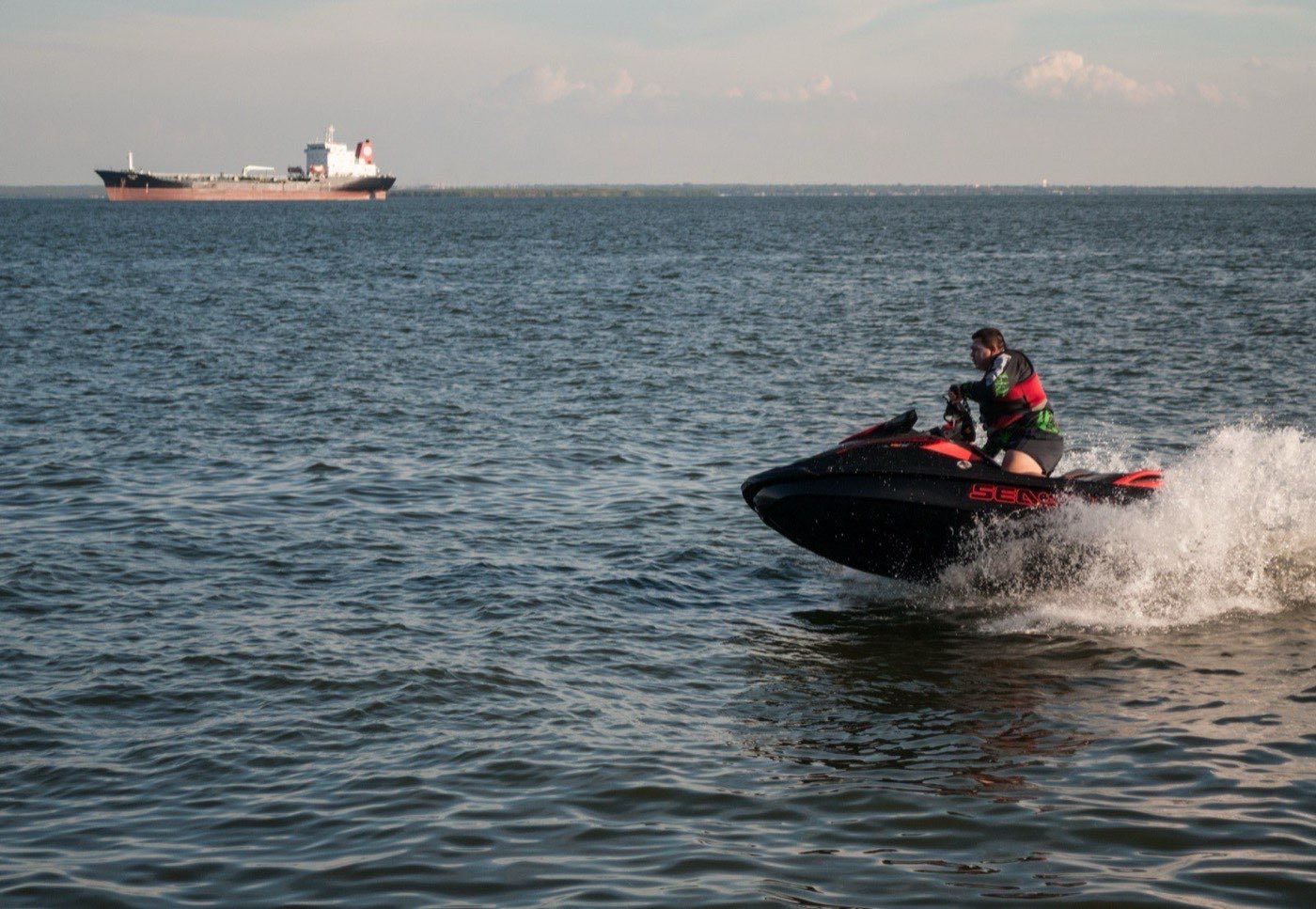
🔎 TL;DR
- Mexican recreational waverunner operations are regulated by the Secretaría de Marina (SEMAR) through the local Capitanía de Puerto. In Cabo San Lucas that office sits in the marina and inspects concessionaires periodically. See gob.mx/semar.
- No private pilot license required for tourist waverunner rental in Mexico — you sign a waiver and receive an operator briefing instead. This is unlike the US where some states require a boater education card.
- Minimum age to drive: 16 years. Minimum age as passenger: 5 years with helmet and lifejacket. Some operators require 18+ for solo open-water rides.
- Speed limits inside Cabo bay: 5 knots no-wake within 200 m of swim lines, idle-only in marina entrance, observation-speed at Pelican Rock and sea lion colony.
- Alcohol: zero-tolerance for operators. SEMAR can fine the renter and pull the operator's concession for alcohol-impaired riding. Detected blood-alcohol over 0.04% is grounds for arrest.
- Whale distance: 60 m minimum, 240 m around mother-calf pairs per CONANP NOM-131-SEMARNAT. Same rule applies to sea lion colonies inside marine protected areas.
- Insurance: not federally mandated for renters, but legitimate operators carry liability coverage and include a small damage-deposit / waiver. Confirm at booking.
Who actually has authority — SEMAR, CONANP, and the Capitanía de Puerto
If you ride a waverunner in Mexican waters, three federal authorities can technically issue you a citation. Knowing which one does what makes the difference between a smooth tour and an awkward conversation on the beach.
The Secretaría de Marina (SEMAR) — the Mexican Navy — has constitutional authority over recreational and commercial navigation in Mexican territorial waters under the Ley de Navegación y Comercio Marítimos. Locally that authority is delegated to the Capitanía de Puerto Cabo San Lucas, which sits inside the marina complex and runs registration, inspections, operator licensing, and incident response. The Capitanía issues the operator concessions that every legitimate Médano-based jet-ski rental holds. They also issue port closures during tropical storms and enforce the daily nautical-twilight return rule. The federal authority is detailed at gob.mx/semar.
CONANP — the Comisión Nacional de Áreas Naturales Protegidas — has authority inside the Cabo San Lucas Marine Park, the federal protected area established in 1973 and covering roughly 7 km² around Land's End and the cape itself. CONANP enforces no-anchor rules, the marine-mammal observation distance under NOM-131-SEMARNAT, and biodegradable-sunscreen requirements. Their authority complements SEMAR's; you can be cited by both for different aspects of the same infraction. See gob.mx/conanp.
PROFEPA — the federal environmental enforcement agency — handles violations of environmental norms (NOMs) that fall under SEMARNAT. In practical terms, PROFEPA writes the bigger fines when marine-life rules are seriously violated (e.g., harassing a whale, damaging coral). Operators rarely interact with PROFEPA day-to-day; it's the agency that arrives when something has gone wrong.
One thing that does not have authority over your waverunner ride: the local police. Municipal officers can enforce land-based rules (parking, beach access), but on the water you are dealing with federal authorities only.
Do you need a license? — no, but read the next paragraph
One of the most common questions from US and Canadian riders: "Do I need a boater education card or a Mexican license to rent a waverunner in Cabo?" The straight answer is no. Mexico does not require recreational private pilot certification for tourist waverunner rentals. You do not need a boating license, a Mexican government permit, or any prior certification. The operator handles registration, the captain is the licensed party, and you ride under their concession.
What you do need:
- Government photo ID (passport for international travellers, INE for Mexican nationals). Operators record ID number on the rental contract.
- Minimum age 16 to drive solo (some operators set the bar at 18 for open-water extensions to Palmilla or Santa María). Driver under 16 must ride as passenger only.
- Signed waiver acknowledging the briefing, the safety equipment, and assumption of risk under Mexican civil-liability terms.
- Sober operation. See alcohol section below.
The operator's captain or beach manager runs a 15–20 minute briefing on throttle, steering, signals, emergency stop, lifejacket use, and route specifics. If you have never operated a waverunner, that briefing is sufficient — operators design the bay-loop product for first-timers. The briefing also covers a "lanyard kill switch" demo: the wrist strap connects to an engine cutoff, so if you fall off, the waverunner stops. Confirm the lanyard works before you launch; it is your single most important piece of safety equipment.
Speed zones in Cabo bay — what the rules actually say
The Cabo bay has formal speed zones marked by SEMAR-installed buoys and enforced by Capitanía patrol. Operators brief the zones, but you should know them coming in.
| Zone | Speed limit | Rationale | Enforcement |
|---|---|---|---|
| Within 200 m of swim line on Médano | 5 knots no-wake | Swimmer safety | SEMAR / beach concessionaire |
| Marina entrance channel | Idle / 3 knots | Commercial traffic congestion | SEMAR Capitanía |
| Pelican Rock dive area | 5 knots no-wake | Divers and snorkelers in water | CONANP + SEMAR |
| Land's End sea lion colony | Observation speed (idle pass) | NOM-131 marine mammal rule | CONANP + PROFEPA |
| Open bay between zones | No fixed cap (operator discretion) | Open water, escort line | Operator captain |
| Pacific side / Cabo Pulmo area | Prohibited for recreational jet-ski | Protected area / open Pacific | SEMAR / CONANP |
Speeds on the open bay segments are not formally capped, but operator captains set the pace based on chop, traffic, and group skill. In practice you ride at 25–35 knots underway between zones. Newer Yamaha FX HO and Sea-Doo GTX hulls can hit 55 knots in calm water but the bay never gives you the conditions to actually run that.
Ride within the rules — book a SEMAR-licensed operator. Book Los Cabos waverunner →
Alcohol, age, and other zero-tolerance rules
Mexican federal maritime law treats waverunner operation the same as vehicle operation for impairment purposes. The legal blood-alcohol threshold for recreational vessel operation is 0.04% BAC — half the US driving limit, and well below what one beer at lunch will produce in a 70 kg adult.
In practice:
- Operators will refuse to launch you if you smell of alcohol at briefing time. They lose their concession if SEMAR finds an impaired rider; they will not take the risk on you.
- SEMAR can spot-check riders on returning to dock during peak season. Failed test = ride is terminated, citation issued, and the operator's permit comes under review.
- Marijuana is not legal for recreational use in Mexico as of 2026 and is treated the same as alcohol for marine operations.
- Prescription medications that impair judgement (some painkillers, sedatives) are also disqualifying — disclose them to the operator at briefing.
The other zero-tolerance items are easy to remember and rarely violated:
- Age 16 minimum to drive. No exceptions. Some operators set it at 18 for the open-water extensions.
- Lifejacket worn and fastened, always. Not "have it in the seat compartment" — worn.
- Lanyard kill-switch attached to wrist. Required before launch.
- Stay with the escort group. Leaving the formation is grounds for the operator to end the ride.
- Helmet required for child passengers at all operators that take children.
Whale distance, sea lion distance, and NOM-131-SEMARNAT
The same federal norm that governs commercial whale-watching also governs your encounter with marine mammals on a recreational waverunner. NOM-131-SEMARNAT-2010 sets the rules for whale and dolphin observation in Mexican waters; in 2017 it was extended to cover other marine mammals in federally protected areas, including the Cabo San Lucas Marine Park sea lion colony.
The numbers that matter to you on the water:
- 60 m minimum distance from any whale.
- 240 m exclusion zone around a mother-calf whale pair.
- 50 m minimum from the Land's End sea lion colony perimeter.
- No parallel chasing. If the animal changes direction toward you, hold position or move off.
- Engine to neutral / idle when a whale surfaces within 100 m.
- No more than three vessels within 240 m of any single whale or pod.
The fines for violation are real. NOM-131 violations are sanctionable under the Ley General del Equilibrio Ecológico y la Protección al Ambiente, with fines from 50 to 50,000 UMA (UMA 2026 ≈ MXN 113), meaning a single infraction can range from MXN 5,650 to MXN 5.6 million. Repeat or aggravated violations carry criminal liability and possible imprisonment under the Federal Environmental Law. The CONANP / PROFEPA enforcement website at gob.mx/conanp publishes the relevant norm references.
In practice, the operator's captain manages distance for you. If a whale surfaces near the group, the captain signals everyone to idle. If the captain holds back, you hold back — they have skin in the game (the operator's permit). Don't try to "get the shot" by ignoring the captain. The fines are large, the consequences for the operator are larger, and the whale doesn't care.
Fines that actually get issued — what you can avoid
Most riders never see a fine. But the ones that do typically fell into one of these traps.
- Riding in the Pacific side / off the route. The most common citation. The Pacific face of Land's End is off-limits and SEMAR knows when a Médano-launched waverunner appears on the wrong side. Fine: 20–500 UMA (MXN 2,260–56,500).
- Anchoring at Pelican Rock. No-anchor zone. If your engine quits and you drop anchor, the CONANP citation comes regardless of intent. Fine: 50–1,000 UMA (MXN 5,650–113,000) plus operator concession review.
- Approaching whales or sea lions inside the 60 m / 50 m line. Fine: 50–5,000 UMA (MXN 5,650–565,000). Substantially higher around mother-calf pairs.
- Operating after nautical twilight. SEMAR Capitanía rule. Fine: 20–1,000 UMA + operator concession review.
- Operating under the influence. Citation + potential criminal charge under federal navigation law. Fine: 100–3,000 UMA + ride termination.
- Damaging seagrass, coral, or rock formations. Federal environmental fine; can run into millions of pesos for deliberate damage. Unlikely from normal riding but possible from a high-speed grounding.
The pattern is clear: stay with the group, follow the captain's signals, do not get off the waverunner outside designated beaches, do not anchor inside the marine park, and respect the marine-mammal distance. Do those five things and you will not see a fine.
Operator-side rules — what your concessionaire must have
From your perspective as a renter, you are not the regulated party — the operator is. But you can identify a legitimate operator by knowing what they must have, and avoid the unlicensed operators that occasionally try to sell from the beach.
A legitimate Cabo waverunner operator has…
- An active concession (concesión) from SEMAR Capitanía de Puerto Cabo San Lucas, with concession number displayed at the launch point.
- Registered waverunners with Mexican registration numbers (matrícula) visible on the hull.
- A captain or beach manager with SEMAR-issued credentials (Patrón de Yate Recreativo or equivalent).
- Lifejackets meeting Mexican / international standards (USCG-approved Type III equivalent or Mexican NOM-035 equivalent), in good visible condition.
- Helmets for child passengers.
- A first-aid kit and VHF radio on the launch site or escort boat.
- A waiver / contrato de servicio that documents the ride scope, included equipment, and liability terms.
- Liability insurance covering third-party damage. Operators are not required by law to insure renters, but reputable ones do.
- CONANP marine park entry fee included in the price if the ride enters the protected area.
What you should walk away from:
- No briefing or a "briefing" under 5 minutes.
- No registration numbers visible on the hull.
- "Cash only, no receipt" pricing.
- Lifejackets with broken straps or visible damage.
- Pressure to skip the waiver.
- Operators that launch from beaches other than Médano. Médano has the concession; other beaches do not.
The other side of this conversation is liability. If you ride with an unlicensed operator and have an incident, your travel insurance and home auto/health insurance may decline coverage on the grounds that the operator was not legally authorised. Mexican civil liability rules can also limit your recourse against the operator if their concession was not active. Book with someone legitimate.
Insurance, deposits, and damage
Most operators charge a small damage deposit ($100–300 USD, often held on credit card pre-authorisation) that is released after the rental if the craft returns undamaged. Genuine damage (collision, grounding, lost waverunner) triggers a claim under the operator's liability insurance, with the renter responsible for the deductible — typically $500–2,000 USD depending on operator. Read the waiver before signing; the deductible amount should be specified.
From a renter's perspective, two insurance angles matter:
- Your travel insurance. Most travel policies cover personal injury during recreational watercraft use under standard adventure-activity riders. Confirm before the trip; some policies exclude jet-ski operation by default.
- The operator's liability. Covers damage you cause to third parties (other boats, swimmers). Does not typically cover damage you cause to yourself or your party.
The US Coast Guard's general safety guidance at coastguard.dot.gov/safety applies the same conceptual framework to recreational watercraft in any jurisdiction: licensed operator, registered craft, briefed rider, sober operation, lifejacket worn. Mexican law mirrors those baselines.
Frequently asked questions
Will I be asked for my passport?
Yes. Operators record passport or INE number on the waiver. Bring the document; a photo on your phone is not sufficient at most operators. Drivers under 18 also need a parental signature on the waiver.
What happens if I have an incident — collision with another boat?
Stop the waverunner, signal the escort captain. The escort handles the immediate response and contacts SEMAR Capitanía if a third party is involved. Mexican civil liability rules apply; the operator's insurance typically covers the third party, you are responsible for the deductible if at fault. Document everything: photos, witness names, time. Mexican insurance claims require documentation.
Can I bring a passenger over the rider weight limit?
Most Yamaha VX Cruiser and Sea-Doo GTI 130 hulls have a 240–270 kg combined-rider weight limit (manufacturer spec). Two adults under ~120 kg each is fine. Two adults plus a child usually fine. Three adults is the edge — operators do not allow it. Verify weight limit at booking if you have a heavier group.
Is the marine park entry fee separate?
Sometimes. CONANP charges a small daily marine park entry fee (MXN 110–150 as of 2026) for visitors to the Cabo San Lucas Marine Park. Most full-service operators include it in the tour price; budget operators sometimes don't. Ask at booking.
What if SEMAR closes the port?
Operators reschedule or refund. Port closures are issued by the Capitanía de Puerto in advance of tropical storms or extreme weather; you will know the day before. SEMAR posts closures publicly; legitimate operators monitor and notify rental customers. If your trip is during hurricane season, build flexibility in.
Want a legal, licensed operator?
Tell us your dates — we book Médano concession-holders with active SEMAR permits and proper insurance.