🔎 TL;DR
- From Progreso cruise port, your two snorkel realities are completely different oceans: karst freshwater cenotes 60–90 minutes inland, or Gulf of Mexico saltwater reef off the coastline (Alacranes Reef National Park sits 130 km offshore — a multi-hour boat ride, not a half-day trip).
- If you only have one snorkel slot from Progreso, the honest answer is almost always cenote first: 95% predictable visibility, no boat ride, fixed schedule, photographable, kid-safe, and uniquely Yucatecan.
- The Gulf coast right outside Progreso has limited natural snorkel value — the beach is shallow sand-bottom flats with low fish density. The nearest serious reef snorkel is Alacranes (Arrecife Alacranes), a CONANP-protected national park 130 km offshore.
- Cost comparison: cenote half-day ≈ $70–$110 USD per person (transport + entries + guide). Alacranes overnight reef trip ≈ $400–$800 USD per person (sleep aboard, 2 days minimum). The cost gap is real and structural.
- What you actually see is the deciding question: cenotes = geology, light beams, freshwater fish, bats, Maya context; Alacranes reef = tropical fish, hard coral, turtles, occasional reef sharks, large pelagics. Both are excellent at what they do.
- The right order for a 3+ day Progreso/Mérida stay: cenote day 1, reef trip on a separate longer block (if budget and weather allow). For cruise passengers with 5–7 hours port time, the choice is settled by physics — only the cenote fits the window.
Two oceans, one port — what "snorkel from Progreso" actually means
When travellers research snorkel options from Progreso, they typically discover that the search results funnel toward two very different products that both wear the same word. Cenote snorkel is a freshwater karst-aquifer experience an hour inland, geologically and biologically nothing like saltwater snorkel anywhere on Earth. Gulf ocean snorkel from Progreso, in practice, means one of two things: a shallow shore-snorkel attempt off the Progreso malecón (low fish density, sand-bottom, not really worth the trip) or a serious offshore expedition to Arrecife Alacranes, the Gulf's only proper coral-reef national park, 130 km north of the port.
That 130-kilometre offshore distance is the load-bearing fact. Unlike Cancún or the Riviera Maya — where the Mesoamerican Reef diving sits 200–800 metres from a beach you can wade off — Progreso's coastline lacks a coral reef in shore range. The NOAA National Ocean Service charts confirm what local boat captains know: the Yucatán shelf in front of Progreso is broad, shallow and sandy, with seagrass meadows but no significant reef structure until you reach Alacranes far out in the Gulf or push east past Telchac toward Madagascar Reef. The result: from a Progreso base, your snorkel decision is not "cenote or beach" but "cenote or expedition" — and those two products operate on completely different time budgets, costs and weather windows.
This guide compares them honestly, side by side, so you can pick the right one first.
Side-by-side comparison table
| Factor | Cenote snorkel (Cuzamá / Homún / Yokdzonot) | Gulf reef snorkel (Alacranes National Park) |
|---|---|---|
| Travel time from Progreso | 60–90 min by road | 4–6 hr by boat each way (overnight trip) |
| Total trip duration | Half day (4–5 hr) | 2–3 days (sleep aboard or on island) |
| Water type | Freshwater, 24–26 °C year-round | Saltwater, 24–29 °C seasonal |
| Visibility | 30–60 m (gin-clear) | 15–30 m (excellent for the Gulf) |
| What you see | Stalactites, light beams, mollies, freshwater turtles, bats, Maya context | Hard/soft coral, parrotfish, angelfish, sea turtles, reef sharks, barracuda |
| Weather risk | Very low — covered/semi-cavern sites work in rain | High — nortes Nov–Mar cancel trips, hurricanes Jun–Nov |
| Cost per person (USD) | $70–$110 (half day) | $400–$800 (overnight) |
| Kid-friendly | Excellent (Yaxbacaltún, Cascabel open-sky) | Limited (rough crossing, distance from medical care) |
| Cruise-passenger feasible | Yes — fits a 5–7 hr port window | No — physically impossible in one day |
| Best season | Year-round (Dec–Apr ideal weather) | Mar–May, Sep–Oct (windows between nortes and hurricanes) |
What you actually see in a Yucatán cenote
The cenote experience is geological more than biological. You descend into a vertical sinkhole — sometimes through a narrow stone shaft, sometimes via wooden stairs into an open-sky pool — and the visual payoff is a cathedral of limestone shaped by 100,000+ years of carbonate dissolution. Stalactites hang from the ceiling, stalagmites rise from underwater pillars, and where sunlight enters at the right angle (typically 11:00–13:00) it forms columns of light that look painted into the water.
The biology is modest but specific. Yucatán freshwater systems host mollies (Poecilia spp.), Mayan cichlids (Mayaheros urophthalmus), small black catfish, and the rare blind cave catfish (Rhamdia guatemalensis) in deeper passages. Open-sky cenotes like Yaxbacaltún in Homún occasionally show Mesoamerican slider turtles (Trachemys scripta venusta) — listed by the IUCN Red List as Least Concern but locally protected by ejido rules. Semi-cavern sites like Bolonchojol (Cuzamá) and several Homún cenotes host roosts of Mexican free-tail bats visible on the chamber ceiling.
What cenotes have that reefs cannot: archaeological context. Many were Maya ceremonial sites with submerged offerings still inventoried by INAH. The cenote you swim in may have received ceremonial objects 1,000 years ago. You are snorkelling inside a heritage site.
What cenotes do not have: colour. The fish are silver, grey, brown. The walls are pale limestone. The drama is structural and atmospheric, not chromatic. If your mental image of snorkel is "tropical fish in 50 shades of yellow and blue," a cenote will surprise you in a different direction — but it will not deliver that specific picture.
What you actually see at Arrecife Alacranes
Alacranes (Spanish for "scorpions") is the only true coral-reef ecosystem in the Gulf of Mexico of significance, a biosphere reserve declared in 1994 and managed by CONANP. It comprises five small low-elevation islands (Isla Pérez, Isla Pájaros, Isla Chica, Isla Muertos, Isla Desterrada) surrounded by a 30 km horseshoe-shaped reef. Permit-only access; commercial visits are limited; the trip is by sport-fishing boat or sailing yacht from Progreso or Yucalpetén.
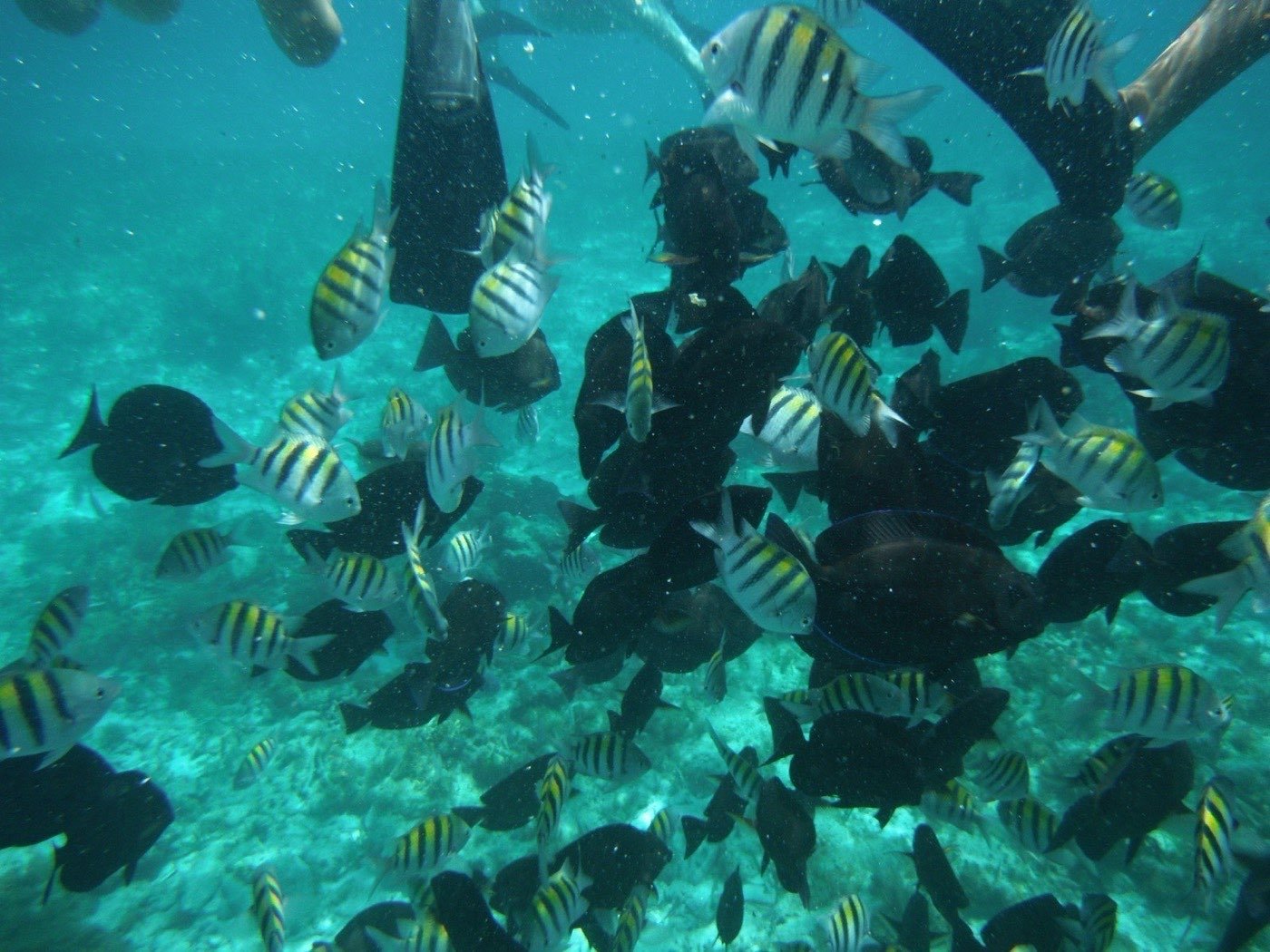
What you see when you get there: large coral heads (mostly Diploria, Montastraea, Acropora), schooling Caribbean reef fish (yellowtail snapper, blue tang, queen angelfish, parrotfish), green and loggerhead sea turtles, occasional Caribbean reef sharks, nurse sharks, barracuda and during seasonal windows, larger pelagics passing through. Bird life is internationally significant — Alacranes is on major Atlantic flyways and the islands host masked booby and brown booby colonies counted by Mexican ornithologists each year.
The catch is the trip itself. Crossing 130 km of open Gulf water takes 4–6 hours each way depending on swell. Nortes — the November-to-March cold-front winds — cancel trips routinely; hurricanes do the same June through November. The realistic operating windows are April–May and September–October, and even then the captain may turn back. This is not a casual half-day plan. It is a 2- or 3-day expedition that you book months in advance with a flexible mindset about weather.
Ready to start with the cenote — the surer Progreso snorkel? Book Progreso cenote snorkel →
Cost and time honestly — who has the budget for which
The cost structures of these two products are not in the same league, and pretending otherwise wastes traveller money.
Cenote half-day from Progreso (Cuzamá or Homún): per-person cost typically falls in the $70–$110 USD band when you bundle private transport from the port or Mérida, the cenote entrance fees ($80–$300 MXN per site, paid to the ejido cooperative), a small lunch, biodegradable sunscreen and tip. Cuzamá's three-cenote horse-cart circuit is the most expensive variant ($400 MXN per person in entries plus the truk fee); Homún's tricitaxi-based four-cenote tour is the cheapest. Either way, under $120 USD covers everything for a half-day.
Alacranes Reef from Progreso: per-person cost typically falls in the $400–$800 USD band for a 2-day overnight (sleep aboard a sport-fishing boat or in a CONANP-permitted bunkhouse on Isla Pérez), and easily $1,200–$2,000+ on a private chartered sailing yacht. Operators commonly require 4–6 paying guests minimum to launch a trip; solo travellers may need to find a group already departing. Cancellation policies vary, but most operators give credit toward a future trip rather than refunds when nortes hit. Budget at least $500 USD per person and plan a flexible 3-day window.
If you are travelling with kids, on a tight budget, or on a cruise schedule, the cost math alone settles the question.
Weather, season and the rhythm of Yucatán cancellations
Cenote snorkel is essentially weather-proof. Semi-cavern and fully enclosed cenotes (Bolonchojol, Santa Rosa, Xooch) work in rain because you are underground. Open-sky cenotes (Yaxbacaltún, Yokdzonot, Cascabel) get a bit grey on rainy days but the water remains the same 24–26 °C and the visibility unaffected — rain doesn't stir up freshwater karst. Even a hurricane day, the cenote sites within 90 km of Mérida usually stay open with mild access restrictions. Booking confidence is very high.
Alacranes is the opposite. The Gulf of Mexico in front of Progreso is shallow, exposed and rough whenever the wind blows. The Yucatán "norte" season runs November to March: cold fronts from North America push 20–35 knot northerly winds across the Gulf for 2–5 days at a time, building 2–3 m seas that make the Alacranes crossing dangerous and miserable. Hurricane season runs June through November, with peak risk August–October — the U.S. National Ocean Service Atlantic basin advisories drive Yucatán operator cancellations. The honest weather window for Alacranes is mid-March to mid-May, and a narrow re-opening in September after hurricane lulls. Even within those windows, captains read 48-hour forecasts and cancel often.
So if you want a snorkel experience you can book with confidence ahead of arrival, especially as a cruise passenger working a fixed port date, the cenote is the only product that delivers reliably.
Gear and physical demand — what each one asks of you
Cenote snorkel is physically gentle. The water is calm, there are no currents, sites are reached by short staircase descents (Cuzamá circuit) or wooden platforms (Homún, Yokdzonot, Santa Bárbara). Vest is mandatory at semi-cavern sites and available at all open-sky sites. A 2 mm shorty wetsuit is recommended for sessions over 30 minutes — freshwater cools you faster than the temperature alone suggests, per dive-medicine guidance from PADI. Children from age 4 manage open-sky cenotes; ages 8+ handle semi-cavern; ages 10+ handle full cavern entries like Bolonchojol.
Alacranes is physically demanding. The 4–6 hour crossing is exposed to Gulf swell; seasick travellers should premedicate. Once at the reef, snorkellers enter from a boat into 5–15 m water with currents that vary by tidal cycle; even strong swimmers stay with the guide and within sight of the boat. A 2–3 mm wetsuit is recommended November–April; rash guards and reef-safe sunscreen mandatory year-round. Kids under 8 are typically declined by reputable operators; ages 12+ with prior open-water snorkel experience are the working minimum.
Gear-wise both trips require mask, fins, snorkel, biodegradable sunscreen, rash guard. Cenotes additionally require a vest (provided on-site at most ejido cooperatives). Alacranes additionally rewards an underwater camera and a 3 mm wetsuit. Neither needs certification or prior experience for snorkel-level participation (diving at either site is a separate product).
Pick by traveller type — the honest matrix
- Cruise passenger (5–7 hr port time): Cenote only. Alacranes physically does not fit your window. Pick the Cuzamá circuit — closest to port, best photo payoff. See our cruise-friendly half-day itinerary.
- Family with kids 4–10: Cenote, open-sky variant (Yaxbacaltún or Cascabel). Read our family safety guide before booking.
- Mérida-based traveller with 3–5 days: Cenote day 1 (Cuzamá or Homún cluster). Then on a separate longer trip, consider Alacranes if weather and timing align.
- Serious reef/diving enthusiast with flexible dates: Plan Alacranes 6+ months ahead in the March–May window. Add a cenote day as a different-format complement, not a substitute.
- Caribbean-trained snorkeller wanting to compare oceans: Both. Cenote for the geology, Alacranes for the Gulf reef contrast with what you know from Cozumel/Riviera Maya. Read our Progreso vs Cancún coast guide to size the trade-off.
- Photographer: Cenote wins on light beams (11:00–13:00 at Chacsinikche, Santa Rosa, Yaxbacaltún). Alacranes wins on fish biomass photography but you fight boat motion and current.
- Anyone unsure: Cenote first. It is the lower-risk, higher-confidence Yucatán snorkel experience, and it teaches you what you actually like about underwater Mexico. Build the bigger trip later.
Combining both on a longer Yucatán trip
If you have 5+ days in Yucatán and want to do both, sequence them deliberately:
- Day 1–2: Mérida base, Cuzamá or Homún cenote half-day. Build your bearings, see the karst aquifer side of the peninsula. Eat in Mérida's centro.
- Day 3: Buffer / cultural day (Chichén Itzá, Izamal, or Uxmal). Use this as your weather-flex day for the next item.
- Day 4–5: Alacranes overnight (only if weather window holds). Confirm with operator 48 hours ahead; have a backup plan.
- Backup if Alacranes cancels: A second cenote day at Yokdzonot + Chichén Itzá combo, or a Celestún flamingo biosphere trip.
This sequence respects the weather risk of Alacranes and uses the cenote as your guaranteed payoff. If Alacranes ends up cancelled — which it will, perhaps 40% of attempts in non-peak windows — you still got the Yucatán snorkel experience that defines the region. The reverse sequence (Alacranes first, cenote as backup) tends to disappoint because if Alacranes cancels you didn't plan time for a cenote day, and you leave Yucatán without doing either properly.
Rules and conservation — both ecosystems are protected
- Cenotes: CONANP federal framework + ejido cooperative authority. Biodegradable sunscreen mandatory; oxybenzone and octinoxate banned. No touching formations. Life vest mandatory at semi-cavern sites. No artefact handling — INAH heritage law protects submerged Maya material.
- Alacranes: Federally protected since 1994 as a Biosphere Reserve under CONANP. Permit-only access for commercial operators. No anchor drop on coral — boats use designated mooring buoys. No fishing in marked zones. No collecting shells or coral fragments. The U.S. NOAA and Mexican CONANP jointly monitor several Gulf-of-Mexico coral health indices that include Alacranes.
- Wildlife rules common to both: No touching turtles, fish or coral. Maintain 2+ metres from marine animals. Do not feed wildlife. Respect operator and guide direction without exception.
- Sunscreen rules: Biodegradable, reef-safe formulations only. The same chemicals are banned at both sites because oxybenzone damages freshwater calcite formations AND coral.
Related guides on AquaCore
- Best Cenotes for Snorkeling From Progreso — Cuzamá, Homún, Yokdzonot
- Cenote Snorkel Season From Progreso — Water Temp & Crowds
- Cenote Snorkel With Kids From Progreso — Family Safety & Gear
- Half-Day Cenote Snorkel From Progreso — Cruise Plan
- Cenote vs Reef Diving — Riviera Maya counterpart
- Riviera Maya cenotes (eastern comparison)
- Akumal turtle snorkel rules & season
- Progreso vs Cancún — which coast for you
- Progreso Cenote Snorkeling — service page
- Progreso destination overview
- All Snorkeling Tours
Frequently asked questions
Can I snorkel right off the Progreso beach?
Technically yes, but the Gulf shoreline in front of Progreso is shallow sand-bottom with seagrass meadows and low fish density. There is no coral reef within wading distance. If your goal is to see fish or interesting marine structure, the Progreso town beach is not a serious snorkel site. The cenote belt inland is dramatically better for any honest "what will I see?" criterion.
How far is Alacranes Reef from Progreso, and is it really a day trip?
Alacranes Reef sits 130 km north of the Progreso/Yucalpetén coastline. The crossing takes 4–6 hours each way by sport-fishing boat, depending on Gulf swell. It is not a day trip — every serious Alacranes operator runs it as a 2- or 3-day overnight, with sleep aboard the vessel or in CONANP-permitted bunkhouses on Isla Pérez. Trips routinely cancel due to CONANP-flagged weather and require flexible scheduling.
Which is better for first-time snorkellers?
The cenote, without serious debate. Calm freshwater, fixed depth, no currents, no boat ride, vests provided, kid-safe sites available. Most travellers gain real water confidence in a cenote and then graduate to ocean snorkel on a different trip. Starting with Alacranes when you have not snorkelled before is asking a lot of yourself in conditions that punish unpreparedness.
Is the cenote experience boring if I have already snorkelled the Caribbean?
No — it is a different category of experience entirely. Caribbean reef snorkel emphasises colour and fish diversity; cenote snorkel emphasises geology, light, scale, and the eerie quiet of an enclosed freshwater chamber. Most travellers who have done both rank the cenote among their most memorable underwater experiences because it does not look like anything they have done before.
If I have to pick just one because of time, which one?
Cenote. It fits any time window, weathers any cancellation risk, costs a fraction of the alternative, and delivers a regionally-unique experience that travellers consistently rank as a highlight. Alacranes is worth planning around if you have a full multi-day window and weather cooperates; otherwise, the cenote is the safer and more rewarding bet from Progreso.
What about Madagascar Reef or other nearby Gulf sites?
Madagascar Reef (Arrecife Madagascar), off the Telchac/Dzilam de Bravo coastline 60–80 km east of Progreso, is a smaller and less-developed Gulf snorkel option occasionally run as a long day trip. Conditions are similar to Alacranes — exposed Gulf water, swell-dependent, less predictable than cenote snorkel. It does exist and a few operators run it; treat it as a niche option, not a mainstream half-day plan.