🔎 TL;DR
- Yucatán cenotes are family-friendly when you pick the right site type: open-sky shallow sinkholes (Yaxbacaltún in Homún, Cascabel in Santa Bárbara, Yokdzonot) work for kids from age 4; semi-cavern sites (Cuzamá's Chacsinikche, Homún's Santa Rosa) work from age 8; fully enclosed caverns (Bolonchojol, Xooch) work from age 10+.
- Three load-bearing safety rules: life vest mandatory for every child regardless of swim ability, biodegradable reef-safe sunscreen only (oxybenzone and octinoxate banned by CONANP at every ejido-managed cenote), and cold-water tolerance limited to 25–35 minutes at the 24–26 °C freshwater baseline before kids start shivering.
- Gear list per child: kid-sized mask + snorkel (adult masks leak on smaller faces), 2 mm shorty wetsuit for sessions over 25 minutes, water shoes for limestone steps (sharp edges, wet), life vest (provided by every ejido — verify before booking), UPF 50 rash guard for sun-exposed travel between sites.
- What kids actually love about a cenote: swimming inside what looks like a cathedral, watching mollies and Mayan cichlids swim around their feet, seeing real bats roosting overhead in semi-cavern sites, and the horse-cart truk ride in Cuzamá which works as half the experience for kids under 8.
- The two most-asked parent questions answered: yes the water is cold enough to need a wetsuit for a child after 20–30 minutes, and yes vests are mandatory and provided — but bring your own kid-sized snorkel mask because rental masks at ejido cooperatives are usually adult-sized.
- Best family cenote from a Progreso cruise/Mérida base: Yaxbacaltún (Homún) if you have one slot; Cuzamá three-cenote circuit with kids 8+ if you want the iconic Yucatán experience; Santa Bárbara (Homún) if you want a polished cleaner site.
Picking the right cenote for the right kid
The biggest mistake families make planning a cenote day from Progreso is treating "cenote" as one product. It is not. The Yucatán cenote belt spans three distinctly different morphologies that demand very different things from a child: open-sky shallow sinkholes, semi-cavern vertical-shaft sites, and fully enclosed caverns. Picking the wrong type for your kid's age and confidence is the difference between a memorable family afternoon and a child crying at the top of a wooden ladder refusing to descend.
The rule of thumb that works: open-sky from age 4, semi-cavern from age 8, full cavern from age 10. These are floor recommendations — confident swimmers can go younger, anxious kids should go older. The map below explains how to read each Yucatán cenote by morphology so you can pick correctly from a Progreso, Mérida or cruise-port base.
The good news is that the open-sky tier alone is enough for any first family trip. Yaxbacaltún (Homún), Cascabel (Santa Bárbara) and Yokdzonot are all stand-alone destinations that justify a half-day on their own and require no cavern descent at all. Most families return from Progreso with a child remembering the open-sky cenote as the highlight of the whole Yucatán trip — not the museum, not the Mayan ruin, not the beach.
Cenote-by-age recommendation table
| Cenote | Type | Min age (confident swimmer) | Min age (anxious swimmer) | Vest provided | Why it works for kids |
|---|---|---|---|---|---|
| Yaxbacaltún (Homún) | Open-sky vertical sinkhole, platform | 4 | 6 | Yes | Shallow at edges, wood platform, no overhead, fish to watch |
| Cascabel (Santa Bárbara) | Open-sky with wooden deck | 4 | 6 | Yes | Wading entry, very calm water, family-oriented site |
| Yokdzonot | Open-sky deep sinkhole + platform | 5 | 7 | Yes | Platform entry, women-run friendly staff, on-site restaurant |
| Hool-Kosom (Homún) | Small open pool | 4 | 5 | Yes | Quietest, smallest, almost private — great for shy kids |
| Chelentun (Cuzamá) | Vertical chamber, semi-open | 6 | 8 | Yes | First Cuzamá stop, easiest descent, dramatic visual payoff |
| Chacsinikche (Cuzamá) | Semi-cavern, narrow shaft | 8 | 10 | Yes (mandatory) | Iconic light-beam photo for older kids, dim descent |
| Santa Rosa / Bal-Mil (Homún) | Semi-cavern, stairs | 8 | 10 | Yes (mandatory) | Stalactites, deeper, requires steady stair descent |
| Bolonchojol (Cuzamá) | Fully enclosed cavern + bats | 10 | 12 | Yes (mandatory) | Bat sighting reward, but ladder descent + darkness can scare younger kids |
| Xooch (Santa Bárbara) | Semi-enclosed cavern + bats | 10 | 12 | Yes (mandatory) | Similar to Bolonchojol; bicycle-rickshaw transport part of circuit |
The three safety rules every parent must internalise
You will read a longer rules list at any cenote entrance, but three rules carry more weight than the others combined:
Rule 1 — Life vest is non-negotiable for every child. Every ejido-managed cenote (Cuzamá, Homún, Yokdzonot, Santa Bárbara) provides vests included in the entry fee. They are required at every semi-cavern and vertical-sinkhole site and strongly recommended at open-sky sites for any child under 12. Even a competent 9-year-old swimmer wears one — this is not because the water is rough but because the freshwater density is lower than ocean, your child floats less than they expect, and the chamber walls offer no shallow refuge to grab. Verify the vest is properly buckled and chest-snug before your child enters.
Rule 2 — Cold-water tolerance is real and clock-bound. The cenote water sits at a steady 24–26 °C year-round. That sounds warm, but freshwater conducts heat away from a child's body faster than warmer saltwater does — and kids have a higher surface-area-to-mass ratio than adults, so they cool faster. The medical guidance from PADI for non-wetsuit-protected children in 24–26 °C freshwater is 25–35 minutes maximum per session before shivering starts. After shivering starts, get the child out immediately, wrap in a dry towel, and warm them in the sun for 15 minutes before any second entry. For kids who want longer sessions or who feel cold quickly, a 2 mm shorty wetsuit doubles the in-water window.
Rule 3 — Sunscreen must be biodegradable, full stop. Oxybenzone, octinoxate and octocrylene are banned at every CONANP-managed cenote because they damage the calcite formations and freshwater fauna. The ejido cooperatives at Cuzamá, Homún and Yokdzonot operate rinse stations at the entry — if your sunscreen is not reef-safe, you will be asked to wash it off. Bring a labelled biodegradable bottle (Stream2Sea, Sun Bum Mineral, Banana Boat Simply Protect Mineral, Thinksport — all work). Reapply with the kids before each cenote, not after, since rinsing removes whatever was on.
Plan a kid-safe cenote snorkel from Progreso. Book Progreso cenote snorkel →
The family gear list — what to pack from your hotel
The ejido cooperatives provide vests and basic snorkel rentals (often adult-sized). For a smoother family day, bring the following from your hotel or stop at a Mérida or Progreso sporting-goods shop the day before:
- Kid-sized snorkel mask + snorkel — the single most important purchase. Adult rental masks leak on small faces and the resulting flooded mask is the leading cause of kids refusing to re-enter the water. A simple $15 USD kid mask from a Mérida sporting store solves this. Test the seal at the hotel before you leave.
- 2 mm shorty wetsuit per child — Decathlon Mérida or any sporting store; rentals exist at some cenotes but not all. Doubles the in-water comfort window.
- Closed-toe water shoes — limestone staircases at every cenote are wet and have sharp edges. Crocs work in a pinch; aqua socks are better. Flip-flops slip.
- UPF 50 rash guard / long-sleeve swim top — sunburn risk between cenotes (in the truk cart, walking) is real. A rash guard reduces sunscreen reapplications and gives wind protection on the ride.
- Biodegradable reef-safe sunscreen — mineral (zinc oxide) preferred. Apply 20 minutes before the cenote and reapply after each rinse-out.
- Insect repellent (DEET-free preferred near the water) — picaridin-based works; apply before leaving the hotel, not at the cenote.
- Microfiber towel per child + dry change of clothes — for between cenotes if you are doing the Cuzamá or Homún cluster.
- Snacks + water bottle — cenote sites have small palapas with food but lines can be long. A granola bar between cenotes keeps kids happier.
- Waterproof phone pouch or GoPro — for the inevitable photos. Most kid memories of the trip are mediated by the photos parents take.
- Cash (MXN) — most cenotes are cash-only; ATMs in Cuzamá and Homún are unreliable. Withdraw $1,000–$2,000 MXN per family in Mérida or Progreso before leaving.
Cold water and kids — the real numbers
Parents underestimate cold-water exposure because the cenote temperature reads "warm" in numbers. Here is what actually happens.
Freshwater at 24–26 °C feels comfortable for adults for 30–45 minutes before mild chill sets in. Children — because of their higher surface-area-to-mass ratio and lower fat reserves — cool faster: typically 20–30 minutes before shivering. The clinical literature on paediatric water exposure (referenced by NOAA water-safety guidance and PADI youth-program standards) shows that kids hide cold poorly: by the time they say "I'm a little cold," they are already at the threshold of hypothermia precursors.
Practical implications for cenote families:
- Plan 20–25 minute in-water sessions per child without a wetsuit, 35–45 minutes with a 2 mm shorty.
- Watch for shivering, blueing lips, withdrawn behaviour — these are exit signs. Don't negotiate.
- Between sessions, dry the child completely and warm in the sun for 15 minutes before a second entry.
- If you are doing the Cuzamá three-cenote circuit, expect each cenote stop to be shorter for kids than for adults — that is fine, the truk ride between them provides the warm-up.
- For under-7s, one cenote is plenty for a half-day. Don't push a second.
A child who shivers their way through three cenotes is a child who refuses to do another cenote on the trip. A child who does one cenote, warm and happy, asks to come back. Plan for the second outcome.
What kids actually find interesting (use this to motivate them)
You can pre-sell the cenote to a hesitant child with the right details. Things kids consistently love:
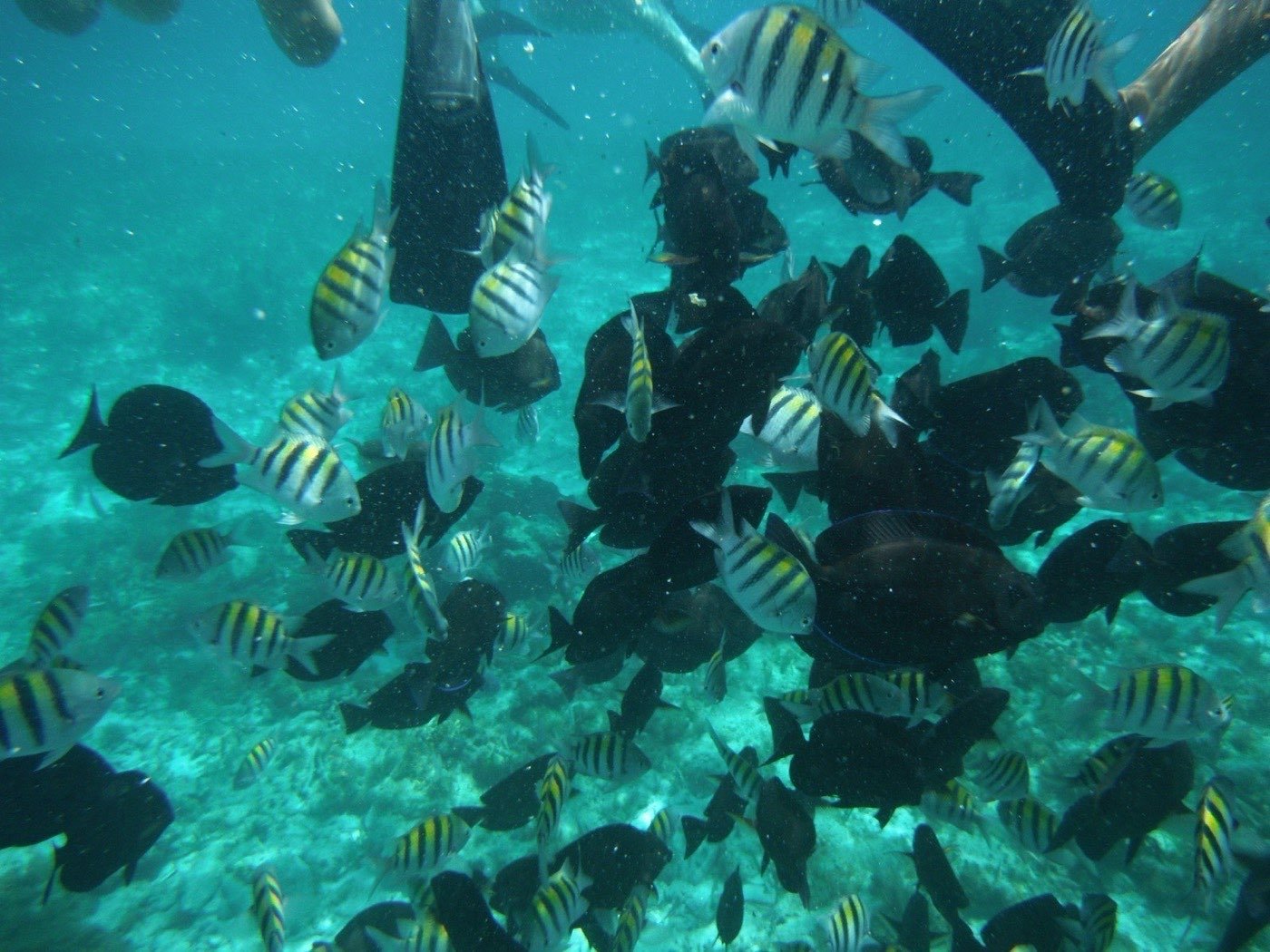
- The mollies and Mayan cichlids that come right up to your mask. They are not afraid. A motionless snorkeller becomes a fish-watching platform within 30 seconds. Kids realise quickly that the fish are checking them out, not the other way around.
- The bats overhead at Bolonchojol, Xooch and Santa Rosa. They roost on the ceiling, are inactive during snorkel hours, and look like a National Geographic photo come to life. For kids 8+, this is unforgettable.
- The truk horse-cart ride at Cuzamá. Three kilometres of narrow-gauge rail across dry scrub, pulled by a horse, between cenote stops. Kids under 8 often love the truk more than the cenote itself — and that is a perfectly legitimate way to enjoy the day.
- The light beams between 11 AM and 1 PM. At Chacsinikche, Santa Rosa and Yaxbacaltún, the sun penetrates narrow vertical shafts and creates columns of light hitting the water. Kids who would never look at "geology" will look at this.
- Climbing wooden stairs into a cave. The descent into Bolonchojol or down the staircase at Yokdzonot is itself an adventure that kids 8+ remember vividly. Some kids prefer the descent to the swim.
- The freshwater turtles at Yaxbacaltún. Not guaranteed (about 1 in 4 visits) but Mesoamerican sliders do show up and are docile. IUCN lists them as Least Concern but protected locally.
- Yucatec lunch after. Cochinita pibil, panuchos, sopa de lima at the on-site palapa restaurants at Yokdzonot or Santa Bárbara. The post-snorkel meal is part of the memory.
From Progreso cruise port with kids — the practical logistics
If you are a cruise family with one shore-day window in Progreso, the math is tight but workable. The Cuzamá circuit is the closest serious cenote experience (75 min by road); Homún is 90 min; Yokdzonot is 2 hours. For a 5–7 hour port window with kids:
- Best fit: Yaxbacaltún (Homún), single open-sky cenote, 90-minute drive each way, 90 minutes on-site, lunch on the way back. Family-friendly, low-stress, kid-confident.
- If kids are 8+: Cuzamá full three-cenote circuit. Tight but doable: dock at 9 AM, on-site Cuzamá by 10:30, truk circuit 10:30–13:30, lunch in Cuzamá town 13:30–14:15, back at dock by 15:45. See our half-day cruise itinerary.
- Avoid Yokdzonot from a cruise day — too far, leaves no buffer for traffic. Save it for a non-cruise Mérida stay.
- Confirm the operator provides: child-sized vests, transport with seatbelts, biodegradable sunscreen if you forget yours, a Spanish/English bilingual guide.
- Allow 90-min buffer before re-boarding — the road from Cuzamá or Homún to Progreso port can hit traffic in Mérida ring road during midday.
Cruise families consistently report that one well-chosen cenote is more memorable than trying to fit two and rushing both. Pick well and move slowly.
Mid-trip mistakes families regret
- Not pre-testing the snorkel mask seal at the hotel. Leaky masks on small faces ruin the in-water session and there is no fix on-site.
- Skipping the wetsuit because "it's hot outside." The water doesn't care about air temp. Without a wetsuit kids hit shivering at 25 minutes.
- Letting a child refuse the vest because they "can swim." Vests are mandatory at semi-cavern sites and recommended everywhere. Freshwater is denser-feeling than ocean in ways kids notice.
- Forgetting cash. ATMs in Cuzamá and Homún towns are intermittent. Card payment is rare. Withdraw before leaving Mérida or Progreso.
- Pushing a second cenote when the child is tired. Better to do one well than two poorly. The Cuzamá circuit fights this because the truk transports between three sites — adults can pace the kids by skipping the third descent if needed.
- Booking Bolonchojol or Xooch with kids under 8. The ladder descent and darkness can produce a refusal at the top. Stick to open-sky for the under-8 crowd.
- Using non-reef-safe sunscreen and trying to hide it. Rinse stations check; the cooperative will ask you to wash it off. Bring biodegradable from day one.
- Eating a heavy lunch before snorkelling. Kids tolerate cenote swims much better on a light snack than a full meal. Save the cochinita pibil for after.
Related guides on AquaCore
- Best Cenotes for Snorkeling From Progreso — Cuzamá, Homún, Yokdzonot
- Cenote Snorkel Season From Progreso — Water Temp & Crowds
- Cenote vs Gulf Ocean Snorkel From Progreso — Which First
- Half-Day Cenote Snorkel From Progreso — Cruise Plan
- Riviera Maya cenotes (compare with Yucatán)
- Akumal turtle snorkel rules & season
- Progreso vs Cancún — which coast for families
- Progreso Cenote Snorkeling — service page
- Progreso Cenote Diving — service page
- All Snorkeling Tours
Frequently asked questions
What is the minimum age for cenote snorkel in Yucatán?
There is no federally mandated minimum age, but practical floors are: age 4 at open-sky shallow sites (Yaxbacaltún, Cascabel) with a vest and a parent in arm's reach; age 8 at semi-cavern sites with stair descent; age 10+ at fully enclosed caverns like Bolonchojol. Each ejido cooperative has its own internal policy and may decline very young children at higher-difficulty sites.
Is the water really cold for kids?
The water sits at a steady 24–26 °C year-round, which sounds warm but cools children faster than ocean water of the same temperature because freshwater conducts heat away more efficiently and kids have less body fat than adults. Plan 20–30 minute sessions without a wetsuit before shivering starts; a 2 mm shorty wetsuit roughly doubles the comfortable window. PADI youth-program standards back this guidance.
Do I need to bring my own snorkel mask for my child?
Strongly recommended. Rental masks at ejido cooperatives are usually adult-sized and leak on small faces, which leads to children refusing to re-enter the water. A simple kid-sized mask + snorkel set from a Mérida or Progreso sporting-goods store costs about $15 USD and prevents the most common bad family-cenote outcome. Test the seal at the hotel before leaving.
Is biodegradable sunscreen really enforced?
Yes — every CONANP-framework cenote (Cuzamá, Homún, Yokdzonot, Santa Bárbara, and all ejido sites) operates entry rinse stations and asks visitors with non-reef-safe sunscreen to wash it off before entering. Mineral (zinc oxide / titanium dioxide) sunscreens are accepted; oxybenzone and octinoxate are banned. Buy a reef-safe brand before the trip rather than relying on on-site availability.
Are there bathrooms and changing rooms at the cenotes?
Yes at the major ejido-managed sites — Cuzamá (Hacienda Chunkanán terminal), Homún town entry, Yokdzonot and Santa Bárbara all have basic but functional bathrooms and changing rooms, typically included in the entry fee or for a small extra charge ($5–$10 MXN). At smaller secondary cenotes (Hool-Kosom, some Homún satellites), facilities may be minimal — use the main town stop before heading out.
Which is the single best family cenote from Progreso?
For families with kids 4–10 looking for one slot: Yaxbacaltún in Homún. Open-sky, wooden platform entry, shallow at the edges, no overhead, vest provided, photo-friendly. For families with kids 8+ who want the iconic Yucatán experience, the Cuzamá three-cenote horse-cart circuit. For polish and cleanliness, Santa Bárbara's three-cenote ejido circuit.