🔎 TL;DR
- Medano Beach is the only SUP launch in Cabo San Lucas that works for total beginners — calm 6–9 am window, hotel-row access, but choked with jet-skis, parasail boats and water-taxis by 11 am.
- Chileno Bay is the best SUP-snorkel combo on the corridor — protected marine zone managed by CONANP, a small horseshoe reef in 1–4 m, and almost zero motorised traffic.
- Santa María Cove is the postcard horseshoe between Cabo San Lucas and San José — protected south side, very shallow inner cove, exposed to swell on the open mouth.
- East Cape (Cabo Pulmo, La Ribera, Los Barriles) is for confident paddlers — bigger fetch, El Norte thermal wind 15–25 knots Nov–Apr, but the cleanest water and the most marine life.
- El Norte thermal afternoon wind makes 11 am–5 pm unrideable for SUP November through April. The window is sunrise only. Windguru models the cape stations reliably.
- Water temperature drops to 18–20 °C in Jan–Feb on the Pacific side per NOAA SST data — a 2 mm shorty is the difference between a one-hour shiver and a three-hour paddle.
Why Los Cabos SUP is its own discipline
Travellers who have only paddled in the Caribbean arrive in Cabo expecting the same forgiving lagoon water they know from Cancún. They do not get it. The tip of the Baja California peninsula sits at the meeting point of the Pacific Ocean and the Sea of Cortez, and both bodies of water are fundamentally less SUP-friendly than the Mesoamerican Reef diving. The Cortez is denser, cooler, more nutrient-rich, and drives an afternoon thermal wind — locally called El Norte — that flips a glass morning into a 20-knot mess by lunchtime. The Pacific side is colder and grumpier still. None of this means Los Cabos is bad for SUP. It means you must pick your spot, your hour, and your level honestly. If you do, the paddling here is among the most rewarding in Mexico: sea-lion encounters from the board, mobula rays jumping a metre out of the water alongside you, and granite headlands that drop straight from the cliff into 20 m of visibility.
This guide ranks every launch worth knowing from the Cabo San Lucas marina north to the East Cape, with honest notes on wind window, water condition, hazards, and who each spot is actually for. We pulled site notes from local operators and reconciled them with public wind and SST data from Windy, Windguru, and NOAA Ocean Service. If you want one launch to start with — and you are not an experienced paddler — it is Medano Beach at 6:30 am. If you want the spot that actually justifies the flight, it is Chileno Bay. Both are covered in detail below.
Medano Beach — the obvious starting point
Medano Beach is the long, swimmable hotel-row beach immediately east of the Cabo San Lucas marina, running from the Pueblo Bonito strip down to the public end at Hacienda Beach Club. It is the only beach in the city of Cabo San Lucas where swimming is officially permitted year-round — the so-called "safe beach" rating maintained by the local capitanía — and that same protection makes it the only beach inside city limits where a beginner can comfortably launch a SUP. The bay sits inside the natural curve of Land's End, which blocks the Pacific swell. Water is calm by Pacific standards, depth on the swim line is 1–3 m, and the inner half of the beach has no boat traffic.
The catch is timing. From roughly 11 am to 5 pm the outer half of the bay turns into a working harbour: jet-skis from the watersports concessions, parasail boats, banana-boats, glass-bottom tours, and water-taxis to the Arch. None of these will hit a SUP rider deliberately, but the combined wake is constant and the noise breaks the calm-water feeling that makes SUP work. The honest paddling window on Medano is 6:00 am to roughly 9:30 am. Within that window you have flat water, no traffic, and an unforgettable view of Land's End from the deck.
Quick read
- Level: Beginner.
- Window: 6:00–9:30 am. After 10 am, intermediate-only because of motor traffic.
- Hazards: Jet-skis and parasail boats after 10 am. Occasional rip on the east end (toward Villa del Palmar) when Pacific swell wraps in.
- Water temp: 21–23 °C Jan–Apr, 26–29 °C Jun–Oct.
- Rental price: $25–40 USD per hour from the concession line on the beach; $60–90 USD for a guided 2-hour SUP with photos.
- Verdict: Best entry-point launch. Do it once at sunrise then graduate up the corridor.
Chileno Bay — the SUP-snorkel combo every operator hides
Drive 20 km up the Cabo San Lucas–San José corridor and you reach Bahía Chileno, a horseshoe of pale-gold sand with a tiny coral-and-rock reef in 1–4 m of water on the eastern side. It is officially a public beach managed by the federal beach access law (ZOFEMAT), and the reef itself sits inside a no-take protected zone monitored by CONANP. No commercial jet-skis. No banana-boats. No water-taxis. The bay is small enough that motorboats stay outside the swim line, and the swim line is patrolled.
For SUP, Chileno is the spot. You launch off the central sand, paddle 200 m east to sit directly over the reef, and from the standing deck you can spot parrotfish, surgeonfish, panamic green moray, king angelfish, schooling sergeant-majors and the occasional spotted eagle ray gliding under the board. Water clarity 8–20 m depending on swell. You can clip your fins to the deck and drop directly off the board for a 20-minute snorkel, then climb back on and continue. The west end of the cove also has a smaller second reef in 2–3 m, less crowded.
Two practical points the brochures skip. First: Chileno is exposed to the south-east — when summer chubascos send swell up from the Pacific into the Cortez, the bay can be unusable for SUP and the reef gets stirred up. Check Windy the night before; if the swell forecast is over 1.2 m, switch to Santa María. Second: parking is limited and fills by 9 am — show up before 8 am or take the public bus from Cabo San Lucas to the highway stop and walk down.
Launches ranked — wind, water, and who they're for
| Launch | Level | Window | Water | Hazards | Best for |
|---|---|---|---|---|---|
| Medano Beach | Beginner | 6:00–9:30 am | Calm bay, 1–3 m | Jet-skis after 10 am | First-timers, sunrise SUP |
| Chileno Bay | Beginner+ | 7:00 am–11:00 am | Protected, 1–4 m, reef | SE swell summer | SUP-snorkel combo |
| Santa María Cove | Beginner+ | 7:00 am–10:30 am | Horseshoe, 1–5 m | Open mouth swell | Photogenic SUP-snorkel |
| Palmilla Beach | Intermediate | 6:30–9:30 am | Open Pacific lull | Pacific swell, current | Distance fitness paddling |
| La Ribera (East Cape) | Intermediate | 6:00–9:00 am | Cortez open, 22 °C+ | El Norte by 10 am | Calm Cortez SUP |
| Cabo Pulmo | Intermediate+ | 6:00–9:00 am | Marine park, 25 m viz | No-anchor zones | Wildlife encounters |
| Los Barriles | Advanced | None Nov–Apr | El Norte fetch | 15–25 kt afternoon wind | Downwind SUP, summer only |
Pick the right launch for your level. Book Los Cabos SUP →
Santa María Cove — the picture you've seen of Cabo
Bahía Santa María is the smaller horseshoe immediately north of Chileno, off Highway 1 at roughly km 13. It is the cove that appears in every aerial Cabo postcard: a deep gold beach, two rocky headlands, and a clear inner bay that drops from sand to scattered rock in 3–5 m. It is also a CONANP-monitored snorkel area, and access is by walking down from the highway lookout — there is no road into the cove itself, so motor traffic is essentially zero.
For SUP, Santa María is the cove you choose when Chileno is closed by south-east swell, or when you want a less crowded launch and don't mind carrying the board 150 m down a stone path. The inner bay is well protected and the water is glass on a calm morning. Rock heads on the eastern shore hold a smaller reef with parrotfish and angelfish, and the deeper centre often shows cortez damselfish, panamic sergeant-major, large bluestriped chubs, and rays cruising the sand. The trade-off: less sand to launch from at high tide, and the open mouth of the horseshoe catches any swell from the south. On a moderate swell day, the inner cove stays paddleable but the mouth is choppy and the snorkel turns murky. Save Santa María for clean mornings.
Quick read
- Level: Beginner+ (cove paddling), Intermediate (full bay).
- Window: 7:00–10:30 am.
- Hazards: Open mouth swell; rocky headlands on both sides; no lifeguard.
- Logistics: Carry board 150 m from highway lookout. Limited parking.
- Verdict: The visually stunning option. Pair with Chileno on a two-launch morning.
The East Cape — Cabo Pulmo, La Ribera, Los Barriles
Drive two hours north-east from Cabo San Lucas — past San José, past Los Cabos airport, up Highway 1 to Las Cuevas and east on the dirt road — and you exit the resort corridor entirely. The East Cape is the stretch of coast from La Ribera in the south up to Los Barriles in the north, fronting the open Sea of Cortez. The water here is cleaner and clearer than at the cape, the marine life is denser, and the wind is the defining variable. From November through April, El Norte sweeps down the Cortez and turns the coast into a kitesurfing wind tunnel by 10 am. From May through October the wind drops and the coast becomes an open SUP playground.
Cabo Pulmo
Cabo Pulmo is the no-take marine reserve managed by CONANP since 1995. The reef is a finger of hard coral that runs parallel to shore and has rebuilt to among the highest biomass density in the Gulf — a finding documented repeatedly in scientific literature on the area. For SUP, this matters: paddling 200 m offshore in 4–8 m of water you can spot schools of bigeye jacks, snapper, large groupers, hawksbill turtles, and seasonally the Pacific manta rays and bull sharks that make Cabo Pulmo famous to divers. Strict rules apply: no anchoring on reef, biodegradable sunscreen only, no fishing within the park boundary. We cover the diving side in our Sea of Cortez diving guide.
La Ribera
La Ribera is the sleepy village 8 km south of Pulmo with the most accessible beach launch on the East Cape. The Cortez here is open but calm at dawn — typically glass until 9 am between May and October — and the bottom is sand all the way out, no reef to worry about. Distance paddlers use La Ribera to do long flat sessions toward Cabo Pulmo or up toward Los Barriles. The town has a small fish-camp on the south end, so watch for pangas departing at first light.
Los Barriles
Los Barriles is the wind town. From November to April this is one of the most consistent thermal-wind beaches in North America — kite and windsurf central — and SUP here is functionally impossible after 10 am. In summer (Jun–Oct) the wind drops and Los Barriles becomes a calm, warm, open Cortez beach. For the Nov–Apr months, SUP is dawn-only and the smarter call is to be at La Ribera, where the fetch is shorter and the morning lull lasts a little longer. The full kitesurf side of Los Barriles we cover separately.
Pacific side — when to go, when to skip
The Pacific side of the cape — Playa Solmar at Land's End, Migriño, Cerritos heading north toward Todos Santos — is a separate ocean. Pacific swell wraps around Land's End year-round, the water is 2–4 °C colder than the Cortez side, and currents along this coast are stronger. For SUP, the Pacific is essentially advanced-only territory. Playa Solmar at the foot of the Solmar resort is a swimming-prohibited beach — the shore-break is heavy and rip currents are persistent — and the same applies to Migriño and several other Pacific-facing beaches. The local lifeguard signage is honest: red flag means stay out.
The one Pacific-side launch worth considering for intermediate SUP riders is Cerritos Beach, an hour north toward Todos Santos. Cerritos is a known beginner-friendly surf beach, and on calm Pacific mornings (typically Apr–Jun and Sep–Oct) a confident SUP rider can paddle it as an open-water session. Conditions change fast on the Pacific side; check surf and swell forecasts and ask the local lifeguard before launching. If in any doubt, drive back to the Cortez side and paddle Chileno or Santa María instead. The Pacific is not a discovery zone for casual paddlers.
Gear, lessons and the SUP-snorkel logistics
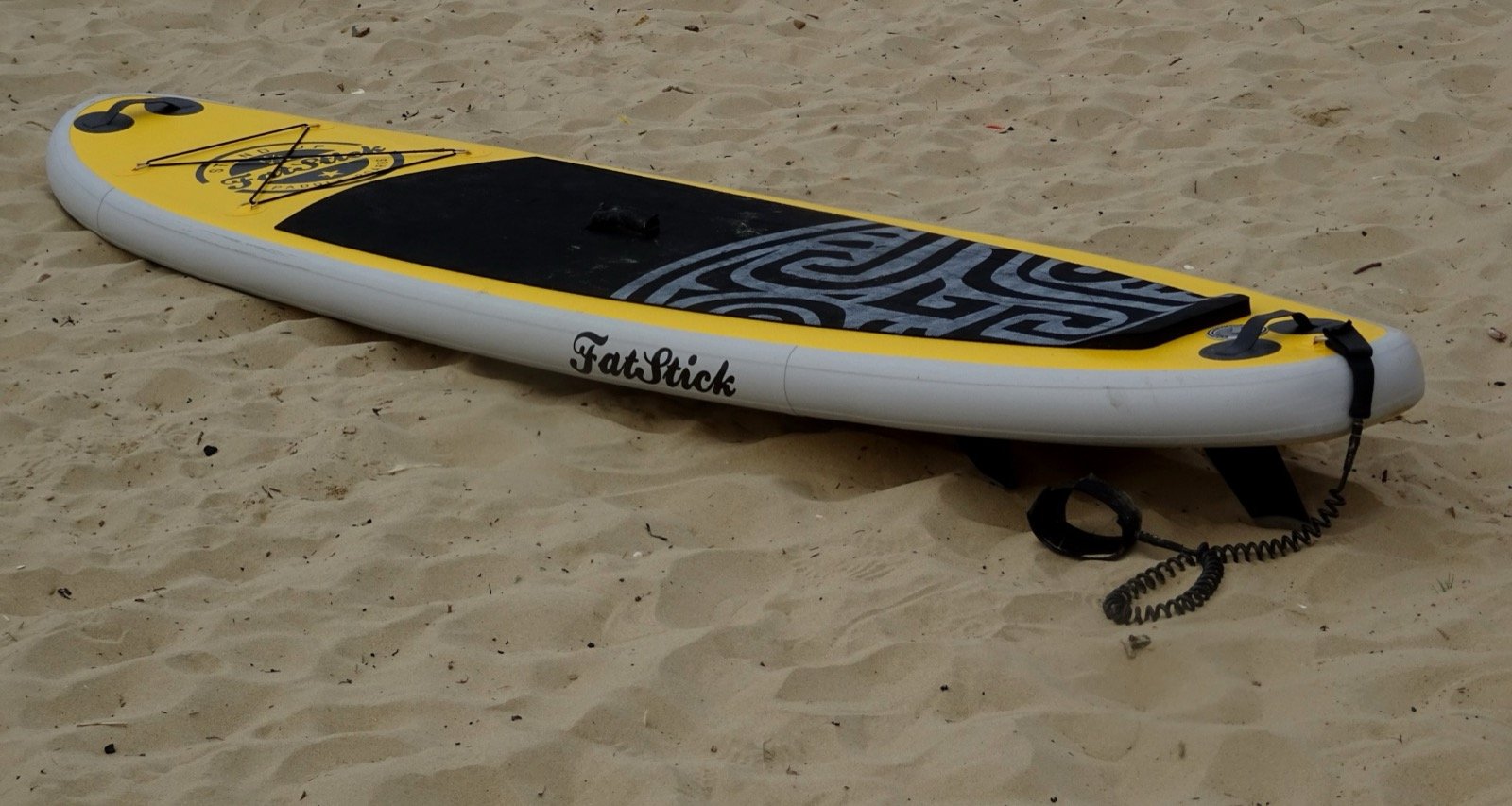
Almost every Cabo SUP operator runs the same basic product: a 10'6" all-around board, a standard fibreglass paddle, an ankle leash, and a basic PFD (foam vest or hip-belt inflatable, depending on the operator). For the corridor launches you do not need anything beyond that. Wetsuit choice depends on the month: a 2 mm shorty is comfortable Dec–Apr on the Cortez side; nothing needed May–Oct.
SUP-snorkel combo logistics
If you want to combine SUP with reef snorkelling at Chileno or Santa María, the most reliable approach is a guided half-day with an operator who runs a small panga support boat. The boat carries the snorkel gear and water, the guide carries the dry bag with your phone and camera, and you paddle from launch to reef without worrying about losing fins or board. Solo SUP-snorkel is possible but you need to plan: a deck bungee with a mesh bag for fins, a leash you can quickly remove when snorkelling, and a clear plan for whoever stays with the board. The American Canoe Association SUP standards cover the basic safety overlap between paddling and in-water swimming — read them before attempting unguided SUP-snorkel anywhere.
Lessons — who needs them
If you have never SUPed before, take a 60-minute lesson on Medano on your first morning. It cuts the learning curve from a frustrating hour of falling to ten minutes of standing. After that you are competent for the corridor launches. Lessons run $50–80 USD per person; group lessons cheaper, private lessons in English or Spanish either way.
Honest verdict — the two-day Los Cabos SUP plan
If you have two paddleable mornings in Los Cabos, do this: Day one, Medano at 6:30 am with a guide or rental — short session, get the feel of cape water, watch the sun come up behind the Arch. Day two, Chileno Bay at 7:30 am with snorkel gear — paddle the reef, drop in for a 20-minute swim, paddle back. That is the full Los Cabos SUP experience for a casual traveller. If you have a third morning and the wind window holds, drive to La Ribera and do a flat Cortez sunrise paddle.
The advanced version — Cabo Pulmo paddle, East Cape distance sessions, downwind from Los Barriles in summer — assumes you have done open-water SUP before and you read wind forecasts seriously. For everyone else, the corridor (Medano, Chileno, Santa María) is what you came for. Skip the Pacific side unless you are an experienced surfer-paddler. The full multi-day itinerary version lives in our 3-day Los Cabos SUP sunrise itinerary.
Frequently asked questions
Can I rent a SUP and paddle Medano on my own?
Yes — the watersports concessions on Medano rent boards by the hour with a basic briefing and a leash. You will be asked to stay inside the swim line and return before noon. No certification or proof required, but you sign a liability waiver. If you have never paddled before, take a 60-minute lesson on day one and rent solo from day two.
Is Chileno Bay always paddleable?
No. Chileno is exposed to the south-east, and when summer chubascos or hurricanes push swell from the Pacific around the cape into the Cortez, the bay can be unsafe for SUP for two or three days at a time. The reef stirs up and visibility crashes. Check Windy or Windguru the night before; if swell models show over 1.2 m at the cape, switch to Santa María or postpone to the next morning.
Do I need to be in shape to paddle Cabo Pulmo?
Reasonable shape, yes. Cabo Pulmo is the East Cape — water is open Cortez, wind picks up by 10 am even in summer, and the launch is from a sand beach with no operator beach concession. Most paddlers go with a local guide from the village who knows the no-anchor zones inside the reserve. Solo SUP is allowed but you must respect park rules: no anchoring on reef, biodegradable sunscreen only, no fishing. CONANP enforces these.
What is the price difference between corridor SUP and East Cape SUP?
Corridor (Medano, Chileno, Santa María): $25–40 USD per hour rental, $60–120 USD per person for a 2-hour guided. East Cape (La Ribera, Cabo Pulmo, Los Barriles): typically $80–150 USD per person guided, because of the drive (2 hours each way), the smaller operators, and the more remote logistics. The East Cape is not more expensive per hour of paddling — it is more expensive per day of paddling, because the day is longer.
Which spot is best for sunrise photos from the board?
Medano Beach for the sunrise with the Arch silhouette in the foreground — that is the iconic Cabo shot. Santa María Cove for the horseshoe-bay aesthetic. Chileno for the reef-fish-from-deck angle. East Cape (La Ribera) for the open-Cortez sunrise with no human structures in frame. Take a phone in a dry case clipped to your leash plug; do not bring an unprotected camera on the board.
Want us to plan your Los Cabos SUP days?
Tell us your dates and skill level — we tell you which launch is running clean.