🔎 TL;DR
- The Sea of Cortez is a protected federal area. SUP encounters with whales, sea lions, mobula rays and turtles are regulated by NOM-131-SEMARNAT-2010 — the official Mexican standard on whale-watching distance rules — and enforced by CONANP.
- Minimum 60 m from whales; 50 m from mating pairs and mother-calf groups; no chasing, no flash photography, no engine in idle.
- Sea lions at Land's End are habituated to swimmers and divers — stay calm, do not chase, do not touch. Bulls weigh 300+ kg and have full teeth.
- Mobula ray aggregation season (Apr–Jul) is the spectacle, but the rays do not strike SUP. Stingrays on sandy bottoms — shuffle into shallow water, do not stomp.
- PFD is required by Mexican federal regulation for non-swimmers and recommended for everyone on open water (American Canoe Association best practice).
- Wetsuit: 2 mm shorty Dec–Apr for Cortez side; cooler water on the Pacific side means 3 mm or skip the launch.
Why Cabo SUP safety is a real subject
Most paddlers arrive in Los Cabos thinking about wind, water temperature, and which cove looks the most photogenic. The marine-life encounter question rarely makes the planning list — and that is a problem, because the Sea of Cortez is densely populated with charismatic megafauna that you genuinely can encounter from a SUP, and Mexican federal regulation has specific rules about how those encounters must happen. Get the rules wrong and you face the prospect of CONANP enforcement (fines and gear confiscation are real) plus the genuine safety risks: a 300 kg male sea lion that feels its space invaded, a mother humpback that perceives you as a threat to its calf, a stingray that you step on getting back to the beach. None of these animals are aggressive by nature. All of them have specific behavioural rules you need to know before you launch.
This guide compiles the official Mexican regulation, the relevant IUCN Red List status notes for the species you might encounter, and the operational rules our partner Cabo SUP guides apply on every session. It is written for the paddler who wants to enjoy these encounters and leave the animals undisturbed.
The NOM-131 rules — whales and big cetaceans
The Mexican standard NOM-131-SEMARNAT-2010 ("Lineamientos y especificaciones para el desarrollo de actividades de observación de ballenas...", published by SEMARNAT in the Diario Oficial de la Federación, 17 December 2010) regulates all whale-watching activities in Mexican waters. It applies whether you are on a commercial whale-watching boat, a private yacht, or a SUP board. The headline numbers you must remember:
- Minimum approach distance: 60 m from a whale or group of whales.
- 50 m for mother-calf pairs (more conservative, not less).
- 30 minutes maximum per encounter (commercial boats).
- No more than 3 vessels within 240 m at any time.
- No parallel approach from in front of the whale's path; approach only from behind or from the side at a 30° angle.
- No engine in idle near whales; no whistles, shouts, or sudden movements.
- No swimming with whales unless under specific permit.
For a SUP paddler, this translates to a simple rule: if you see a whale, stop paddling and stay where you are. Do not paddle toward it. If the whale chooses to swim toward you, the legal responsibility is on you to keep the 60 m distance — so back-paddle away if needed. Cape and East Cape SUP guides routinely sight whales from December through April; the proper response is to drift, photograph from distance, and continue with the session once the whale has moved on. Whale species present in the cape region include humpbacks (Dec–Apr, listed Least Concern globally but locally protected), grey whales on migration (mostly further north up Baja but occasional southern stragglers), and seasonally blue whales and fin whales further offshore.
Marine life encounter cheatsheet
| Species | Season | Distance | Hazard | Action |
|---|---|---|---|---|
| Humpback whale | Dec–Apr | 60 m min | Mother defending calf | Stop, drift, photograph |
| Grey whale | Jan–Mar | 60 m min | Same — calf protection | Same as humpback |
| California sea lion (juvenile) | Year-round | ~5 m advisable | Low (juveniles curious) | Stay still, do not touch |
| California sea lion (bull) | Year-round, peak Jun–Aug | ~15 m advisable | Territorial bite | Avoid colony rocks |
| Mobula ray | Apr–Jul aggregation | None (they avoid you) | None | Drift and watch |
| Pacific manta ray | May–Oct | None — protected species | None | Drift and watch |
| Spotted eagle ray | Year-round | None | None to SUP | Drift and watch |
| Stingray (sandy bottom) | Year-round | Watch step on beach | Tail spine if stepped on | Shuffle feet into water |
| Mola mola (sunfish) | May–Oct | None | None | Drift and watch |
| Whale shark | Oct–Apr (La Paz) | Permit only | None | Booked tour only |
| Bull shark (Pulmo deep) | Jul–Dec | n/a — not near surface SUP | Negligible at SUP depth | Continue session |
Paddle the Cortez right. Book guided Los Cabos SUP →
Sea lions — the encounter most paddlers will actually have
The California sea lion (Zalophus californianus) is the marine mammal you are most likely to share water with off Cabo San Lucas. A year-round resident colony of 100–200 animals lives on the rocks just outside Land's End, and the colony fluctuates seasonally. Juveniles are curious, playful, and habituated to humans — divers and snorkellers report routine close approaches, and SUP paddlers in the area frequently have juveniles surface alongside the board. Adults are different: bulls weigh 300+ kg, defend territorial space, and bite. Documented cases of sea lion bites on swimmers and divers in Cabo are uncommon but real, almost always involving humans approaching too close to a bull or wandering into the female-juvenile area during pupping season (June–August).
The rules every Cabo SUP guide briefs
- Stay calm and still if a sea lion approaches. Juveniles are most interested when you are not moving. Splashing or paddling away makes them lose interest faster, not slower.
- Do not touch. Cute juveniles bite too. Touching habituates them further, which causes problems for the next group.
- Stay outside the obvious colony rocks. The bull's territory is the haul-out rocks at the south end of Land's End — your guide will route you around them.
- Do not bring food onto the water. Sea lions associate the scent of bait with fishing boats and may approach aggressively.
- If you fall off the board near a sea lion, get back on calmly. A flailing human is more interesting to a juvenile than a still one.
Sea lion sightings from SUP off Medano and the Land's End side are routine. Most encounters are pleasant 1–2 minute curiosity visits. Pupping season (Jun–Aug) increases bull aggression at the colony — that is when distance matters most.
Mobula and manta rays — the spectacle
The Sea of Cortez hosts one of the world's largest aggregations of mobula rays (Mobula munkiana and related species) each spring and early summer. Thousands of rays form schools off the East Cape and La Paz Bay, and the species' famous habit of leaping a metre or more out of the water makes the spectacle one of the most photographed phenomena in Mexican marine biology. SUP paddlers off La Ribera and Cabo Pulmo regularly find themselves drifting on flat morning water with hundreds of rays jumping around them.
Safety with mobula and manta rays is not about distance: the rays avoid you, not the other way around. They are filter feeders, completely non-aggressive, and their large pectoral wings mean they detect a SUP board from far further away than you detect them. The risk to a paddler is essentially zero. The only mobula-related hazard is that of being startled — if a ray jumps two metres from your board, the splash and the noise can knock a balance-precarious paddler off the board.
Both mobula and manta rays are protected species under Mexican law (NOM-029-PESC-2006 prohibits fishing them, and CONANP designates aggregation zones). Standard SUP etiquette is to drift quietly through a school, not paddle through it, and to photograph from your board rather than enter the water to try to swim with rays. If you want to swim with mobulas specifically, book a permitted tour from La Paz or La Ventana; SUP is for viewing, not in-water interaction.
Stingrays, jellyfish, and small-but-real hazards
The encounter that actually injures the most travellers in Cabo is not a whale or a sea lion: it is a stingray. Both California stingrays and Cortez stingrays bury themselves in sand in shallow water (knee-deep to thigh-deep), and a foot stepped onto a ray's tail receives a tail-spine puncture and venom injection that is painful enough to ruin a day. Hospital visits are common during peak summer months on Cabo beaches. The single most effective preventive technique is the stingray shuffle: walk into the water by sliding your feet across the sand instead of lifting and stomping. The vibration warns the ray and it swims away before you reach it. Use this technique every time you walk into the water from any sandy beach in Cabo.
Other small hazards
- Jellyfish: sea nettles and other species occasional, usually summer. Mostly mild stings. No box-jellyfish equivalent in the Sea of Cortez.
- Sea urchins: on rocky bottoms (Chileno reef edges, Santa María headlands). Wear booties if walking on rock.
- Sun: the most likely thing to genuinely hurt you on a SUP in Cabo. Strong UV, reflective water, 3-hour exposure. Apply mineral sunscreen (oxybenzone-free per CONANP rules) every 90 minutes and wear a long-sleeve rashie.
- Dehydration: the second most likely thing. Carry water on the deck.
PFD, leash, and the gear rules
Personal flotation devices and SUP leashes are not optional gear. Mexican federal regulation requires PFDs on non-motorized vessels on open water, and the practical reality is that a SUP rider who falls in the Sea of Cortez in 20 °C water with an offshore thermal building has roughly fifteen minutes before hypothermia onset and exhaustion become a serious problem. The American Canoe Association (ACA) SUP standards are clear on the safety overlap:
- PFD: required for non-swimmers, recommended for all paddlers on open water. Hip-belt inflatable PFDs are the standard for casual SUP — comfortable, low-profile, fully Coast-Guard-equivalent when inflated.
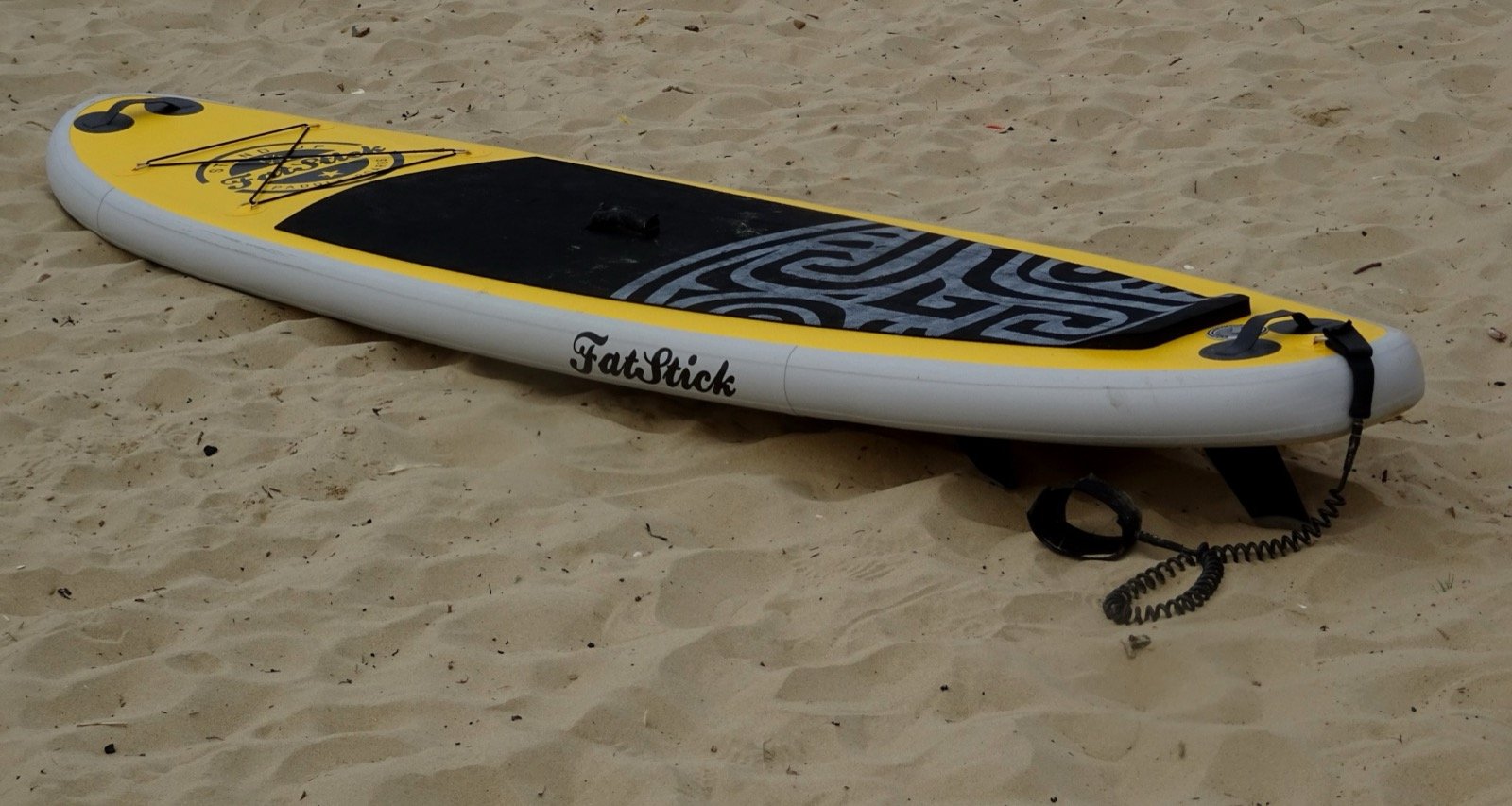
- Leash: always. A board separated from a paddler in wind drifts faster than you swim. A standard 9-foot coiled ankle leash is the universal Cabo rental.
- Whistle: attached to PFD. Required by maritime authority for non-motorized vessels.
- Phone in dry case: attached to your leash plug or PFD. Coverage on the corridor is solid; in the East Cape it is patchy but usable for emergencies.
Reputable Cabo SUP operators provide all of this as standard. Solo rental on Medano gives you board + paddle + leash + PFD by default. If an operator does not include a leash and PFD, do not rent from them.
Wetsuit, water temperature, and the cold-shock window
Water-temperature safety is the underrated topic. SUP feels like a low-immersion sport, and most of the time it is — but if you fall off in a winter dawn session and the air is 16 °C, the water is 19 °C, and the wind is building, you have a real problem on your hands. Cold shock at 18–20 °C produces involuntary gasping and reduced muscle function within the first 60 seconds of immersion. Hypothermia onset begins around 15 minutes for most adults. None of this is dramatic on a guided session with a support boat; on a solo session it can kill.
Our practical recommendations, again:
- Cortez side, Dec–Apr: 2 mm shorty for SUP-only sessions; 3 mm for SUP-snorkel combos.
- Pacific side, Dec–Apr: 3 mm full or 2 mm long sleeve; some paddlers add neoprene booties.
- Any side, May–Oct: rashie and shorts; no wetsuit needed.
- Hood and gloves: not needed for Cabo SUP at any time of year.
NOAA SST charts for the Gulf of California are accurate and updated. NOAA Ocean Service is the reference source if you want to check water temperature before your trip.
CONANP rules, reef-safe sunscreen, and how to be a good guest
CONANP (Comisión Nacional de Áreas Naturales Protegidas) manages the marine protected areas in the cape region: Cabo San Lucas Marine Park, Cabo Pulmo National Park, and several others. SUP within these areas is permitted but governed by basic conservation rules:
- No anchoring on reef. Use sand bottoms only.
- Reef-safe sunscreen only. Oxybenzone and octinoxate are restricted. Mineral sunscreens (zinc oxide, titanium dioxide) are the standard.
- No collecting shells, coral, sand. You pack out what you bring in.
- No feeding any marine animal.
- No fishing within park boundaries; possession of fishing tackle in a no-take zone is a violation in itself.
- Park entrance fees apply at Cabo Pulmo (~$10–15 USD per person per day in 2026); collected by CONANP at the entrance.
Operators include these rules in their briefing and most paddlers comply without issue. Enforcement at Cabo Pulmo is active — CONANP patrols the park during operating hours and will intervene on visible violations.
Frequently asked questions
Is it legal to paddle near a whale if it approaches me?
The 60 m minimum approach distance under NOM-131-SEMARNAT-2010 applies to your approach to the whale. If the whale approaches you, the law requires that you do not respond by pursuing — back-paddle away to restore distance if needed, or simply hold position and let the whale move on. Do not paddle parallel or follow. CONANP and PROFEPA enforce these rules; violations can result in fines and equipment confiscation.
Are sea lions ever aggressive toward SUP riders?
Rarely, and almost always provoked. Documented incidents involve humans chasing or touching juveniles, paddling into the bull territory at the colony rocks, or having food/bait on the board. Stay calm, stay still, do not touch, do not approach the colony rocks closer than 15 m, and you will have only positive encounters. Pupping season (June–August) raises bull aggression baseline — that is the season to be most conservative on distance.
What do I do if I see a mobula ray jumping near my board?
Enjoy it. Mobulas are filter-feeders, non-aggressive, and protected. They will not strike a SUP. The only risk is being startled by the splash if a ray jumps within 2–3 m of you — keep your knees soft and your stance wide if you see one launching nearby. Drift, photograph, do not paddle into the school. Solo SUP-with-mobula encounters are not legal in the strict sense (CONANP designates some aggregation zones as restricted); permitted tours exist for in-water interaction.
Do I really need a PFD on a SUP?
Yes — Mexican federal regulation requires PFDs on non-motorized vessels on open water, and the American Canoe Association best practice is universal PFD use on open water. The standard inflatable hip-belt PFD is unobtrusive, comfortable, and inflates with a cord pull if you go in. On a guided session your operator will provide one; on a solo rental, refuse to take a board out without one. Falls happen, wind shifts happen, conditions change, and a 90-second swim back to a drifting board is the moment you wish you had it.
How do I avoid stepping on a stingray getting back to the beach?
The stingray shuffle: walk into shallow water by sliding your feet flat across the sand rather than lifting and stomping. The vibration warns the ray and it swims away before you reach it. Use this technique every time you walk into water from any sandy beach in Cabo, especially in summer when stingrays bury themselves in 30–80 cm of water just off the shore line. The technique reduces the most common Cabo marine injury to near zero.
Want a guided SUP with the rules covered?
Tell us your dates — we book you with operators that brief NOM-131 every session.