🔎 TL;DR
- Five days is the realistic minimum for a complete beginner to plane on the harness lines in the Isla Blanca lagoon. Three days is enough to sail close-haul and tack; five days unlocks jibing, harness use and short planing reaches. Two-week riders progress further into freeride speed and freestyle basics.
- The progression is non-negotiable: you do not skip day 2 to do day 4. Each day's skill is a load-bearing piece of the next. The camps that try to put students on planing rigs in 20 knots before they have tacked are the camps that produce injuries — see our injury prevention guide.
- Cancún's wind belt cooperates: April–June peak season delivers 4–6 windy days per week reliably, mostly side-onshore trade wind in the 15–22 kn band. Winter Nortes are 25+ kn and not beginner-friendly. Pick April–June for the camp if you can.
- Isla Blanca lagoon is the only realistic teaching venue. The shallow, flat, side-onshore lagoon is purpose-built for this progression. See our launch spots deep dive for the specific entry to use.
- Gear progression matters: day 1 you're on a 200+ L wide stable board with a 4.5 m² sail. By day 5 you're on a 140 L freeride board with a 6.0–6.5 m² sail with footstraps. Renting the right gear at the right day from a school that has a real fleet is essential.
- Cross-reference the actual forecast each morning with Windguru, iWindsurf and Windy.com. If day 4 is forecast at 25+ kn, that's a freestyle day on small gear, not a harness drill day.
What "learn to plane" actually means
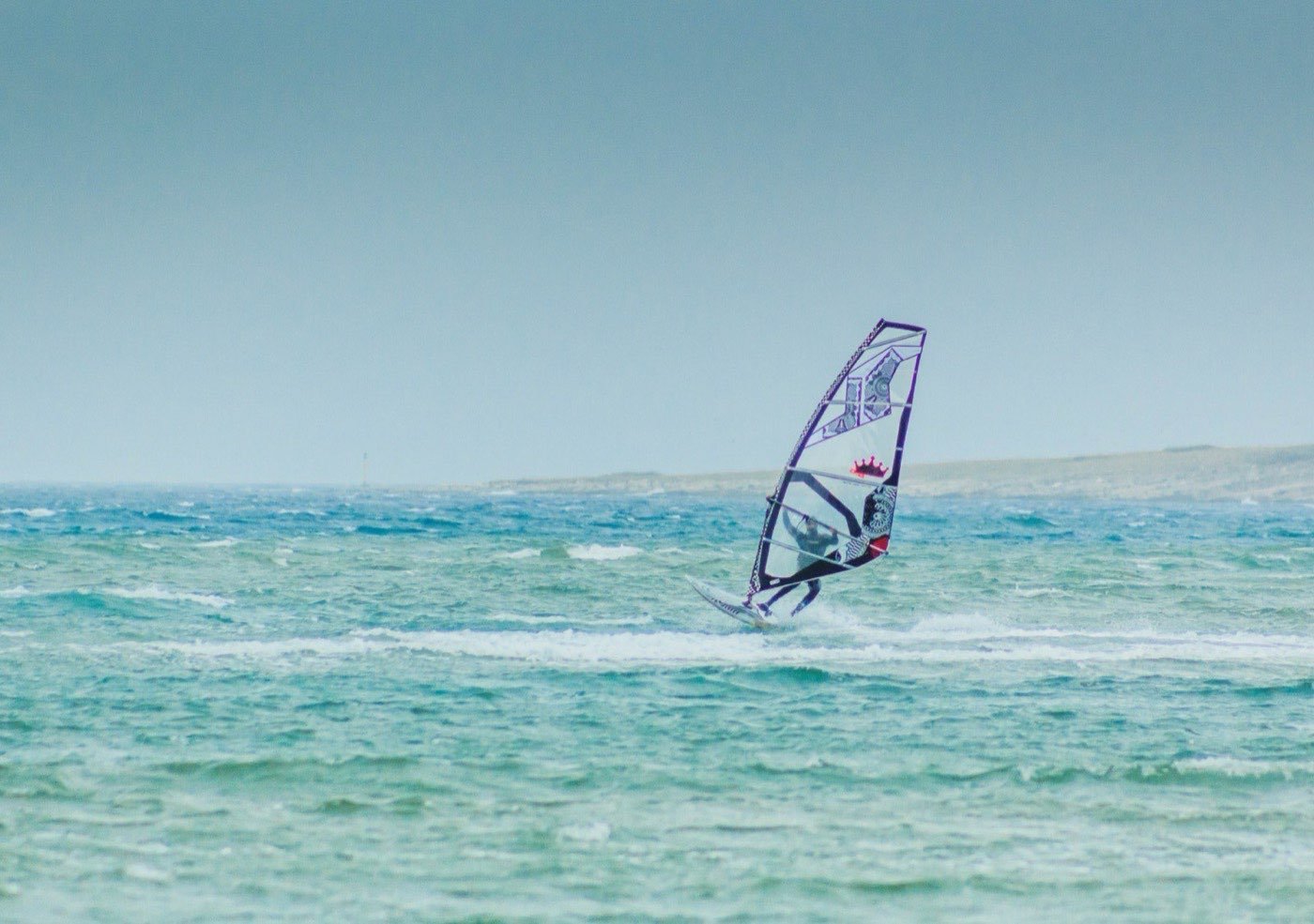
Planing is the moment a windsurf board stops pushing water and starts skimming on top of it. Before planing, the board is in displacement mode — it ploughs through the water at 5–8 km/h, the sail powers the rider through gentle reaches, and the experience feels like sailing a slow dinghy. The instant the board planes, it lifts onto its rocker, the apparent wind shifts forward, the speed jumps to 25–40 km/h, and the rider hooks into the harness and locks the feet into footstraps. This is the moment that defines windsurfing as a sport.
The gap between "I can sail a reach" and "I can plane on harness lines" is the gap that turns a one-week tourist into a windsurfer. It takes about five days of steady wind and competent coaching to cross. Riders who push too fast — try to plane on day 2 before they have tacked cleanly — end up frustrated, sore, and sometimes injured. Riders who pace correctly through the progression end day 5 on the harness, planing in 15 kn, sometimes longer reaches by day 6 or 7 if they extend the trip.
The Cancún wind belt cooperates with this timeline because the spring trade-wind regime in April–June is statistically the most reliable window. Refer to our wind calendar for monthly probability. Plan the camp around the season, not the cheapest flight.
Day 1 — Stance, balance, uphaul and first reaches
The first day is on land for the first hour, then on a wide stable board (200+ L) in the inside lagoon for the rest. The skills are foundational and non-negotiable:
- Land rig identification: every part of the rig named and its function explained. Mast, mast foot, mast extension, base, boom, boom head, sail, batten, downhaul, outhaul, uphaul. Five minutes; saves a lot of confusion later.
- Stance drill on the simulator or on the beach with the rig: feet straddling the mast base on the centerline, knees soft, hips back, lumbar neutral, eyes forward. The coach corrects the posture before you ever touch water.
- Uphaul drill in shallow water: feet positioned, hip hinge, straight arms, drive the legs. The student uphauls 10–15 times in a row until the motion is automatic. This is where most back injuries are prevented for life.
- First reach across the lagoon: after uphauling cleanly, the student transfers hands to the boom, sheets in just enough to feel the sail catch wind, and sails across the lagoon perpendicular to the wind. The "reach" is the simplest sailing direction — wind on the side of the body.
- Return reach by stepping around the front of the mast: not a tack yet, just a beach-style turn. Get back to the launch.
By the end of day 1, a typical student has sailed 4–8 short reaches across the lagoon, uphauled 20–30 times, and feels both excited and tired. Soreness in the legs is normal (it's the hip hinge). Soreness in the shoulders is a warning — see the injury prevention guide.
Day 2 — Sailing close-haul and basic upwind
Day 2 builds on the reach. The new skill is close-haul — sailing as close to upwind as the rig allows, typically about 45 degrees off the wind. The student learns that a windsurf board does not sail directly into the wind, but can sail at an angle to it, and by tacking back and forth can make progress upwind across the lagoon.
The mechanics: as the student turns the board toward the wind (using subtle pressure on the heels and a backward rake of the mast), the sail edge — the luff — starts to "shiver" or luff. The student then sheets in firmly until the luff goes smooth and the sail powers up. The board accelerates and tracks at a 45-degree angle. This is the close-haul.
By the end of day 2, the student has:
- Sailed 10+ close-haul reaches at various angles.
- Made measurable upwind progress across the lagoon — typically getting back to the launch from a position 200 m downwind.
- Started to feel the relationship between board, sail and wind angle as a feedback loop, not as separate controls.
- Spent some time on a slightly smaller board (170–190 L) if the coach judges it appropriate.
This is also typically when the coach introduces the harness, in the second half of the day, on a steady reach in 12–15 kn. The first hook-in feels strange — the boom suddenly stops pulling at the arms and starts pulling at the waist. Most students sail two or three short hooked-in reaches and then unhook, which is fine. The point of day 2 is exposure, not mastery.
Day 3 — Jibing and tacking
Day 3 introduces the two ways to turn the board around: the tack (turning through the wind, sail crosses over the bow) and the jibe (turning away from the wind, sail crosses over the stern). Tacks are first because they happen at low speed and are forgiving; jibes are taught next because they are how planing riders turn.
The tack is essentially a controlled stop-and-rotate. The student sails close-haul, steps the front foot around the mast as the board comes up into the wind, transfers the sail to the other side, and sails out on the new tack. Cancún coaches teach the tack with a count: "step, step, hand, hand, sail."
The jibe is harder. The student bears away (turns downwind), commits weight to the inside rail, the board carves through 180 degrees, the sail "flips" through the eye of the wind, the rider transfers hands and feet, and sails out on the new tack. A clean jibe day 3 is a stretch goal — most students get a bumpy jibe with some uphauling at the end. That's normal. The clean planing jibe is a year-two skill, not a day-3 skill.
By the end of day 3, the student should:
- Tack reliably in light wind — 8 out of 10 attempts complete without falling.
- Have attempted a dozen jibes with varying success.
- Be using the harness on most reaches in 12–15 kn, even if unhooking before turns.
- Be on a 160–180 L board, with a 5.5 m² sail.
This is also the day to start watching the wind forecast more carefully. The progression toward planing requires steady 14–18 kn for the next two days. If a Norte is forecast for day 4–5, the coach will adjust — see day 4 below.
Book a structured 5-day windsurf progression in Cancún. Book Cancún windsurf →
Day 4 — Harness technique and footstrap basics
Day 4 is the technical day. The student has the basics — reach, close-haul, tack, attempted jibes — and now the coach focuses on the two skills that separate non-planing from planing windsurf: confident harness use and footstrap entry.
Harness technique drill: the student sails close-reach in steady wind, hooks in within five seconds of starting the reach, sails the full lagoon length hooked in, unhooks before the turn, and repeats. The coach calls out posture corrections from the boat or beach: "hips down, arms straight, look forward." The student begins to feel that hooking in is restful, not scary. By the end of the day, hooked-in time should exceed unhooked time.
Footstrap drill: the front footstrap first, then the rear. The board's footstraps are positioned for planing speed — they're set wider apart than feels natural at low speed, and the rider has to lean back slightly to reach the rear strap. The drill is to slide the front foot into the front strap while sailing a hooked-in reach, ride for 50 metres, and slide it back out. Same for the rear. Most students struggle with the rear strap on day 4 — that's fine. The front strap is the priority.
Gear progression: the student is now on a 140–160 L freeride board with footstraps, a 6.0 m² sail, and a 22–26 cm shallow-water fin (see fin notes in the launch spots guide). The boom is set chin-to-shoulder height; the downhaul is at sail spec tension; the outhaul is medium-tight.
If the wind forecast for day 4 is over 22 kn — say a Norte arrives early — the coach pivots. The day becomes a smaller-gear day on a 130 L board with a 5.0 m² sail, focused on speed control and short hooked-in reaches in chop. The progression continues, just on different gear. Cross-reference Windguru and Windy.com the night before each day to plan gear.
Day 5 — Planing on harness lines
Day 5 is the milestone day. The goal: a planing reach of at least 30 seconds, hooked into the harness, with the front foot in the footstrap. Many students achieve this. Some need a sixth day. A few — the athletic and the lightweight — plane in shorter reaches by the end of day 4.
The conditions need to cooperate. The ideal day-5 conditions are 15–18 kn of steady side-onshore wind, lagoon flat, no Norte arriving. The student rigs a 6.0–6.5 m² sail on a 140 L board with a 22 cm fin. The coach sets up at the launch and calls out instructions over a radio or by hand signals.
The planing sequence:
- The student sails a hooked-in reach in steady wind, building speed.
- Slides the front foot into the front footstrap.
- Sheets in firmly and bears off slightly downwind — this is the "pump" that transfers weight forward and triggers the board onto the plane.
- The board lifts onto its rocker, the apparent wind shifts forward, the speed roughly doubles.
- The student now has both hands on the boom, harness loaded, front foot strapped — and is planing.
The first planing reach feels electric. The board is no longer fighting the water; it's skimming on top. The wind sound changes pitch. Most students celebrate audibly, sometimes lose concentration, and crash 50 metres later. That's normal. Get back on, repeat. By the end of day 5, three or four good planing reaches is a successful camp outcome.
The rear footstrap and the planing jibe are the next milestones — they're a day 7–10 skill for most riders, or a second-trip skill for one-week visitors. Don't rush them. Build confident planing on the front strap first.
Gear progression by day — the realistic table
| Day | Skill focus | Board volume | Sail size | Fin |
|---|---|---|---|---|
| Day 1 | Stance, uphaul, first reaches | 200+ L (wide stable) | 4.5–5.0 m² | 32 cm freeride |
| Day 2 | Close-haul, upwind, intro harness | 170–190 L | 5.0–5.5 m² | 28 cm freeride |
| Day 3 | Tacks and first jibes | 160–180 L | 5.5 m² | 26 cm freeride/weed |
| Day 4 | Harness drills, front footstrap | 140–160 L freeride | 6.0 m² | 22–26 cm weed |
| Day 5 | Plane on harness, front strap | 140 L freeride | 6.0–6.5 m² | 22 cm weed |
These ranges assume a 70–85 kg rider in 14–18 kn. Adjust sail size by 0.5 m² per 10 kg of body weight outside that range, and by 0.5–1.0 m² per 3 kn of wind speed outside the range. Renting from a school with a real progression fleet — not a kite school with two windsurf rigs — matters. See our gear rental reality guide for which Cancún operators stock real progression fleets.
Camp logistics — booking, accommodation, daily schedule
The realistic 5-day camp structure used by Cancún-belt operators:
- Daily schedule: morning session 9:00–12:00 (wind typically lighter), break for lunch + sun avoidance, afternoon session 14:30–17:30 (wind typically peaks 14:00–16:00 with the sea breeze added to trade wind), debrief and video review at 18:00 if available.
- Accommodation: Cancún Hotel Zone (15-min taxi to Isla Blanca shuttle pickup), Punta Sam (10-min drive), or on the peninsula itself in casitas (zero-commute but limited amenities). Most camps include shuttle from Hotel Zone.
- Number of students per coach: 2 students per coach maximum for serious progression. Group classes of 6 don't deliver planing in 5 days — too little individual feedback per reach.
- Total cost band: $700–1,400 USD for 5 days of coaching + gear, depending on operator and whether accommodation is bundled. Compare to a private lesson rate of $80–110/hr, the camp delivers better value.
- Insurance and self-rescue training: a competent camp includes a self-rescue briefing on day 1 — how to derig in the water, lash the sail to the board, and paddle in. CONANP-coordinated coastal safety protocols (gob.mx/conanp) apply at Isla Blanca.
For the wider Caribbean offshore picture, the NOAA NDBC buoy network publishes wave height and period that affects sea-side conditions even when the lagoon is flat. The ISO sailing safety standards inform the harness and rig-tuning recommendations above. The synoptic Caribbean wind picture is best visualized live at earth.nullschool.net.
Frequently asked questions
Can a complete beginner really plane in 5 days?
Realistically yes, in the right conditions. The combination of Cancún's steady April–June trade wind, the Isla Blanca flat-water lagoon, and a 2-student-per-coach camp produces planing on the front footstrap by day 5 for most athletic adults. Heavier riders may need a 6.5 m² sail; lighter riders plane sooner. Non-athletes or older riders may need 6–7 days. Don't book a 3-day "intro" expecting to plane.
What if the wind dies on day 3?
Coaches pivot to light-wind drills — long-board sailing, tacking practice, sail handling, video review. Cancún has very few zero-wind days in April–June, but if one happens, it's a recovery day for sore shoulders. The progression continues the next windy day. If a 5-day camp loses two days to no-wind, most operators extend or partially refund — clarify the policy at booking.
When is the best month for a 5-day Cancún windsurf camp?
April through early June is the statistical sweet spot. Wind probability is highest, gust factor is moderate, no hurricane risk yet, water is warm. November–March has wind but with Norte fronts that can blow out a 5-day window with 25+ kn days that aren't beginner-friendly. July–August is too light. See our wind calendar for monthly probability.
Do I need to bring my own harness, boots or wetsuit?
Harness — rentals are fine for the first trip. Buy your own seat harness after the camp if you continue. Boots — not needed on Isla Blanca sand and lagoon. Wetsuit — only a 1 mm shorty for winter Jan–Feb when the water dips to 24 °C; in April–June a rashguard is plenty. Reef-safe sunscreen mandatory; no aerosol sunblocks on the peninsula.
How many students per coach is "real" coaching?
2 students per coach is the threshold for serious progression. 3 is acceptable in light wind days when reaches are slow. Group classes of 6+ are introductions, not progression — you'll plane in week 3 of consecutive trips, not in 5 days. Verify ratio before booking.
Can I do this camp if I already kite-surf?
Yes, and you'll progress faster than a pure beginner — wind reading and harness-line technique transfer. You'll still need 3–4 days to feel comfortable on the board, but you'll likely plane on day 4. See our windsurf vs kitesurf curve guide for the transfer specifics, and consider booking with an operator that runs both — see Cancún kitesurf.
Plan your 5-day windsurf camp
Tell us your dates, weight, fitness and any prior sailing — we match coach, gear and lagoon launch for a real learn-to-plane outcome.