🔎 TL;DR
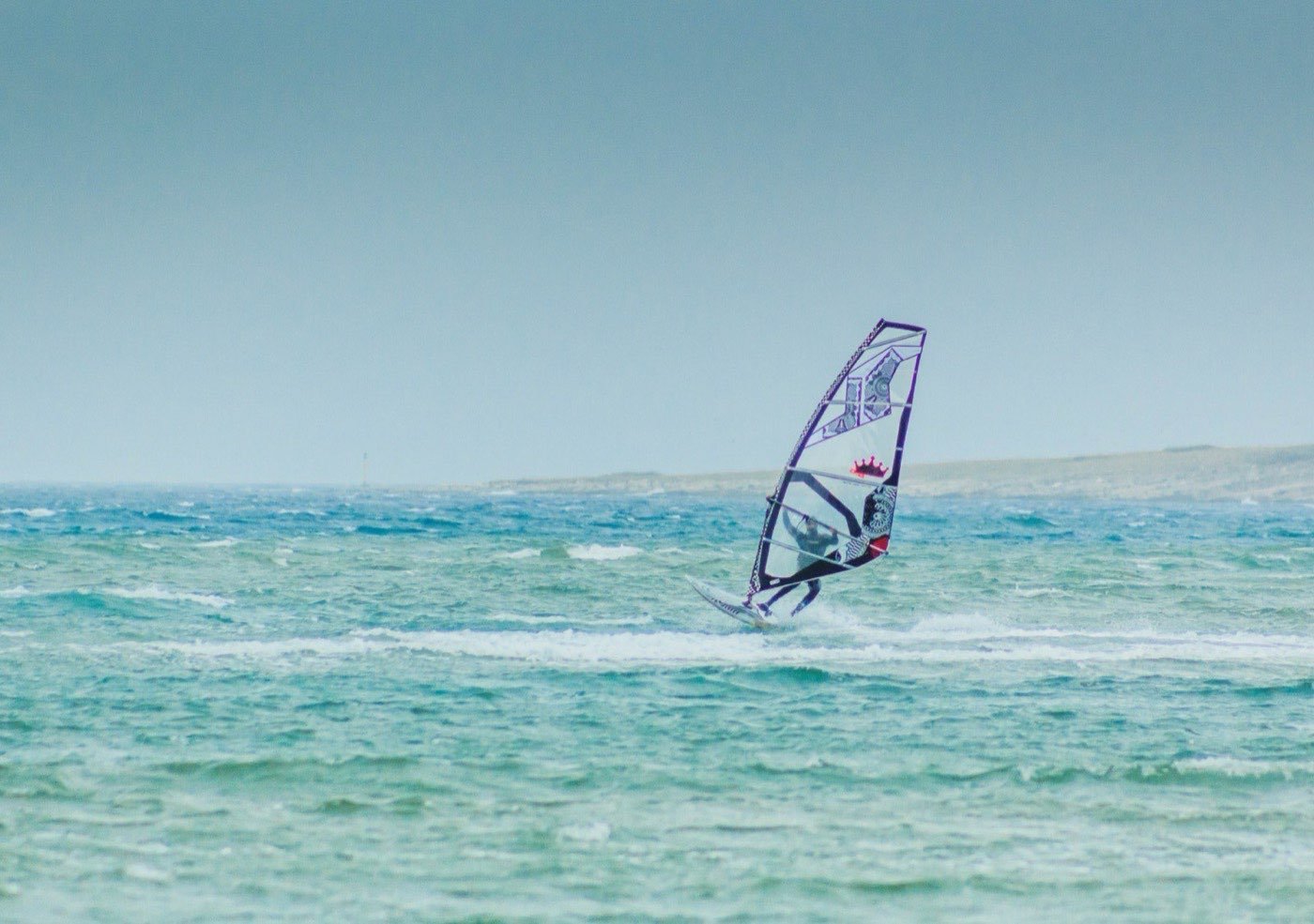
- Isla Blanca is a 7-kilometre sand peninsula 25 minutes north of Cancún with a long, shallow flat-water lagoon that is the single best windsurf launch on the Mexican Caribbean — knee-deep water for the first 80–100 metres offshore, side-onshore trade wind, almost zero chop on a clean day.
- The peninsula has at least four distinct launch points spread across its length, each with subtly different wind angle, sand quality and crowd. We map them in this guide.
- Fin choice for the lagoon is unusual: shallow-water 18–22 cm fins or weed fins beat the standard 28–32 cm freeride fins. Hit a sand bar at speed with a deep fin and you stop on a dime.
- Rigging on the sand is comfortable — the lee side of the peninsula gives you a windbreak for sail assembly. Bring a sail bag tarp because sand gets everywhere.
- Wind data is consistent with the rest of the Cancún belt: 15–22 kn through the April–June peak, occasionally 25+ in winter iWindsurf Nortes events. Live model maps via Windguru and Windy.com.
- The lagoon and adjacent dunes sit under CONANP-coordinated coastal management — no driving on the dunes, no littering, respect nesting markers when present.
Why Isla Blanca matters for windsurfers specifically
The conversation around Isla Blanca is dominated by kitesurf because the peninsula has become one of the most kite-school-dense launches in the western Caribbean. That's fair — there are eleven kite operators within five hundred metres of each other on a peak weekend. But the same flat-water lagoon, the same side-onshore wind angle and the same shallow sand-bottom that makes Isla Blanca a beginner-kite paradise makes it an even better beginner-windsurf paradise. A learner windsurfer who falls in the lagoon stands up in seventy centimetres of warm water. A learner kitesurfer who falls has to relaunch a wet kite. The windsurf path of least resistance is unambiguous.
What follows is a launch-by-launch breakdown written for windsurfers, not for kiters. Where the windsurf launch differs from the kite launch — and it often does, because windsurfers need rigging space and a clean upwind walk while kiters need a downwind safety corridor — we say so. We have also pulled wind direction, fetch and bottom data from the operator logs we maintain alongside iWindsurf daily reports and the satellite-derived wind layer on earth.nullschool.net.
For the general overview of why Isla Blanca's flat water works for boardsailing beginners, our companion piece Windsurf Isla Blanca — Flat-Water Beginner Guide covers rig sizing and first-day checklist. This guide drills down into the launch logistics themselves.
The peninsula geography in one paragraph
Isla Blanca is not an island. It is a long, narrow sand peninsula that runs roughly north-south from Punta Sam (the northern tip of mainland Cancún) up toward Isla Mujeres bay. To the east is the Caribbean Sea. To the west is the Laguna Chacmochuk, a shallow brackish lagoon connected to the sea through narrow channels at the peninsula's tip. Most kite and windsurf operators launch from the lagoon (west) side, not the sea side — because the lagoon is shallow, the prevailing east wind blows from the sea side over the dunes and into the lagoon (so the wind is side-onshore on the lagoon launch), and the fetch across the lagoon is short enough that no real waves develop. The peninsula is accessed by a single sand road that branches off the Cancún–Punta Sam highway. There is no public transport. You drive, taxi or shuttle in.
Launch #1 — "Aquaworld lagoon" entry (southern end)
The southern entry point sits roughly 2 km up the peninsula road from the highway turnoff. It is where many of the older kite and windsurf operators built their first palapas in the 2000s. Water depth at the launch is 40–60 cm at the shoreline, rising to 70–90 cm within twenty metres. The bottom is sand with occasional small seagrass patches; no rock, no coral. Wind at this end of the peninsula is the most consistent side-onshore east — you get the cleanest trade-wind angle here because the peninsula is widest and the dunes block the least.
Why windsurfers like the southern end
- Most rigging space on hard-packed sand — the area behind the palapas is broad enough for ten rigs side by side without conflict.
- Cleanest beach-start zone — you can walk your rig out fifteen metres before water-starting, which is gentler on the lower back than uphauling.
- Closest to the highway turnoff — easiest taxi access from Cancún Hotel Zone.
- Best rescue boat coverage — operator boats patrol the southern lagoon during teaching hours.
Trade-offs
- This is also the busiest kite launch — on weekend afternoons in peak season expect twenty kites in the air within eyeshot.
- Downwind drift from kiters above you can drop a kite on your rig if you're not paying attention. Stay below the kite traffic if you can.
Launch #2 — "Middle peninsula" (km 4–5)
Roughly halfway up the peninsula sits a quieter cluster of operators with smaller palapas, fewer day-tourists, and more long-term riders who have rented a casita on the peninsula for a week or two. The lagoon here is slightly narrower than at the southern end (fetch across to the mangrove edge is about 600 m versus 900 m at the south), so the very small chop is even smaller. Wind angle shifts subtly to ENE — still side-onshore on the launch, but the upwind tack is a little tighter, the downwind tack a little broader.
Why windsurfers like the middle
- Fewer kites overhead — half the density of the south, mostly because the middle operators are smaller schools.
- Cleanest water — the southern launch sees more swimmer and boat-engine traffic; the middle is calmer and visually clearer.
- Better for freestyle and slalom practice — narrower lagoon means you can reach the upwind mangrove edge in four tacks and turn around without losing position.
Trade-offs
- Fewer rental options — most middle-peninsula operators rent kite gear only. Bring your own windsurf rig or call ahead.
- Longer drive on sand road — high-clearance vehicle preferred in rainy season.
Launch #3 — "Far peninsula" (km 6–7, near the tip)
The far north end of the peninsula, close to where it almost touches Isla Mujeres across the bay channel, is the locals' secret. Water depth is similar (60–90 cm shore-side) but the lagoon opens up to Bahía de Isla Mujeres — meaning you can sail past the peninsula tip and out into deeper, slightly choppier water if you want a wave/chop session, then return to flat lagoon for cooldown. This dual-character launch is unique to the far peninsula.
Why advanced windsurfers like the far end
- Two conditions in one session — flat lagoon for jibe drills, then bahía chop for planing speed.
- Almost zero crowd — the drive is committed and casual day-trippers stop at the southern launch.
- View of Isla Mujeres skyline — purely cosmetic, but the sailing aesthetic here is the best on the peninsula.
Trade-offs
- No rescue boat coverage if you sail out into the bay. Self-rescue skills required.
- Channel current — the narrow channel between the peninsula tip and Isla Mujeres pushes a tidal current. Time your sail with the slack tide, not the peak.
- No rental — bring everything.
Pick the right launch for your level and goals. Book Cancún windsurf →
Launch #4 — "Sea-side beach break" (Caribbean side, advanced only)
Most windsurfers never cross the dune to the sea side, but it exists. The east-facing Caribbean beach has open ocean chop of 0.5–1.5 m on a normal trade-wind day, occasionally 2 m+ on a Norte. The launch is challenging because the wind is now side-offshore from the sea-side beach — meaning if you fall and lose your rig, you drift out to sea, not back to shore. This is a sailor's spot, not a learner's spot.
When the sea side makes sense
- You're a confident wavesailor with a small wave board (75–95 L) and a 4.0–5.0 m² sail.
- You have a self-rescue plan and a buddy on the beach with a phone and a radio.
- The day's wind is steady, not gusty — Norte fronts are too gusty for safe sea-side sailing without rescue boat coverage.
When the sea side does not make sense
- You're a beginner or intermediate — go to the lagoon side.
- The wind is offshore strong — beach starts get sketchy.
- Hurricane season swells (Aug–Oct) push wave size unpredictably.
For the wider Caribbean swell context, the NOAA NDBC buoy network publishes real-time wave height and period offshore of the Yucatán. Cross-reference NDBC with Windguru's swell layer before committing to a sea-side session.
Fin choice for the Isla Blanca lagoon
This is where Isla Blanca differs from most other windsurf venues. The lagoon is genuinely shallow — knee-deep over much of the inner zone — and the bottom has occasional seagrass patches that grab a standard freeride fin. The recommended fin setup is:
- Beginner board (150+ L) on lagoon flats: 28–32 cm standard freeride fin works because you stay in the deeper outer zone where seagrass is sparse. Drop to 22 cm if you ride the inner shallows.
- Intermediate board (110–140 L): 22–26 cm "weed" or shallow-water fin. The cutaway shape sheds seagrass and lets you ride knee-deep water without grounding.
- Advanced freestyle / slalom (90–110 L): 18–22 cm weed fin. You'll plane with less drag in the very shallow inside, jibe earlier, and stay protected against seabed contact.
- Sea-side beach break: 18–22 cm wave thruster (multi-fin) setup if your board takes them. Standard freeride fins are too long for the inside whitewater.
The cost of guessing wrong is real: hit a sandbar at planing speed with a 32 cm fin and you stop instantly, throwing yourself over the bars. Hit the same sandbar with a 22 cm weed fin and you skim across with a small bump. We have multiple incident logs from new visitors who shipped a 32 cm fin from home and broke it on day one. Borrow or rent locally — operators stock weed fins specifically for this lagoon.
Sail size by launch and season
Sail sizing differs subtly by launch because wind angle and fetch change. For the broader monthly probability we publish a dedicated windsurf wind calendar and the more granular rig-size monthly probability piece. As a Isla Blanca-specific shortcut:
| Launch | Apr–Jun (peak) | Nov–Mar (Nortes) | Jul–Aug (light) |
|---|---|---|---|
| South lagoon | 5.5–6.5 m² | 4.5–5.5 m² | 7.0–7.5 m² |
| Middle lagoon | 5.5–6.5 m² | 4.5–5.5 m² | 7.0–7.5 m² |
| Far peninsula | 5.0–6.5 m² | 4.0–5.0 m² | 7.0+ m² |
| Sea side | 4.5–5.5 m² | 3.7–4.5 m² | 5.5–6.5 m² |
These ranges assume a 70–85 kg rider. Add 0.5 m² per 10 kg above 85 kg; subtract 0.5 m² per 10 kg below 70 kg, within the rig's tuning range.
Getting to Isla Blanca and what to bring
The peninsula sits 25 km north of central Cancún via Highway 180D then the Punta Sam coastal road. There is no public bus. Taxi from Cancún Hotel Zone is roughly 25–35 minutes and MX$500–800 each way depending on the driver. Most riders coordinate a shared shuttle through their operator, which drops the per-person cost. If you drive yourself, a normal car is fine in dry season; in rainy season (Sep–Oct) the sand road develops puddles and a small SUV is preferred.
What to bring (windsurf-specific)
- Reef-safe sunscreen (zinc oxide, non-nano) — mandatory under CONANP guidance and good for the lagoon ecosystem.
- Long-sleeve rash guard / 1 mm shorty in winter — water temp drops to 24 °C in Jan–Feb.
- Boom protector / mast extension cap — sand pits the metal threads if you drop the mast on bare beach.
- Water + electrolytes — there is one small palapa shop at the southern launch; the middle and far launches have nothing.
- Cash — operators on the peninsula are mostly cash-MXN for day rentals. Credit cards work at the major schools but not the smaller ones.
Live conditions check before you commit to the drive: Windguru spot "Cancún – Isla Blanca", Windy.com ECMWF model layer, and earth.nullschool.net for the synoptic Caribbean wind picture.
Crowd, etiquette and CONANP rules on the peninsula
Isla Blanca is informally shared — there is no central authority assigning launch zones, no permitted-operators-only signage, no enforced lane separation. It works because the kite/windsurf community agrees on local etiquette. As a windsurfer, your obligations:
- Right-of-way standard — the same ISAF / ISO sailing rules apply: starboard tack over port tack, leeward over windward, overtaking craft yields. In practice on the lagoon, windsurfers should give kiters lots of horizontal clearance because kite lines reach further than they look.
- Walk your rig out until you have shoulder-depth water — uphauling in the very shallow inside risks pulling a knee or hyperextending the lower back.
- Don't park your rig on a kiter's launch corridor — kiters need clean upwind sand to lay out lines; windsurfers can rig further to the side.
- Respect CONANP dune markers — sea-turtle nesting season runs roughly May–October on this coast. Stay on existing paths; do not drive on dunes; do not move marked stakes.
- Pack out your trash. There is no garbage service at the middle and far launches.
Frequently asked questions
Which Isla Blanca launch is best for a first-time windsurf visitor?
The southern launch is the right answer for nine out of ten first-time visitors. It has the most rigging space, the most reliable rescue boat coverage during teaching hours, the cleanest beach-start zone, and the easiest taxi access from Cancún Hotel Zone. The middle peninsula is quieter but has fewer rental options. The far peninsula is a committed advanced-only call. The sea side is genuinely advanced wavesail terrain.
Do I need a special fin for the lagoon?
Yes — strongly recommended. A standard 28–32 cm freeride fin will catch seagrass and ground out on shallow sandbars in the inside lagoon. A 22 cm weed fin or shallow-water cutaway is the standard local choice. Operators stock them; don't ship your home fins without checking.
Is rental gear available at every launch?
No. The southern launch has the most rental coverage — multiple operators carry 1–3 windsurf rigs each. The middle has limited rental, mostly kite-focused. The far peninsula has no rental — bring your own. Always call ahead; rental windsurf rigs are scarcer than kite gear on this peninsula. See our windsurf gear rental reality guide.
How shallow is "shallow" in the lagoon?
The first 80–100 metres offshore at the southern launch is 40–90 cm deep on a normal tide. You can stand up almost anywhere in the inner lagoon. The outer zone (toward the mangrove edge on the west side, 600–900 m fetch) deepens to 1.5–2.5 m. For windsurfers this is uniformly great; you never lose your rig to deep water.
Can I sail at Isla Blanca in winter Nortes?
Yes, but with a smaller rig (4.0–5.0 m²) and only if you can handle 25+ kn gusts. The Nortes themselves are a winter cold-front phenomenon that brings 24–48 hours of strong, gusty wind. The lagoon stays flat-ish but the sea side gets large chop. Beginners should skip Norte days entirely and wait for the steadier trade-wind windows between fronts. Cross-check the iWindsurf Cancún forecast against Windguru before driving up.
Want help choosing the right Isla Blanca launch?
Tell us your skill level, dates and whether you bring your own rig — we match the launch, fin and sail size.