🔎 TL;DR
- Three ways to see Cancún's reef without scuba certification: snorkel, glass-bottom boat, and tourist submarine. Each fits a different physical level, budget and group profile.
- Snorkel is the cheapest and the most immersive ($60–110 USD), but requires the ability to swim and put your face in salt water for 30+ minutes.
- Glass-bottom boat ($25–45 USD) is the best option for non-swimmers, very young children, elderly travellers and people with mobility issues. You stay dry.
- Tourist submarine ($80–150 USD) is rare in Cancún proper but available regionally (Atlantis-style operations). Goes deeper than snorkel/glass-bottom — to 20–30 m — and is air-conditioned.
- For most visitors with normal mobility and basic swim ability, a small-group snorkel tour delivers far more reef experience per dollar.
- For mixed groups (some snorkelers, some not), book a combo: a snorkel boat that includes a glass-bottom viewing window for non-swimmers in the family.
Why this comparison matters — three very different products
"How do I see the reef?" is one of the most common questions Cancún visitors ask their concierge, and the answer they often get is "book a snorkel tour" — even when the customer can't swim, is travelling with a 4-year-old or an 80-year-old, or has a back issue that makes treading water for 30 minutes a non-starter. The reality is that the Mesoamerican Reef diving in Cancún can be experienced three different ways without ever putting on a tank, and the right product depends entirely on the group.
All three products operate inside or adjacent to the Parque Nacional Costa Occidental de Isla Mujeres, Punta Cancún y Punta Nizuc, federally protected since 1996 by CONANP. All three are bound by the same CONANP rules — no anchoring on reef, mooring buoys only, no fishing, no removing wildlife — and the reef they're viewing is part of the second-largest barrier reef on Earth, monitored continually by the Healthy Reefs Initiative.
What differs between the three is access mode: do you go to the reef (snorkel), or does the reef come to you through a window (glass-bottom / submarine)?
Option 1 — Snorkel: the immersive, cheapest, most-fun option
A small-group snorkel tour in Cancún is a 3–4 hour boat trip that drops you in the water at 2 of the 4 main reef sites (Manchones, MUSA, Punta Nizuc, El Meco — covered in detail in our Cancún snorkel sites ranked guide). You wear a mask, snorkel and fins; you float on the surface; you breathe through the snorkel; you look down at the reef 3–6 m below you.
What snorkel delivers
- You can see everything within 5–10 m of you — fish swim around you, turtles glide past, you can free-dive (a couple of metres if you're comfortable) to look closer at a coral head.
- You're physically in the marine environment — temperature, current, the noise of parrotfish biting coral. This is the experience that creates memories.
- Photographic potential — GoPro on a wrist tether captures the reef and you in frame.
- Cost — $60–110 USD per person for small-group, $40–60 USD for larger boat operations. Significantly cheaper than dive certification or submarine.
What snorkel asks of you
- Basic swim ability — be able to tread water in a vest for 30 minutes without panic.
- Tolerance of salt water on the face — you'll get water in your mask occasionally; you need to be calm about clearing it.
- Some core fitness — climbing back onto a boat ladder is the hardest part for most adults.
- Age 5+ generally accepted with a vest. Under 5 is a tough sell because of attention span more than physical ability.
For the broader red/green flag framework on snorkel operators, see Snorkeling Cancún — Beyond the Tours.
Option 2 — Glass-bottom boat: dry, accessible, perfect for some groups
A glass-bottom boat is a small motor vessel (typically 12–25 passengers) with a viewing window cut into the hull and a glass / acrylic pane sealing it. You sit on a bench above the window and look down at the reef passing beneath the boat. The boat motors slowly over the reef structure (typically Punta Nizuc and adjacent fringing reef in 2–5 m of water) and the captain holds station over interesting bottom features.
What glass-bottom delivers
- You stay completely dry. Wheelchair-accessible options exist. Suitable for visitors with mobility issues, fear of water, ear-pressure issues, age 0–100.
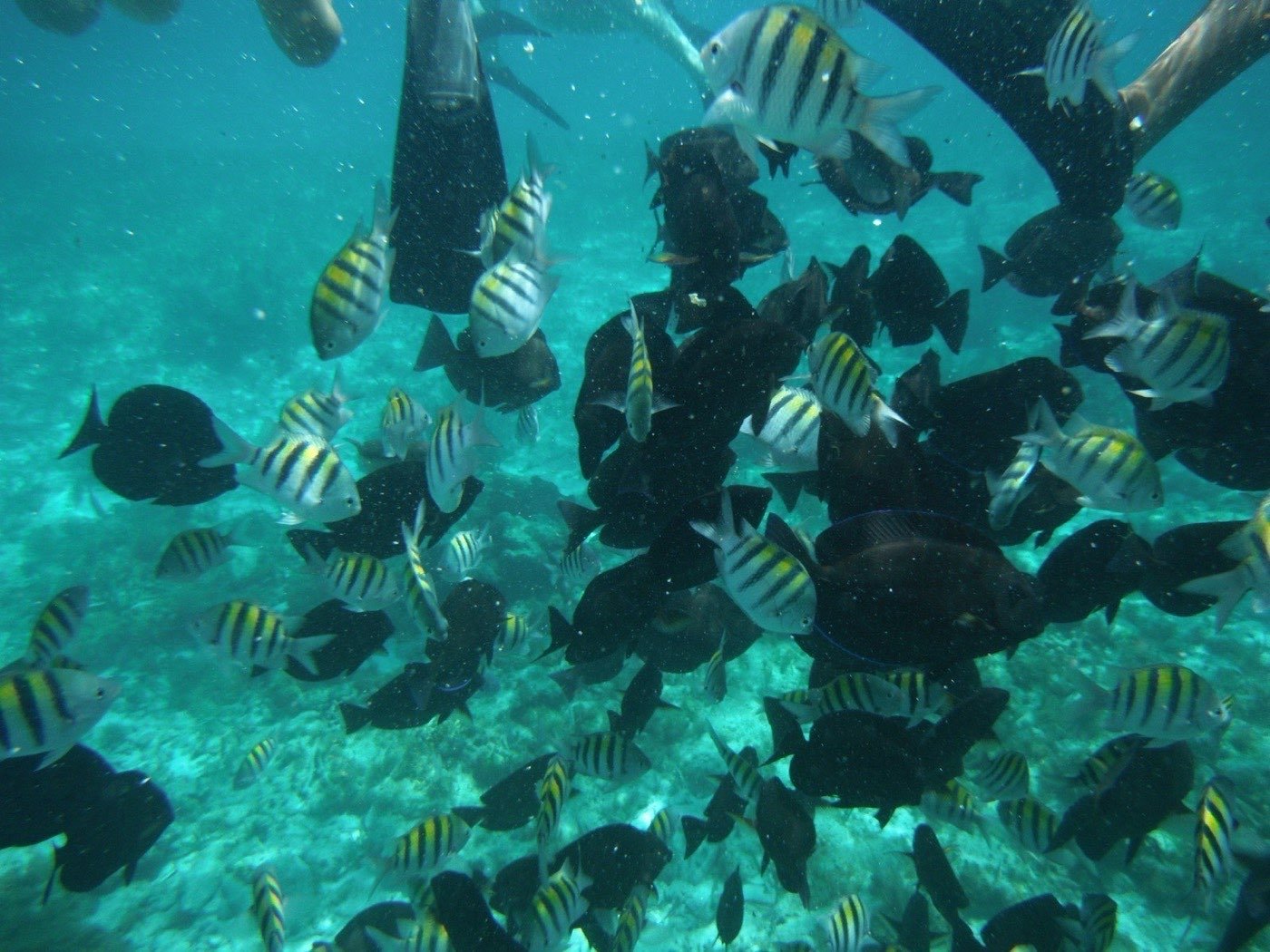
- Same reef, viewed from above. You'll see parrotfish, snapper, sergeant majors, the occasional turtle. Visibility through glass is good in calm water.
- Short duration — typically 1–2 hours total, often paired with a separate beach or marina activity.
- Cost — $25–45 USD per person. The cheapest reef-viewing product in Cancún.
What glass-bottom trades off
- You are not in the water. The visceral experience of being surrounded by fish is absent. This is a window on the reef, not an immersion in it.
- Visibility is limited by glass condition and angle. A scratched or biofouled window cuts the experience badly. Ask the operator about the window age.
- You see what the boat passes over. No free-diving to a sculpture or following a turtle.
- Limited to shallow sites. Punta Nizuc fringing reef is the usual target; deeper sites like MUSA Salón Manchones are not visible from a glass-bottom boat at the surface.
Who glass-bottom is for
- Families with very young children (under 5) or grandparents in a multigenerational trip.
- Travellers with mobility limitations, recent injuries, ear surgery, or fear of being submerged.
- Cruise passengers with 2–3 hours on shore and no time for a full snorkel boat trip.
- "Reef-curious" first-timers who want to see what the reef looks like before committing to a snorkel tour later in the trip.
Option 3 — Tourist submarine: deeper, drier, the rare specialty
A true tourist submarine — Atlantis-style, descending to 20–30 m below the surface in a pressurised cabin — is rare in Cancún proper. Atlantis Submarines operates in Cozumel (90 min boat ride from Cancún plus the submarine dive), Aruba, Curaçao and elsewhere in the Caribbean. The equivalent in Cancún is usually a semi-submarine (cabin partially below the waterline, large viewing windows along the hull at 1–2 m depth), which is closer to a glass-bottom boat than a true sub.
What a true submarine delivers
- Depth. A submarine can show you the reef at 20–30 m — the same depth as the Salón Manchones dive gallery at MUSA, or the deeper outer-reef slope. This is what most non-divers will never see.
- Air-conditioned comfort for 40–50 minutes. No mask, no fins, no salt water.
- All-weather operation — submarines are unaffected by surface chop. They go when snorkel boats stay in port.
- Wildlife potential — schooling fish, occasional turtle, possible larger fauna at depth.
What a submarine costs and asks
- Cost — $80–150 USD per person for the Cozumel Atlantis trip. Plus the boat ride from Cancún to Cozumel (or a flight + ferry combo).
- Booking lead time — limited capacity per dive; book in advance for cruise-day trips.
- Mild claustrophobia consideration — the cabin is enclosed for 40–50 min. Not suitable for severely claustrophobic travellers.
- Pregnancy and recent-surgery restrictions apply; check with the operator.
For Cancún-specific semi-submarine and glass-bottom options, ask your operator for the "Aquaworld Subsee" or equivalent product — these run from Hotel Zone marinas and skip the Cozumel trip.
All three compared at a glance
Cost ranges are 2026 typical prices for Cancún-based operators; reef visibility ratings come from operator surveys cross-checked against NOAA Caribbean visibility data.
| Product | Cost (USD/person) | Duration | Depth seen | Wet? | Best for |
|---|---|---|---|---|---|
| Small-group snorkel | $60–110 | 3–4 h | 0–6 m (free-dive) | Yes | Active travellers, families w/ kids 5+ |
| Large-boat snorkel | $40–60 | 3–4 h | 0–4 m | Yes | Budget travellers (lower experience quality) |
| Glass-bottom boat | $25–45 | 1–2 h | 0–5 m (window view) | No | Non-swimmers, elderly, very young kids |
| Semi-submarine | $50–80 | 1–2 h | 0–3 m (hull view) | No | Mobility-limited, all-weather option |
| True submarine (Cozumel) | $80–150 | 1.5 h dive | 20–30 m | No | Depth-curious, A/C comfort, day trip |
Match the right reef-viewing product to your group. See Cancún snorkeling tours →
Combo strategies — when one group has mixed needs
The most common Cancún scenario: a family of 4 with two snorkel-capable adults, one swim-confident 10-year-old, and one 4-year-old who's never been in the ocean. Booking three separate products is logistically painful. Two strategies work:
Strategy A: snorkel boat with a stay-aboard option
Many small-group snorkel boats welcome non-snorkelers as paying guests at 50–70% of the snorkel price. The 4-year-old stays on the boat with one adult (taking turns); the rest snorkel. The non-snorkeling parent gets a view of the reef from the boat (boats often have a glass viewing panel on the bow), light refreshments, and a calm sea time. The pricing model varies by operator — ask explicitly.
Strategy B: two-half-day split
Morning: glass-bottom boat with the whole family (everyone sees the reef together, 1.5 hr). Afternoon: snorkel tour with the two adults + the 10-year-old, while the 4-year-old is at the hotel pool with a babysitter or other family. This gets the photos, the kid's "I saw a fish!" moment, and the deeper experience for the swim-capable family members.
Strategy C: dive + snorkel combo for couples
If one partner is open-water certified and the other isn't, MUSA is the right destination: the certified partner dives the Salón Manchones gallery at 8 m; the snorkeler does the Salón Nizuc gallery at 4 m from the same boat. See our MUSA — snorkel or dive guide and Discovery dive vs snorkel for more.
Marine-life expectations by product
What you can realistically expect to see varies by depth and immersion. For the full 2026 marine-life calendar, see Cancún Marine Life Calendar 2026.
Snorkel sightings (Manchones / MUSA / El Meco)
- Sea turtles ~60% probability at Manchones in season.
- Parrotfish, snapper, grunts, sergeant majors — every trip.
- Eagle rays (spring), nurse sharks (year-round), stingrays — frequent.
- MUSA sculptures with coral growth — guaranteed on MUSA-itinerary boats.
Glass-bottom sightings (Punta Nizuc)
- Same reef-resident fish census but viewed from above.
- Turtle sightings less likely due to shallower habitat targeted.
- Coral structure clearly visible in calm water.
Submarine sightings (Cozumel / semi-sub in Cancún)
- Deeper-reef species — bigger snapper, grouper, occasional reef shark at depth.
- Coral wall structure visible from the side rather than from above — different perspective.
- Limited individual encounter — the sub is too big to follow a turtle the way a snorkeler can.
Accessibility and special considerations
Pregnancy
Snorkel is generally fine in the first and second trimester for low-risk pregnancies; consult your doctor. Glass-bottom and semi-submarine are fully fine. True submarine has pressure considerations — check with the operator.
Ear / sinus issues
Snorkel and glass-bottom are pressure-neutral (you stay at surface or above). True submarine has mild pressure changes — equivalent to a flight descent — generally tolerated by anyone who can fly without ear pain.
Children under 5
Glass-bottom boat is the right product. CONANP-licensed operators generally don't put under-5s on snorkel itineraries even with a vest because of attention-span and cold-shock risks.
Mobility / wheelchair
Glass-bottom boats vary in accessibility — some have ramps and lift-aboard arrangements; some do not. Ask explicitly when booking. Most snorkel boats are not wheelchair-accessible.
Severe claustrophobia
Glass-bottom is fully open-air. Semi-submarine is partially enclosed but with large windows. True submarine is fully enclosed for 40–50 min — not advisable for severe claustrophobics.
Frequently asked questions
Is the submarine really worth the extra money?
For most travellers, no — a small-group snorkel delivers more reef experience per dollar. The submarine is worth it for two specific cases: (1) travellers who physically cannot snorkel (mobility, ear, severe water fear) but want to see the reef at depth, and (2) bad-weather days when snorkel boats are cancelled but submarines still run. Otherwise, the immersive snorkel experience is the better value.
Can a non-swimmer really go on a snorkel tour?
Yes, with caveats. A non-swimmer with a properly fitted vest can float face-down at Manchones (a very calm site) and see the reef. The operator should brief them, stay close, and not push depth. That said, a glass-bottom boat is often the better product for absolute non-swimmers — less stress, same reef view, lower cost.
Are tourist submarines safe?
Atlantis-class tourist submarines have a strong safety record across decades of operation. They are pressurised, certified by maritime authorities (PADI dive sites and submarine routes are documented under PADI-affiliated and government-approved standards), carry redundant oxygen and life-support, and have surface support boats. The risk profile is comparable to or lower than a commercial flight.
Do glass-bottom boats damage the reef?
Less than poorly operated snorkel boats. Glass-bottoms don't anchor on coral (CONANP enforces mooring buoys for everyone), and they don't deposit fin-kick sediment. The remaining concern is sunscreen / fuel runoff, which is regulated equally for all operators. Reputable glass-bottom operators in the Cancún park are CONANP-permitted and follow the same conservation protocols.
What about the "lobster lunch catamaran" with a glass bottom?
Be cautious. Many 150-passenger party catamarans advertise a "glass-bottom viewing platform" that is, in practice, a small window most of the boat can't access. The marketing claim is real; the experience is not. If glass-bottom viewing is your primary purpose, book a dedicated small glass-bottom boat (12–25 passengers) rather than a catamaran combo.
Match the reef product to your group
Tell us ages, mobility, swim ability — we'll recommend snorkel, glass-bottom, sub, or a combo.