🔎 TL;DR
- The four reef snorkel sites every Cancún operator rotates through are Manchones (calm, beginner-friendly, turtles), MUSA (the underwater museum), Punta Nizuc (closest to the Hotel Zone, busiest), and El Meco (north of Cancún, larger fish, less crowded).
- All four sit inside the Parque Nacional Costa Occidental de Isla Mujeres, Punta Cancún y Punta Nizuc, a federally protected zone managed by CONANP — bracelet fee, reef-safe sunscreen, no touching, no fishing.
- If you only have time for one site: Manchones for families and first-timers, MUSA for the photo trip of a lifetime, El Meco for the local "fish-tank" feel without crowds.
- Boat ride from Cancún Marina: 15–20 min to Punta Nizuc, 25–30 min to MUSA, 35–45 min to Manchones, 25 min to El Meco. Sea-state matters more than distance.
- Best window for visibility: March–July (less Caribbean swell, less rainfall runoff). NHC Atlantic hurricane season Jun–Nov can push viz down at exposed sites.
- Water 26–29 °C year-round per NOAA Caribbean SST — no wetsuit needed for short snorkels, rash guard recommended for sun.
Why Cancún snorkel ranks matter — they are not all the same reef
The shorthand "snorkel Cancún" hides a wide range of underwater experiences. The four sites we cover below are spread across roughly 25 kilometres of coastline between Punta Nizuc in the south and El Meco in the north, and the reef structure, depth, current, fish life and crowd levels at each are genuinely different. Operators who run the same daily itinerary regardless of conditions are skipping the most important part of their job: matching the site to the day. Operators who switch sites depending on wind, swell and group fitness are the ones we recommend.
All four reef sites sit inside the Parque Nacional Costa Occidental de Isla Mujeres, Punta Cancún y Punta Nizuc, a 8,673-hectare federally decreed marine protected area established in 1996 and managed by CONANP (Comisión Nacional de Áreas Naturales Protegidas). The park sits within the larger Mesoamerican Barrier Reef System, the second-longest barrier reef on Earth and the subject of long-running health monitoring by the Healthy Reefs Initiative. CONANP enforces a wristband fee (currently MX$104 per visitor per day, subject to change), reef-safe sunscreen, no-touch rules, no anchoring on coral, and operator capacity quotas.
The ranking below is not a strict 1–4 ordering — it is a "what to pick when" matrix. We'll cover each site in depth, then summarise into a comparison table you can take screenshot of.
#1 — Manchones Reef (best for beginners and families)
Manchones is a 1-kilometre-long shallow reef that sits between Cancún and the southern tip of Isla Mujeres, on the lee (sheltered) side of the island. Depth ranges from 3 to 10 metres across the reef structure, with the snorkel-friendly inner section sitting in 3–6 m. The reef is mostly hard coral — brain coral, star coral, sheet coral — with sandy channels between coral heads. Because the island blocks the prevailing easterly wind, Manchones is the calmest of the four sites on most days. It is also where the iconic Cruz de la Bahía (Bay Cross) statue sits in about 9 m of water — a bronze crucifix submerged in 1994 to commemorate sailors lost at sea.
What you'll see at Manchones
- Sea turtles grazing on the seagrass beds adjacent to the reef — primarily green turtles (Chelonia mydas) and the occasional hawksbill (Eretmochelys imbricata). Both are listed as Endangered / Critically Endangered on the IUCN Red List. Operators report sea-turtle sightings on roughly 60% of Manchones snorkels in season.
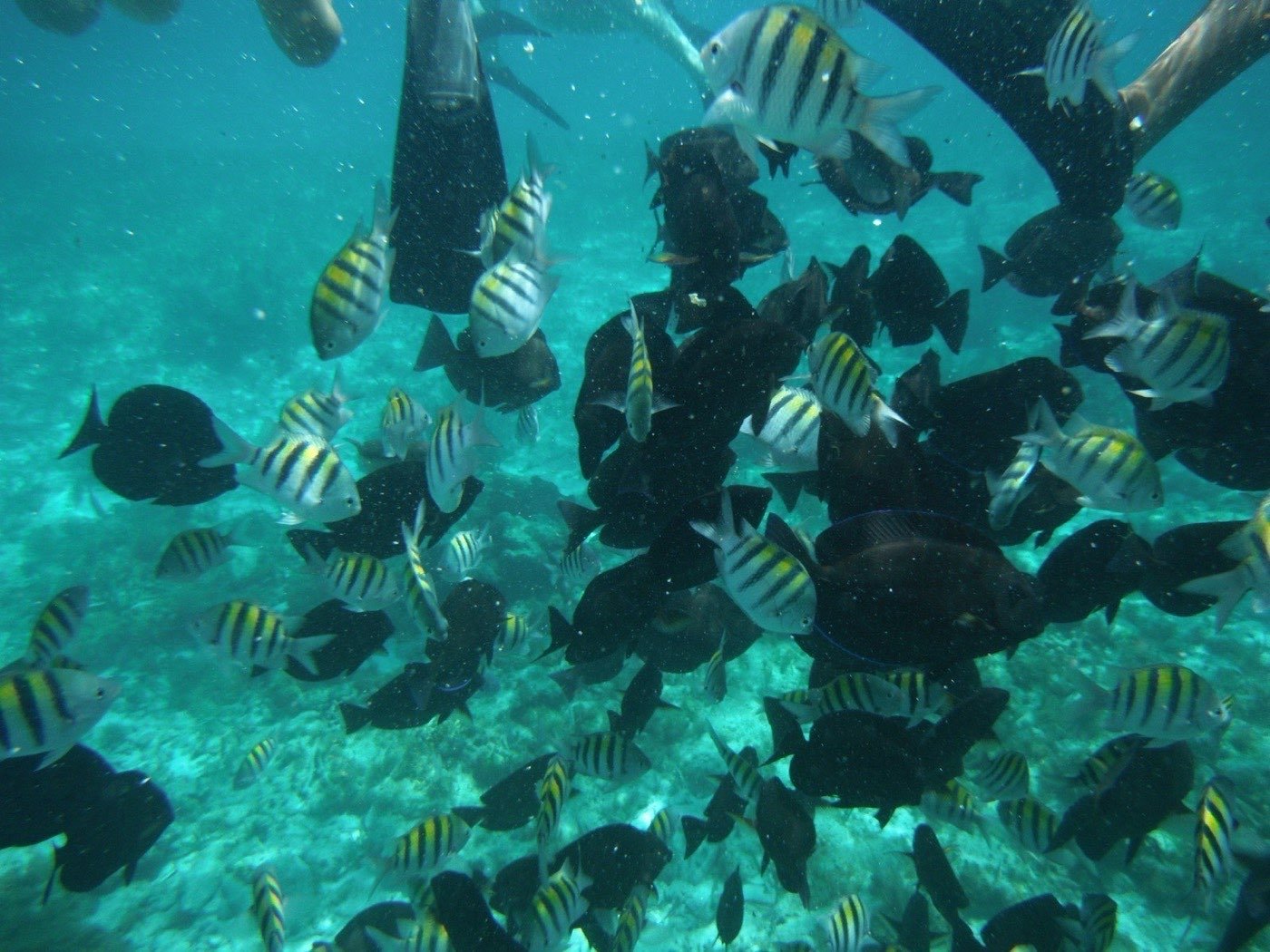
- Large schools of blue tang, yellowtail snapper, French grunt, sergeant majors, parrotfish, and the brilliant Queen angelfish if you're patient.
- Southern stingrays buried in the sand between coral heads.
- Occasional nurse sharks resting under ledges — harmless and shy.
Why Manchones works for first-timers
- Mild current — the island blocks the wind chop. Even nervous swimmers can float and look without fighting drift.
- Lifejackets stay buoyant easily in the 3–6 m inner reef zone.
- Boat moorings — CONANP-managed mooring buoys mean the boat stays put while you snorkel, so you always have a fixed return point.
- Kid-friendliness: excellent. Most operators accept ages 5+ with a vest.
For the broader Cancún-vs-tour-trap context, see our Snorkeling Cancún — Beyond the Tours guide.
#2 — MUSA (Museo Subacuático de Arte) — the underwater museum
MUSA is unlike anything else in the Caribbean. Designed by British artist Jason deCaires Taylor in partnership with the Cancún Nautical Association, the museum is a collection of more than 500 life-size human sculptures sunk between 2009 and 2013 across two main galleries — Salón Manchones (8 m deep, the divers' gallery) and Salón Nizuc (4 m deep, the snorkelers' gallery). The sculptures are made of pH-neutral marine cement specifically engineered to be a substrate for new coral growth, and after a decade-plus on the seabed many are now richly colonised by sponges, coralline algae and live coral. The result is part art installation, part artificial reef.
For snorkelers, the relevant gallery is Salón Nizuc at 4 m. You can free-dive down to touch the sculptures with your fingertips (some operators forbid this — touching is the slow death of the coral colonisation), or simply float over the top and see the figures from above. The visual impact is genuinely Nat Geo material; bring a GoPro on a wrist tether.
MUSA specifics
- Depth: snorkel gallery 3–4 m; dive gallery 8 m.
- Boat ride: 25–30 minutes from Cancún Marina.
- Current: mild to moderate, depending on tide. Less sheltered than Manchones.
- Visibility: 8–20 m depending on season; clearest March–July.
- Fish life: the artificial reef now supports the same families seen at Manchones — parrotfish, sergeant majors, angelfish, plus interesting macro on the sculpture surfaces (encrusting sponges, fan worms).
- Rules: CONANP and the museum's own management ask snorkelers to avoid fins in the gallery (fin-kick lifts sediment and damages the slow coral growth on the cement). Many operators rent foot-only floats so you can move without fins.
For the deeper dive-vs-snorkel question at MUSA specifically, our MUSA snorkel or dive guide walks through both options.
#3 — Punta Nizuc — closest, busiest, still worthwhile
Punta Nizuc is the southernmost tip of the Cancún Hotel Zone, where Boulevard Kukulcán curves west to meet Laguna Nichupté. The reef itself is a shallow patch reef in 2–5 metres of water, less than 100 metres offshore, accessed by boat from the Aquaworld marina or by a 10-minute boat ride from the Hotel Zone hotels. Because it's so close to the city and so shallow, it's where the high-volume tour operators send their entry-level snorkel guests, and on a peak-season afternoon it can feel like a buffet line.
That said, the reef itself is real, the fish are real, and at 8 am before the crowds arrive it is a perfectly good snorkel site for an introduction. The reef structure is mostly brain coral and fire coral patches separated by sand, in 2–5 m of water. Fish life is similar to Manchones but lower density because of the traffic.
What Punta Nizuc is for
- First-timers who want the closest possible site to the hotel — minimum boat ride, easy logistics.
- Half-day combo tours that include the Jungle Tour (small motor-boat through the lagoon) plus a 30-minute snorkel stop.
- Beginners testing the water before booking a more committed Manchones / MUSA day.
What Punta Nizuc is not for
- People who came to Cancún specifically for snorkeling — go to Manchones or MUSA.
- Photographers — too much fin-kick sediment, too many people in frame.
- Afternoon snorkels in high season — go early or skip it.
#4 — El Meco — the locals' secret north of Cancún
El Meco is the one site in the rotation that the cattle-boat tours don't visit, because it's 25 minutes north of Cancún Marina (Puerto Juárez side) rather than south toward the Hotel Zone, and the high-volume operators have their docks at the wrong end of town. The reef sits in 4–12 metres of water, includes both fringing reef and a small wreck (the El Meco grounding from a 1980s shipwreck), and gets noticeably more open-water fish life because it sits in cleaner offshore current.
The local-operator advantage at El Meco is that you get a less curated visual: more barracuda, larger snapper, occasional eagle ray patrolling the deeper slope, and sometimes nurse sharks under the wreck structure. The hard coral is healthier on average than at Punta Nizuc because the site sees less foot-traffic and less runoff from the Hotel Zone storm drains. Healthy Reefs data on the Mesoamerican Reef diving consistently shows that less-visited reef segments retain higher coral cover.
What El Meco trades off
- Slightly more current than Manchones — the site is less sheltered. Confident swimmers only, or operators with vest-required policy.
- Boat ride from north dock, so most tour pickups will route you through downtown Cancún rather than the Hotel Zone.
- Less infrastructure — no MUSA-style sculpture spectacle. The draw is the reef and the fish, not the photo op.
If you have two snorkel days in Cancún, do Manchones + MUSA on day one and El Meco on day two. That's the local-operator rotation.
All four sites compared at a glance
Numbers below are operational ranges used by Cancún-based snorkel operators, cross-checked against CONANP park documentation and NOAA Caribbean ocean data.
| Site | Boat ride | Depth | Current | Viz | Kid-friendly | Best for |
|---|---|---|---|---|---|---|
| Manchones | 35–45 min | 3–10 m | Mild | 10–25 m | Yes (5+) | Beginners, families, turtles |
| MUSA (Salón Nizuc) | 25–30 min | 3–4 m | Mild–mod | 8–20 m | Yes (7+) | Photo trip, art lovers |
| Punta Nizuc | 10–20 min | 2–5 m | Mild | 6–15 m | Yes (5+) | First-time test, short trip |
| El Meco | 25 min (N dock) | 4–12 m | Moderate | 10–20 m | Limited (8+) | Confident swimmers, locals' pick |
Match the right site to your group, dates and skill level. See Cancún snorkeling tours →
Season, weather and what changes month by month
The four sites do not perform equally across the year. Cancún sits squarely in the Atlantic hurricane belt, with the official season running June 1 to November 30 according to the National Hurricane Center. Even when there is no named system, late-summer tropical waves push swell and rainfall runoff that drop visibility at exposed sites (MUSA, El Meco) before they affect the sheltered Manchones lee.
Month-by-month visibility shortlist
- December–February: "Nortes" cold fronts bring north-east wind, choppy seas, occasional 24-hour port closures. When it's calm, viz is good. When it's not, snorkel is rescheduled — work with an operator who reschedules without penalty.
- March–May: the sweet spot. Settled weather, water 26–28 °C, viz 15–25 m at MUSA on a calm morning, sea-turtle nesting begins in April–May (look but don't approach).
- June–August: hot, humid, occasional afternoon thunderstorms. Whale shark season runs in parallel offshore — see our whale-shark season guide.
- September–October: peak hurricane risk. Snorkel days happen but are weather-dependent.
- November: rebound — water still warm, first Nortes arrive late in the month.
For the parallel ranking on the Riviera Maya side, our Riviera Maya reef snorkel guide covers Akumal, Yal-Ku and Xpu-Ha.
CONANP rules at all four sites
The marine park rules are consistent across Manchones, MUSA, Punta Nizuc and El Meco. They are enforced by park rangers and by any reputable operator's dock briefing.
- Wristband fee (currently MX$104 per visitor per day) covers park entry and reef-conservation programmes. Operators bundle it in or collect at the dock.
- Reef-safe sunscreen only — no oxybenzone, no octinoxate. Mineral (zinc oxide / non-nano titanium dioxide) is standard. See our forthcoming reef-safe sunscreen guide for the approved brand list.
- No touching coral, sculptures (MUSA), or marine life. Touching is the slow death of the reef.
- No fishing, no anchoring on reef, no removing shells / sand / artefacts.
- Maintain distance from sea turtles. Watching distance is 3 m minimum; never chase, never block their path to the surface.
For the international science context, the IUCN Red List classifies most Caribbean turtle species as Endangered or Critically Endangered, and the State of the World's Sea Turtles annual report tracks population trends region by region.
Choosing the right operator (the same rules apply everywhere)
Site selection only matters if you've already picked the right boat. The same red/green flag framework we walk through in Snorkeling Cancún — Beyond the Tours applies at all four sites:
Red flags
- 50+ passenger boat, DJ, open bar before 11 am.
- Price under $40 USD all-inclusive. Math does not work honestly.
- Same itinerary regardless of conditions — operator doesn't switch from MUSA to Manchones when the wind kicks up.
- No CONANP briefing, no reef-safe sunscreen check, no vest enforcement for kids.
Green flags
- Group capped at 10–15 guests.
- Captain calls the site based on the morning's wind and swell.
- Bilingual guide who can ID fish species and brief on park rules.
- PADI Dive Centre or equivalent credential — even on snorkel-only operators, PADI-affiliated shops follow safety/insurance standards.
Frequently asked questions
Which Cancún snorkel site is the absolute best?
There is no single answer because the sites serve different needs. For first-timers and families with kids 5–10, Manchones is the answer — calm, shallow, sea turtles. For a once-in-a-trip photo experience, MUSA is unique on Earth. For a short half-day with minimum boat time, Punta Nizuc is fine before 10 am. For confident swimmers who want a less curated reef, El Meco delivers. Most two-day snorkel itineraries do Manchones + MUSA on day one and El Meco on day two.
Can I snorkel MUSA without an operator?
Technically no. MUSA sits inside a CONANP-protected zone with mooring-buoy access only, and a wristband fee plus operator boat are required. Even if you could anchor independently, fin-kick sediment damages the slow coral growth on the sculptures — the museum management actively asks all visitors to enter via a credentialed snorkel operator.
Is Punta Nizuc worth booking on its own?
Honestly — it depends on logistics. As a 2-hour stop on the way to MUSA or as the snorkel-half of a Jungle Tour combo, yes. As a stand-alone full-day, no — Manchones or El Meco both deliver more reef per dollar. The advantage of Punta Nizuc is purely proximity. Go early (8–9 am) before the volume operators arrive.
Do I need to be a strong swimmer for these sites?
Manchones, MUSA snorkel gallery and Punta Nizuc all accept non-swimmers with a buoyancy vest provided by the operator. El Meco asks for confident swimmers (vest still provided) because the current is stronger and the depth runs deeper. If you cannot swim and have never used a mask, start at Manchones with a vest and a guide-led "snorkel walk" — many operators offer this.
Will I see sea turtles on a Cancún snorkel?
Realistic probability: ~60% at Manchones (the seagrass beds adjacent to the reef are turtle grazing habitat), ~30% at MUSA Salón Nizuc, lower at Punta Nizuc and El Meco. Nesting season is April–October on the Caribbean coast; the higher-probability turtle snorkel is actually at Akumal — see our Akumal turtle snorkel rules guide.
Want help picking the right Cancún snorkel site?
Tell us your dates, group size and skill level — we match the spot, the boat and the time of day.