🔎 TL;DR
- Seven full days at Isla Blanca is the canonical "from zero to riding" duration in kitesurf. The combination of warm shallow lagoon, IKO instructor density and high probability of teachable wind makes Cancún the most efficient learning location in the Americas. The week below is structured to take an absolute beginner to confident waterstart, plus add foil intro and wave-kite exposure for riders who arrive with some experience.
- Day 1-2: IKO Level 1 — land theory, trainer kite, body-drag, basic safety drills. Day 3-4: IKO Level 2 — first waterstarts, both directions, body-drag with board recovery. Day 5: downwind from km 12 to km 5 of the peninsula. Day 6: Caribbean-side session at Playa Delfines for wave exposure. Day 7: foil intro session with a small foil board and short mast.
- Base in Cancún city or Puerto Juárez, not the Hotel Zone. Daily commute to Isla Blanca is 25 minutes vs 60 from the Hotel Zone. We document the spot geography in detail in our four-spot Cancún kite guide.
- Best months: April through July (steady trade winds, 85-95% kiteable days per Windguru stats) and November through February (Nortes, shorter windows but harder punch). May is the sweet spot for a 7-day camp — warm water, lowest crowd density, peak trade reliability.
- Wind reliability cross-referenced against NOAA NDBC buoy 42056 and Windy ECMWF historical layers. Curriculum aligned with IKO Level 1-2-3 standards.
- Build the rest-day plan around protected-area visits: CONANP Isla Contoy day trips, snorkel at Isla Mujeres, cenote diving from Cancún. Sit-out days happen — usually one no-wind day in seven on a May camp — and a rest-day plan turns an empty day into a highlight.
Why 7 days at Isla Blanca is the canonical kite camp
The "from zero to riding" timeline in kitesurf is well documented across the IKO, VDWS and BKSA curricula: a complete beginner needs roughly 12 to 16 hours of structured instruction plus 10 to 20 hours of supervised water time to reach a confident upwind ride. That maps cleanly to a 7-day calendar block at a single base, which is why most kite camps everywhere in the world default to a week. The question is which base, and Isla Blanca has a structural advantage that is genuinely hard to match.
The advantage is the combination of: (1) chest-deep clean flat-water in the first 200-300 m of the Chacmuchuc lagoon, which means students who lose the board don't lose the kite, (2) side-onshore trade winds for 85-95% of mornings from April through July per Windguru's long-run stats and cross-checked against NOAA NDBC buoy 42056 archives, (3) eight to ten IKO-aligned operators sharing the same strip of beach, which means schedule flexibility on weather days, and (4) proximity to Cancún airport, eliminating the 6-hour Brazil flight or the 11-hour Cape Verde flight that other "world-class" beginner spots require. Our Isla Blanca beginner guide covers the spot mechanics; this article is the trip plan.
The week below assumes an absolute beginner who has never held a trainer kite. Students with prior experience compress days 1-2 into a half-day refresher and pull foil and wave content forward. The numbers — hours, levels, kite sizes — come from operator logbooks for ~150 student-weeks per season at the Isla Blanca strip.
Day 1 — Arrival, land theory, trainer kite
Land in Cancún by 13:00 if possible. Transfer to your base in Cancún city or Puerto Juárez — both options sit 25-30 min from the Isla Blanca school strip via the Punta Sam road, vs the 60 min commute from a Hotel Zone hotel. Drop bags, lunch, and head to the beach by 15:30 for a 2-hour Day 1 session. The first afternoon is intentionally lighter than later days because of jet lag.
The Day 1 session is 100% land-based. IKO Level 1 theory: wind window, power zone, neutral position, safety release, wind-speed assessment, kite anatomy. Followed by 90 minutes on a small 2-line trainer kite (typically 2-3 m) on the beach. You will learn to fly the trainer in figure-8 patterns through the power zone, park it at 12, and trigger the depower line. By the end of the session you can launch and land the trainer to a partner without dropping the kite. No water, no harness, no big kite. Today is about learning what wind feels like under your hands.
Evening: dinner in Cancún downtown. Early bed — Day 2 starts on the water.
Day 2 — Body drag, big-kite control, safety drills
Beach call at 09:00. By Day 2 your instructor has assessed your trainer skill and selected a kite size — typically 7 m for a 60-75 kg adult in 15-18 kt trade. You will now wear a harness, fly the kite from the bar with the chicken-loop attached, but without a board.
The Day 2 morning is body-drag and safety. Body-drag is the foundational skill of all subsequent water work: you fly the kite at 11 or 1 o'clock, let the kite pull you through the water in a side-on direction, steering the kite to keep the angle constant. Two hours of body-drag — first downwind only, then one-handed upwind, then upwind with the free hand simulating board recovery. Interspersed with safety drills: chicken-loop release at 12, secondary leash release at 12, full self-rescue mock once with the kite parked. We treat the safety drills as a hard prerequisite — no student moves to Day 3 board work without a clean safety-release reflex. (Full protocol in our kite safety guide.)
Afternoon: light wind window for additional body-drag if conditions allow, or beach theory on relaunch and waterstart mechanics. Total water hours Day 2: 3-4 depending on wind.
Day 3 — First waterstarts
The watershed day. Beach call 09:00, full IKO Level 2 session. Now wearing harness, kite (typically 9 m for a 75 kg rider on April-June trades), and finally a board — beginner kite-specific 140-145 cm twin-tip with full straps.
Morning protocol: 15 minutes of body-drag warm-up, then waterstart drill in chest-deep water. You lie on your back, board on your feet straps, kite parked at 11 or 1. Steer the kite into a power-stroke down toward 2 or 10 — the kite pulls, you press your feet into the board, the board planes, you stand up. The first 20 attempts end in a face-plant 3 m later. Attempt 25-30 produces 3 seconds of standing-up time. By the end of the morning you have a 5-10 second ride on one side, and you switch hands and try the other side. By end of Day 3, most students are doing 10-15 second rides on both sides, downwind only, in chest-deep clean water.
Afternoon: rest. Day 3 is physically the hardest day of the week and most students need a nap. The lagoon water is chest-deep at the launch zone for 200 m offshore so students are safe to drop the kite at any time. Cumulative water hours by end of Day 3: 7-9.
Day 4 — Extending rides, both directions, upwind angle
Day 4 is consolidation. Waterstarts are working; the goal is extending them. Beach call 09:00, 3 hours on the water in the morning, 2 hours in the afternoon. By the end of Day 4 a successful student is doing 50-100 m rides on both sides, returning upwind partially under their own power, and starting to think about upwind body-position (back foot weighted, hips forward, kite at 11). Some Day-4 students are still struggling with one side; in that case the afternoon is targeted single-side work with the instructor.
Day 4 is also where the instructor introduces the relaunch skill from a downed kite. You will deliberately crash the kite on the water, then learn the two relaunch techniques: walking the kite to the edge of the wind window for a side-relaunch, and the bowtie / inverted relaunch for the case where the kite ends up upside down. By the end of Day 4 a student should be able to relaunch a crashed kite in 60-90 seconds without instructor help.
Wind cross-check tools the instructor will reference throughout the day: Windguru Cancún hourly, Windy ECMWF gust layer, the live buoy reading from NDBC 42056, and the synoptic layer at earth.nullschool.net for any incoming frontal pattern.
Day 5 — Downwinder km 12 → km 5
The fun day. By Day 5 most students can ride 100-200 m at a time on both sides. The Day 5 plan is a downwinder along the Isla Blanca peninsula — start at km 12 (the central peninsula launch, fewer crowds), ride south with the wind toward the school strip at km 5-8. Total distance 4-7 km of intermittent riding plus self-rescue practice plus rest stops on the beach.
The downwinder is the first session that feels like the kitesurf you saw in the YouTube videos. The lagoon is wide open, the wind is clean side-onshore at 18-20 kt, the water is chest-to-waist deep in the inshore zone, and the route is set up so that any time you fall or struggle you just walk the kite up the beach a short distance and try again. We use a chase-panga from the school for water-side support. Cumulative water hours by end of Day 5: 15-18.
Day 5 is also the typical day to introduce upwind body-position seriously. With ride distance now extended past 100 m, you have enough time on each tack to actually focus on edge angle, weight distribution and kite trim. By end of Day 5 a strong student is making partial upwind on the wind-favourable side, plus full downwinder progression. A typical student is still drifting downwind net but with much smaller drift.
Want this exact 7-day Isla Blanca camp set up for you with instructor, gear, transfers and accommodation? Book Cancún kitesurf →
Day 6 — Wave-kite morning at Playa Delfines
Day 6 leaves the lagoon. The plan is a morning Caribbean-side session at Playa Delfines (Hotel Zone km 18) — the same easterly trade rotates from side-onshore (lagoon) to on-shore-to-side-on (Caribbean). Conditions: 18-22 kt trade, 0.5-1 m shore-break swell, deep water within 20 m of the beach. This is not a beginner spot, which is why we save it for Day 6, not Day 2.
The Playa Delfines session adds three skills not available in the lagoon: riding ocean chop (which feels qualitatively different from glassy lagoon water), reading swell timing for the chop hops that are the gateway to early jumps, and managing self-launch in onshore wind — which we walk through carefully because onshore self-launch is the wrong-direction self-launch, useful only as an emergency demo. (Detailed protocol in our kite safety guide.) The session is 90 minutes, supervised, and ends back at the beach by 11:30 before the bather crowd builds.
Afternoon: rest day in Cancún or a half-day excursion to Isla Mujeres by passenger ferry. The combination of morning kite session plus afternoon non-kite activity is part of why a 7-day camp does not feel like 7 days of grinding — pacing matters.
Day 7 — Foil intro back at Isla Blanca
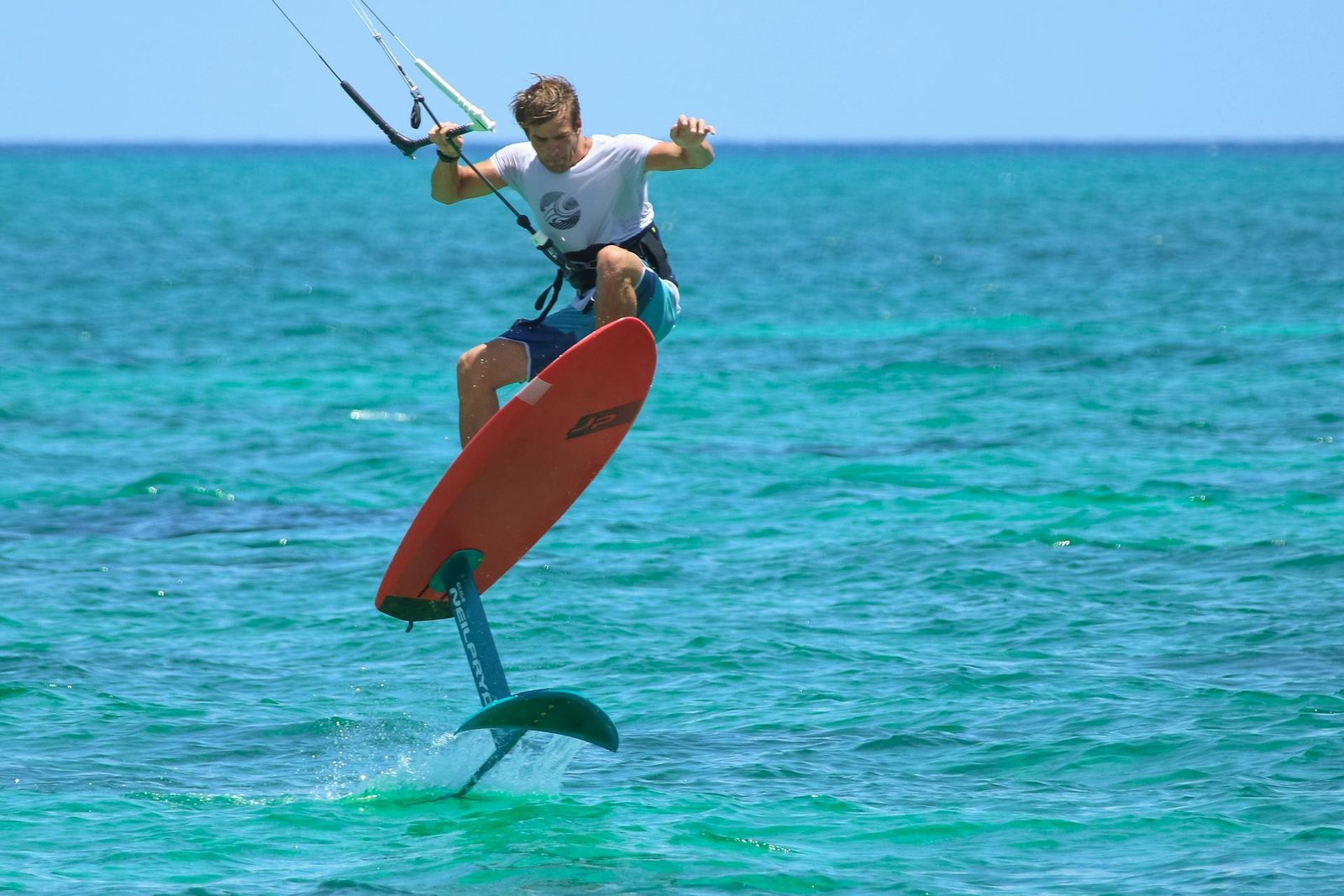
Day 7 is the gateway-to-future-progression day. After 6 days of twin-tip work, most students can ride well enough to start trying a kite-foil — a hydrofoil mounted under a small board that lifts the rider above the water at 8-10 kt of board speed. We use a beginner-friendly foil setup: 65 cm mast (short by foil standards, much more forgiving on falls), low-aspect front wing, larger surface board (110 cm). Kite size drops by one — usually a 9 m from your Day-3 rig becomes a 12 m on foil because foils require less power.
The morning starts with 30 minutes of land theory on foil — what the wing does, how the mast height changes pitch, the foiling-up sensation. Then 90 minutes on the water in chest-deep flat lagoon. The first foiling attempts are short pop-ups of 1-2 seconds. A focused student gets to 5-10 seconds of clean foiling by lunch. Foil is harder to start than twin-tip, but easier to ride in light wind — which means once you can foil, the season expands from 4 hours/day to 8 hours/day. (For deeper progression beyond a day-7 intro, see our IKO Level 1-2-3 Cancún timeline.)
Afternoon: rest, repack, last sunset on the lagoon. Most camps end with a beach dinner at one of the small palapas on the peninsula. Departure typically the morning of Day 8.
7-day camp at a glance
| Day | Focus | Water hours | Kite size (75 kg) | Location | Skill check |
|---|---|---|---|---|---|
| 1 | Land theory, trainer kite | 0 | Trainer 2-3 m | Isla Blanca beach | Trainer figure-8 |
| 2 | Body-drag, safety drills | 3-4 | 7 m | Isla Blanca lagoon | Safety release reflex |
| 3 | First waterstarts | 3-4 | 9 m | Isla Blanca lagoon | 10 sec ride both sides |
| 4 | Extending rides, relaunch | 4-5 | 9 m | Isla Blanca lagoon | 50-100 m rides + relaunch |
| 5 | Downwinder km 12-5 | 4-5 | 9 m | Isla Blanca peninsula | Partial upwind one side |
| 6 | Wave-kite Playa Delfines | 1.5 | 9 m | Playa Delfines Hotel Zone | Ride open chop 200 m |
| 7 | Foil intro | 1.5-2 | 12 m + 65 cm foil | Isla Blanca lagoon | 5-10 sec clean foil |
Total instructor-supervised water time: 17-23 hours over 7 days. Matches the IKO Level 1-2 standard plus Level 3 introduction.
Rest-day and weather-day plan
A 7-day camp in April-June typically has one no-wind day. The forecast stack — Windguru, Windy, NDBC buoy 42056, the earth.nullschool.net synoptic view — usually flags the no-wind day 48 h in advance. Plan accordingly. The best Cancún rest-day plays:
- Isla Contoy day trip — boat from Puerto Juárez to the CONANP Isla Contoy national park, 4 hours of snorkel plus lunch on the beach. Best no-wind / blue-sky plan.
- Cenote diving from Cancún — 90 min drive south to the Riviera Maya cenote belt, dive Dos Ojos or Chac Mool. Standalone day, separate booking.
- Sup paddle Nichupté at sunrise — covered in our sunrise SUP guide, ideal active-rest morning.
- Isla Mujeres ferry + beach — 20 minute ferry from Puerto Juárez, lunch at Playa Norte, return same day. Beach-day plan for tired-but-not-injured days.
The point of the rest-day plan is to absorb a forced day off without it feeling like a wasted day. Most successful 7-day camps build at least one rest-day into the plan deliberately on Day 4 or Day 6 — going hard for 7 days straight tends to produce a Day 6 collapse rather than a Day 7 breakthrough.
Logistics — gear, accommodation, transfers
- Accommodation: Cancún city centre or Puerto Juárez. Cuts the daily Isla Blanca commute to 25-30 min vs 60 min from the Hotel Zone. Budget options $40-80 USD/night, mid-range $90-150, kite-house dorm $20-30.
- Gear: camps include kite (typically Naish, Cabrinha, Duotone or Ozone), bar, board, harness, helmet, impact vest. If you own a kite and want to bring it, schools typically deduct $80-120 USD off the package. Bring sunglasses with retainer strap, reef-safe sunscreen, water shoes for stingray-shuffle protection, and your own harness if you have one — chafing on a rental harness is common after 3 days.
- Transfers: daily van to and from Isla Blanca included in school packages. Self-driving works but the Punta Sam road parking can be informal — easier to use the school van.
- Insurance: a kite-specific travel insurance is sensible. The cheapest acceptable option covers helicopter evacuation for the rare offshore drift incident — read our best month wind data for risk timing.
- Certifications: ask for an IKO Level 1 + Level 2 card at end of camp. Costs $40-60 USD added to the package; the card is recognized worldwide and means lower hassle renting at your next destination.
Frequently asked questions
Can I really go from zero to riding in 7 days?
Yes, with the qualifier "riding" meaning "doing 100-200 m rides downwind in both directions in safe flat-water." Going upwind reliably typically needs 9-12 days. The 7-day camp gets you to a point where you can rent gear and continue self-progression, which is the actual gating skill. Students who already have windsurf or wing-foil experience compress this further to 4-5 days.
What if my partner doesn't want to kite?
Cancún is one of the better non-kiter partner cities in the kite world. The Hotel Zone has full beach resort infrastructure; Isla Mujeres, Cozumel and the Riviera Maya are day-trip distance; the cenote belt is a 90 min drive. Non-kiting partners typically build their own plan around 3-4 morning solo kite sessions per week, with shared afternoons.
Best month for a 7-day Cancún camp?
May is the consensus answer. April-June gives the highest probability of teachable wind (85-95% per the Windguru long-run dataset), the water is already warm at 27-28°C, and the crowd density at Isla Blanca is below peak-summer. July-August are also good but the afternoon heat is intense. November-February work but Nortes add gust variability that is harder to teach in. Full month-by-month breakdown in our best month for kitesurf Cancún guide.
How much does a 7-day camp cost?
Operator pricing as of 2026 runs roughly $1,200-1,800 USD per person for the school-only package (instructor, gear, transfers, IKO card). Add accommodation $300-900 USD for budget-to-mid-range. Add food $200-400 USD for the week. Total trip cost typically lands $1,800-3,500 USD per person all-in, depending on accommodation tier.
What if the wind doesn't come for 3+ days?
Statistically rare on a May camp — the Windguru long-run data shows two-day no-wind windows happen roughly 15% of weeks, three-day windows roughly 4% of weeks. When it does happen, schools typically extend instruction by adding a make-up day, and the rest-day plan above turns the down-days into productive activity. Most schools also offer a partial refund if no riding day is feasible in 7 days, though we have not seen that scenario in 5+ years at Isla Blanca.
Can I add a Holbox or El Cuyo day-trip into the 7 days?
Holbox yes if you stretch to 8-9 days, El Cuyo not really inside a 7-day frame. We cover the multi-spot logic in our four-spot Cancún kite guide. For a first-time camp, stick with the Isla Blanca-focus plan — adding a road trip pulls instruction time and most beginners cannot afford the loss.
Lock in your 7-day camp
Plan your 7-day Cancún kite camp
Tell us your level, dates and partner setup — we build the full week including instructor, gear, transfers and rest-day plan.