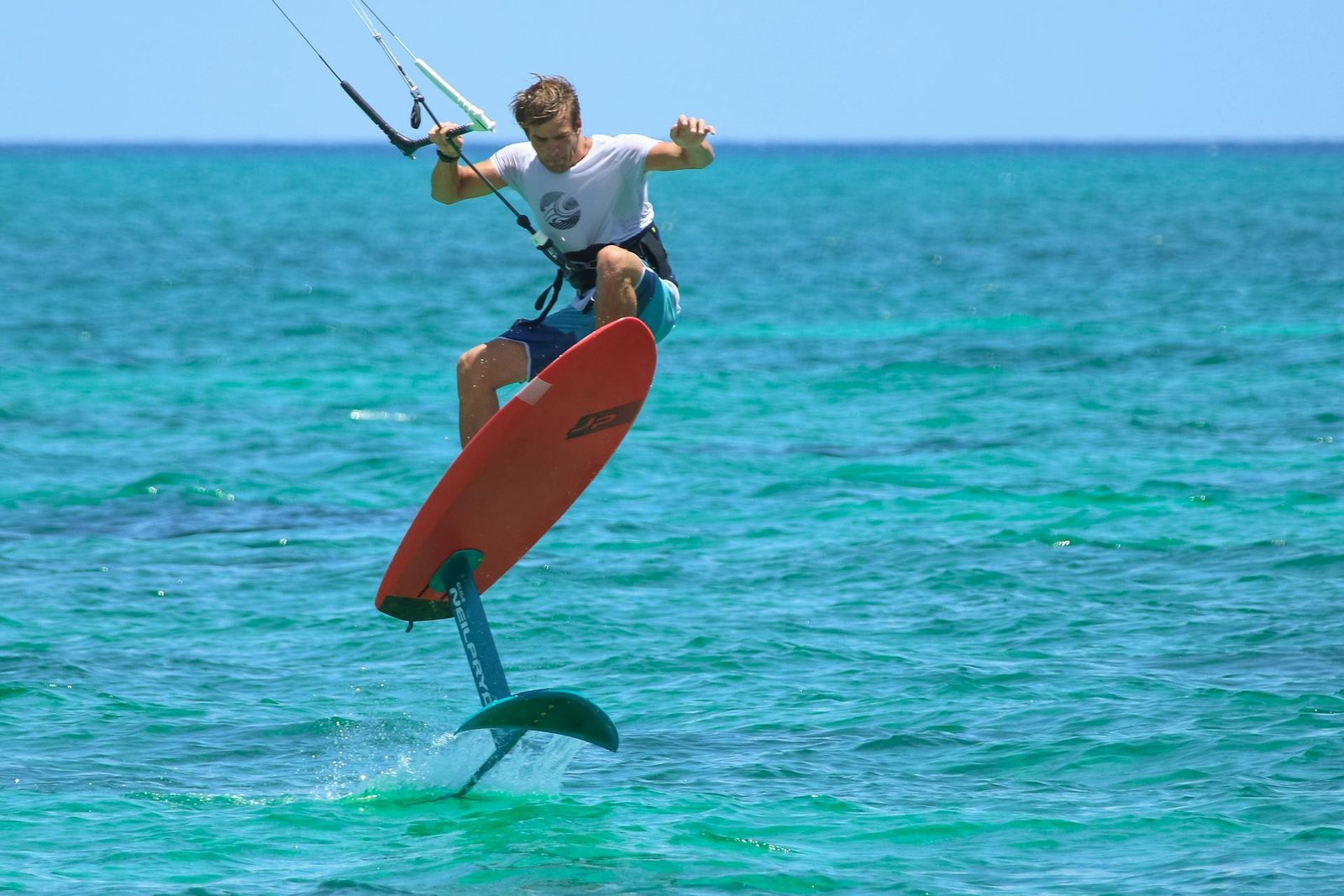
🔎 TL;DR
- Self-rescue is the single most important non-riding skill in kitesurf. The IKO Level 2 protocol — depower → wind the bar → swim the kite as a sail or pack-down — is the difference between a 20-minute solo recovery and a panicked call to a panga driver who may be 40 minutes away.
- Self-launching at Isla Blanca lagoon is normal practice on light-wind early-season days when the school strip is empty. Done wrong it produces 80% of the broken-arm incidents we see each season. Done right it adds 30 minutes of session time per day.
- Three equipment failures cause 90% of in-water incidents: depower line breaks (kite stays full-power, unsteerable), bar jams (chicken-loop refuses to release), and bridle/Y-line tangle (kite spins on the surface, can lift you on a relaunch). Each has a specific recovery — drilled on land, executed cold on water.
- Hard rules for when not to fly: sustained offshore wind without rescue cover, gusts spiking >35 kt on the Windguru forecast, any thunderstorm or cumulonimbus build-up within 30 km on radar, lightning within 50 km, sargassum mats covering the launch corridor. Each one is a hard stop, not a discussion.
- Cross-referenced against IKO instructor protocols, NOAA NWS marine forecasts, the NDBC buoy 42056 realtime feed and Windy ECMWF gust models. Conservative practice in Cancún means stopping a session 10 minutes early — not riding until something breaks.
- Companion reading: our four-spot Cancún kite guide, the IKO Level 1-2-3 Cancún timeline, and the best-month wind data analysis.
Why kitesurf safety is its own discipline (not a sub-chapter of riding)
Kitesurf is the only board sport in which the propulsion source — a 9 to 14 square-metre traction kite anchored to your harness by a 22-metre line set — can independently decide to lift, drag, or rag-doll the rider with no warning. Surfboard, SUP, windsurf, wing-foil: each has its own risks but none of them includes "the gear actively tries to take you somewhere you did not ask to go." That single fact is why the international training agencies — IKO, VDWS, BKSA — spend roughly half of each certification level on rescue and equipment-failure protocols and only the other half on riding technique. It is also why the Cancún kite community treats self-rescue and self-launch as the two skills you must own before you start counting transitions or jumps in your logbook.
The Cancún region presents a specific safety geometry. Isla Blanca lagoon — covered in detail in our Isla Blanca beginner guide — is shallow enough that a downed kite in the inshore zone is mostly inconvenient rather than dangerous. The Caribbean side of the peninsula, Playa Delfines and El Cuyo are different stories: open water, real swell, rip current potential, and a rescue infrastructure that is far thinner than what European or Brazilian riders are used to. The Quintana Roo state lifeguard service is excellent on the Hotel Zone bathing beaches but does not patrol the Isla Blanca or El Cuyo kite corridors. Rescue, in the practical sense, is what you can do yourself plus the panga driver your school knows by name.
This article walks the three pillars of solo kitesurf safety in Cancún: the IKO-style self-rescue protocol drilled step by step, light-wind self-launch mechanics (and when to refuse to self-launch), and the small set of equipment failures that account for most in-water incidents. We close on the hard "do not fly" rules. Read this before booking your first lesson, and re-read it the morning of every session on which the forecast looks marginal.
Self-rescue — the IKO step-by-step you must own before Level 2
Self-rescue is the procedure for getting yourself, your kite, your bar and your board back to the beach without outside assistance after the wind dies, your kite drops, or you slack-line yourself into trouble. Every IKO-certified rider passes a self-rescue drill before they receive a Level 2 card. The protocol below is the canonical version we teach at Isla Blanca; it is also what every reputable school in the world teaches with minor wording differences. The point of writing it out is that you should be able to recite it without thinking — because when you actually need it, you will be tired, salty, possibly cold, and 600 m offshore.
Step 1 — Stop, breathe, depower
The instant something goes wrong, push the bar away from you. That depowers the kite. If the kite is still flying, fly it to the neutral 12 o'clock position and park it there. Take three slow breaths. Locate the safety release on your chicken-loop and confirm it is reachable. If you cannot recover from this state, fire the safety: yank the red safety release outward. The kite flags out on a single line, drops to the water, and you are now in a recoverable, low-power state.
Step 2 — Recover your bar and lines
You are now connected to the kite by your safety line, with the bar floating loose. Swim or kick toward the bar. Recover it. Then start winding the front lines onto the bar — one full pass around the bar, then around the bar floats — until you are within 5 m of the kite. As you wind, keep the bar oriented so the lines stay parallel and untangled. A tangled bar is a 20-minute land-side job; do not let one form on the water.
Step 3 — Make a sail of the kite
With the lines fully wound, you are at the kite. Now reach across the kite's leading edge to the leech (the trailing edge). Grab the wing tip closest to you. Lift it slightly out of the water and let the wind catch the inside of the kite. The kite acts as a sail, with you holding it from underneath, and pulls you downwind toward the beach at roughly walking pace. This is the standard mode for a wind-died-too-far-from-beach situation. It works in 5 knots of wind. The kite as sail will get you home faster than swimming with the kite stowed.
Step 4 — Pack-down if conditions deteriorate
If wind disappears entirely, sail-mode no longer works. Roll the kite inward from the wingtip you are holding, deflate the central strut if your kite has a one-pump dump valve and you can reach it, and tuck the rolled kite under your harness or hold it across your chest. Recover the bar onto your harness with a buddy clip or carabiner. Now swim — slow front crawl or breast-stroke, board between your knees — toward the nearest shore. This is the slowest mode but it is the only mode that works in zero wind.
Step 5 — Reaching shore
Land any way you can. Stand the kite as soon as you can touch bottom. Walk it up the beach by the leading-edge handle if it still has air; drag it on the sand if it has folded. Recover your board (always last priority). Take a minute to check yourself for cuts, line burns, or hyperthermia. If you used the safety release, your chicken-loop pin will need to be reset before the next session — most riders reset on the beach.
The above is a clean dry-land description. In the water you will be tired and salt-stung after step 1. Drill the full sequence on the beach a minimum of three times before your first solo session. Practice the safety-release pull until it is a reflex.
Self-launch — when to use it and the four-step protocol
Self-launching is the procedure for getting your kite into the air without a second person to hold and release it. At Isla Blanca it is normal practice for experienced riders on quiet light-wind mornings — the school strip empties out around 11 am once the trade fills in, and arriving at 9 am with a 12 m kite and no one to help becomes a routine problem. Done correctly, it adds 30 to 45 minutes of usable session time and means you do not need to wait for the school crowd. Done incorrectly, it produces the single largest category of broken-arm and dislocated-shoulder injuries in the sport. The threshold for "should I self-launch" is honest skill at relaunching, comfort with one-handed kite control in 15+ knots, and a beach long enough to abort.
The technique below is the standard "lazy-launch" or "self-launch sandbag" method that all major schools teach. There is also a "sand-anchor" variant where you stake the kite with a screwdriver-shaped sand peg through the bridle pulley — same physics, more gear. Both are valid. We will document the lazy-launch.
- Layout the kite in a horseshoe. Place the kite on the sand leading-edge down, with the trailing edge upwind and the wingtips opening toward you. Both wingtips should be touching the sand, anchored by a small pile of sand on each tip. The kite forms a "C" opening downwind, with the body of the kite pointing upwind. Verify the lines are clean, the bar is downwind of the kite, the chicken-loop is connected, and the safety system is armed.
- Walk the upwind wingtip closer. With the bar in your downwind hand, walk to the upwind wingtip. Lift it slightly out of the sand and let it catch wind. The kite rotates and now rests on the downwind wingtip alone, with the leading edge starting to rise. This is the "9 o'clock" position from the rider's perspective if you face the kite.
- Walk slowly backwards toward the bar. As you walk, the kite stays rotated on its downwind wingtip; you should not pull the bar yet. Keep tension on the front lines minimal. The kite should be edge-up, leading edge into wind, balancing on the downwind wingtip.
- Pull both front lines gently to launch. When you reach the bar, pick it up with both hands and pull both front lines symmetrically — no steering input. The kite walks up the wind window edge to 12 o'clock. Park it there, breathe, then begin the session.
Three things that cause injuries: (1) launching with a kite oversized for the wind, which lifts before you reach the bar — never self-launch a kite bigger than your normal-wind size; (2) launching in gusty wind where a sudden gust ramps the kite from a 9 o'clock anchor into a 12 o'clock power zone with you tethered to a still-sand-anchored wingtip — never self-launch in gust-spike forecast; (3) attempting to self-launch in onshore wind, where any failure pushes you and the kite back onto the beach, often into people — self-launching is a side-shore-to-side-onshore technique only, never directly onshore. Isla Blanca lagoon is side-onshore on trades, which is why the technique works there. Playa Delfines is onshore and you should never self-launch there.
Light wind below ~8 knots is the only condition under which self-launching is straightforward — the kite has no muscle, and a single sand-pile on each wingtip holds it. Above 18 knots, the protocol is unforgiving — small errors get magnified. Above 25 knots, self-launching solo is generally not a sensible activity; find a partner.
Drill self-rescue and self-launch under live IKO instructor supervision before you ride alone. Book Cancún kitesurf lessons →
Equipment failures — the three you must rehearse
Across thousands of session-hours we have observed three recurring failures that account for roughly 90% of in-water "I can't ride home" events. None of them is exotic; all three are mechanical failures of components that are stressed every session. Each one has a specific recovery, and each recovery should be rehearsed on the beach before you need it for real.
Failure 1 — Depower line break
The depower line is the central main line that runs through the chicken-loop and along the depower strap of the bar. It transmits the "push to depower, pull to power" input. When it breaks (uncommon but it happens with old gear, especially on 4-line kites where the depower line is under constant load), the kite stays at whatever depower setting it had when the line snapped — typically fully powered. The bar input still steers the kite, but you can no longer reduce power. Recovery: fire the safety release immediately. The kite flags out on the safety line, drops to the water, and you proceed with self-rescue. Do not try to ride home with a broken depower line — one gust spike and you are out of control. Inspect depower lines every 30 sessions; replace them every season for moderate use.
Failure 2 — Bar / chicken-loop jam
The chicken-loop release pin is the mechanical click-out you trigger to fire the safety. On rare occasions — sand jam, salt corrosion, dropped-and-bent pin — the pin refuses to release. You yank the safety lever and nothing happens. Recovery: the kite stays fully powered, you stay attached. The IKO secondary release is the leash-loop on the rear of the harness, which detaches the entire kite from your harness, leaving the bar attached but the kite hot-launching downwind on the leash alone. Pull that secondary release. The kite flags off completely; the bar swings loose; you are detached. This is the worst-case scenario release. Drill it on the beach with the kite parked at 12 o'clock so your hand finds the leash-loop reflexively. Inspect and rinse the chicken-loop pin after every session — fresh-water flush prevents most jams.
Failure 3 — Bridle or Y-line tangle
The bridle is the short network of lines on the kite's leading edge that connects the front lines to the kite itself. After a hard crash, especially in chop, the bridle can wrap a wingtip or knot itself around a pulley. The visual symptom is a kite that crabs sideways on relaunch, spins in place, or refuses to leave the water. Recovery: do not attempt to power up the kite. Self-rescue immediately — wind in the bar, swim to the kite, untangle the bridle by hand at the kite, then either relaunch from the water (advanced) or sail-mode the kite back to the beach (standard). Most bridle tangles are obvious once you reach the kite and resolve in 60 seconds of hand-work. A pulley jam is harder — sometimes you have to manually re-thread the line through the pulley. Carry a small line-knife for the edge case where a knot is fused too tight to untangle on the water; cut the bridle, sail-mode home, replace the bridle on the beach.
The general principle behind all three: when something feels wrong, depower the kite first, then assess. Riding through a suspected failure to "see what happens" is how single-failure events become double-failure events.
When not to fly — the hard rules
The decisions you make on the beach before launching are the most consequential decisions in the session. There is a deep cultural pressure in kitesurf to "rig and see" — the wind tower is up, your friends are launching, the WhatsApp group is loud. Resist it on marginal forecasts. The rules below are not gentle suggestions; they are the rules that experienced Cancún riders enforce on themselves and on visitors who book a lesson.
- Sustained offshore wind without rescue cover — do not fly. Offshore wind blows you out to sea. At Isla Blanca the trade is side-onshore on the lagoon; offshore would be a westerly, rare. At Playa Delfines a westerly (storm pattern) is unrideable. If you are at a spot where the only wind direction available is offshore and no chase-boat is on the water, the session is cancelled.
- Gust spread above 35 knots on hourly forecast — do not fly. The metric we use is the Windguru hourly gust column versus mean wind column. A mean of 18 with a gust of 22 is fine. A mean of 18 with a gust of 35 means you are riding the gust, not the mean — that is a broken kite or a broken rider on a hard pull. We hard-stop above 35 kt gusts.
- Thunderstorm or cumulonimbus within 30 km on radar — do not fly. Lightning kills kiters. The NOAA NWS lightning detection and the radar imagery on Windy.com let you see frontal cells well in advance. If a CB is building within 30 km, you have 30–60 minutes before downdraft gusts arrive. Stop riding and de-rig.
- Lightning detected within 50 km — clear the water immediately. Wet kitesurf lines plus a long flexible mast attached to your harness make you the tallest conductor in a 100 m radius. The IKO rule is a 30-minute waiting period after the last detected strike before resuming.
- Sargassum mats covering the launch corridor — do not fly. A downed kite in a sargassum mat is much harder to recover than a downed kite in clean water. Sargassum also fouls foils. The CONANP and SEMAR sargassum monitoring publishes weekly forecasts; check the day-of.
- You feel rushed or distracted — do not fly. The single biggest predictor of an incident is rider mental state. Tired, hungry, hungover, fighting with a partner, in a hurry to get back for a flight — the gear punishes inattention. Skip the session.
Failure-to-recovery quick reference
| Scenario | First action | Then | Get home by |
|---|---|---|---|
| Wind dies, kite still on lines | Park kite at 12, breathe | Wind in bar, self-rescue | Sail-mode or swim |
| Kite crashed, will not relaunch | Wind in bar, swim to kite | Untangle bridle, sail-mode | Sail-mode |
| Depower line snapped | Fire chicken-loop safety | Self-rescue from flagged state | Sail-mode |
| Chicken-loop pin jammed | Fire secondary leash release | Recover separated bar | Swim board only |
| Lightning building near | Drop kite to water | Self-rescue and exit ASAP | Sail-mode or swim |
| Caught in rip current (Caribbean side) | Keep kite up if possible, ride 90° to current | If kite drops, swim parallel to shore | Lateral exit then in |
| Sargassum mat trap | Sail-mode through | Hand-clear lines on beach | Sail-mode slowly |
Drilled on the beach until it is reflex. Real-world Cancún rescues — the ones we see on the radio every season — are 80% riders who skipped the drill and froze, and 20% genuine gear failures that resolved with a calm protocol.
Forecast tools and the morning-of checklist
Self-rescue and equipment-failure protocols are downstream of the morning decision: should I rig today and at what kite size. The forecast stack we use for Cancún sessions, in this order:
- Windguru Cancún — hourly mean wind, gust, direction, wave. The base layer.
- Windy.com — ECMWF + GFS comparison, plus the radar layer for CB monitoring. Cross-check Windguru against ECMWF; if the two disagree by more than 4 kt, rig conservatively.
- NOAA NDBC buoy 42056 — real-time wind from the Yucatán Basin, 30 min latency. The truth check on what the models predicted.
- earth.nullschool.net — synoptic visualisation, especially useful 24–48 h before a Norte frontal passage to confirm rotation direction.
- NOAA NWS Caribbean marine forecast — text advisory for swell, lightning probability, frontal arrival timing.
- CONANP protected area rules and sargassum monitoring — relevant for Isla Blanca, Holbox, El Cuyo launches near reserves.
The morning-of checklist takes 5 minutes: pull mean/gust/direction from Windguru and Windy, confirm buoy 42056 is in the same ballpark, scan radar for CB, check sargassum, decide on kite size, drill safety release once on the harness before you walk to the water. Done.
Frequently asked questions
How often should I drill self-rescue?
Run a full dry-land drill before every Cancún trip — five minutes on the beach with the kite laid out. Run a full in-water drill once per season, in waist-deep clean lagoon water with a buddy on the beach. The skill decays without practice; instructors at IKO-certified schools redrill self-rescue with every Level 1+ student on day one of any refresh course.
Can I self-launch a kite I rented at Isla Blanca?
Most operators on the Isla Blanca strip will discourage self-launch with rental gear, mainly because rental kites bear the brunt of bad self-launches. If you are an experienced rider self-launching is generally tolerated on light-wind quiet mornings. If you are mid-progression — IKO Level 2 or below — book launch-help from the school and stop self-launching until you have your Level 3 card.
What kite size should I rig for Isla Blanca in April–June?
For a 75 kg rider, a 9 m is the default in 18–22 kt trades, with a 7 m for hard-gust afternoons above 24 kt and a 12 m for the morning lulls before the trade fills. Riders under 65 kg drop one size; over 85 kg add one. Beginner sessions typically use 7 m trainer kites for body-drag work and 9–11 m for water-start sessions.
Is there a rescue boat at Isla Blanca?
Each major school keeps a chase-panga on call during teaching hours, with a 15–25 minute response time to anywhere on the lagoon. Solo riders outside a school are essentially self-rescue only. The Quintana Roo lifeguard service patrols the Hotel Zone beaches but not the Isla Blanca peninsula. Plan accordingly — file a "back by" time with someone on the beach before launching.
When should I cut my own bridle?
Rarely. The standard answer is "almost never." If a bridle line has knotted itself around a pulley and you have spent 5+ minutes on the water trying to untangle, and you are drifting offshore in deteriorating wind, then a clean cut on a single bridle line can let the kite re-tension on the remaining bridles and become sail-mode-capable. Carry a small fixed-blade line knife on your harness. Replace the cut bridle line on the beach before the next session — do not ride home and back out on a half-bridled kite.
How do offshore vs onshore winds change my decisions?
Onshore is the safest for beginners — any failure blows you back to the beach. Side-shore is the technical optimum — you ride parallel to the beach, can return easily, and the wind across the launch corridor is clean. Offshore is dangerous and is the only direction we treat as a hard stop without rescue cover. On Norte days at Isla Blanca, the wind rotates from E (side-onshore) to NNW (side-shore from the north) — this is fine. A true westerly is rare and means a storm pattern; reschedule.
Train safety with an IKO crew
Add a safety-drill morning to your Cancún kite trip
Tell us your level — we book a dedicated self-launch + self-rescue session before you ride solo.