🔎 TL;DR
- This isn't "warm Mexico vs cold Mexico" — it's two completely different oceans with different physics, fauna and trip logic.
- Cancún (Caribbean): Mesoamerican Reef diving, warm (26–29 °C year-round), coral diversity, turtles, whale sharks Jun–Sep. No wetsuit. Mesoamerican reef health data is the relevant baseline.
- Los Cabos (Sea of Cortez): nutrient-rich gulf, cooler (21–29 °C across the year), sea lions year-round, mobula aggregations, whale sharks Oct–Apr at La Paz, gray + humpback whales Dec–Apr. 3 mm wetsuit Dec–Apr.
- Cost is roughly comparable for a small-group day. Cancún tours $70–110 USD; Cabo tours $90–140 USD; megafauna day-trips (whale shark, mobula, gray whale) $180–250.
- For families with young kids, Cancún wins on water comfort. For wildlife variety and a "wow" boat day, Cabo wins on biomass density.
Two oceans, not one country
The single most common mistake travellers make when planning Mexican snorkeling is thinking of it as a single offering. "Should I snorkel in Cancún or Cabo?" is the kind of question that sounds like comparing two flavours of the same thing. It is not. Cancún sits on the Caribbean Sea, on the western edge of the Atlantic Ocean. Los Cabos sits on the Sea of Cortez, a marginal sea of the Pacific Ocean. The two bodies of water are separated by a continent. They have different temperatures, different currents, different geology, and completely different marine fauna.
The Caribbean off Quintana Roo is the southern end of the Mesoamerican Barrier Reef — the second longest reef in the world after the Great Barrier Reef. It runs from the tip of the Yucatán down through Belize and into Honduras. Water is warm year-round (26–29 °C), visibility is high (often 20–30 m), the reef is hard coral with a community structure that is essentially tropical Atlantic. Fauna includes parrotfish, surgeonfish, snapper, grunts, queen angelfish, French angelfish, hawksbill and green turtles, southern stingrays, nurse sharks. You get this in Cancún, Cozumel, Playa del Carmen, Tulum, Akumal. We cover it in detail in our Cancún snorkeling guide.
The Sea of Cortez is a completely different beast. Geologically it's a young rift basin formed by the Baja California peninsula tearing away from mainland Mexico over the past 5 million years. It is fed by cold Pacific upwellings carrying enormous amounts of plankton, which feeds an extraordinary biomass pyramid — UNESCO-listed for biodiversity, called the "aquarium of the world" by Cousteau. Fauna includes Pacific reef species (Cortez angelfish, king angelfish, panamic green moray), plus a megafauna roster the Caribbean simply doesn't have: California sea lions, mobula rays in mass aggregation, humpback whales, gray whales, whale sharks (different season than Caribbean), occasional orca. The reef structure is rocky / coraline rather than the classic Caribbean hard-coral fringing reef.
So the right question isn't "which is better" — it's "which lessons do I want this trip to teach me about the ocean".
Side-by-side comparison
The table below is built from NOAA sea-surface temperature data, CONANP protected-area documentation, Healthy Reefs Initiative Mesoamerican reef report cards, and operational data from partner operators on both coasts.
| Dimension | Cancún / Caribbean | Los Cabos / Sea of Cortez |
|---|---|---|
| Ocean | Atlantic / Caribbean Sea | Pacific / Gulf of California |
| Water temp (winter) | 26–27 °C | 21–22 °C |
| Water temp (summer) | 28–30 °C | 27–29 °C |
| Wetsuit needed? | Rarely (rash guard only) | 3 mm shorty Dec–Apr |
| Visibility (typical) | 20–30 m | 10–25 m |
| Reef type | Mesoamerican hard coral | Rocky / coraline + sandy |
| Signature sites | MUSA, Manchones, El Meco | Chileno, Santa María, Pelican Rock |
| Sea turtles | Year-round, Akumal famous | Seasonal Aug–Oct, Chileno |
| Sea lions | No (none in Caribbean) | Year-round, Land's End |
| Whale sharks | Jun–Sep, Isla Mujeres | Oct–Apr, La Paz |
| Whales | None reliable | Gray + humpback Dec–Apr |
| Mobula rays | Rare | Mass aggregation Apr–Jul |
| Avg tour cost | $70–110 USD | $90–140 USD |
| Kid-friendliness | High (warm + calm) | Moderate (cool winter) |
| Travel logistics | Easy, all-inclusive friendly | Easy from Cabo, La Paz day-trips |
Once you've picked the coast — book the right boat. Book Los Cabos snorkeling →
What Cancún snorkeling actually feels like
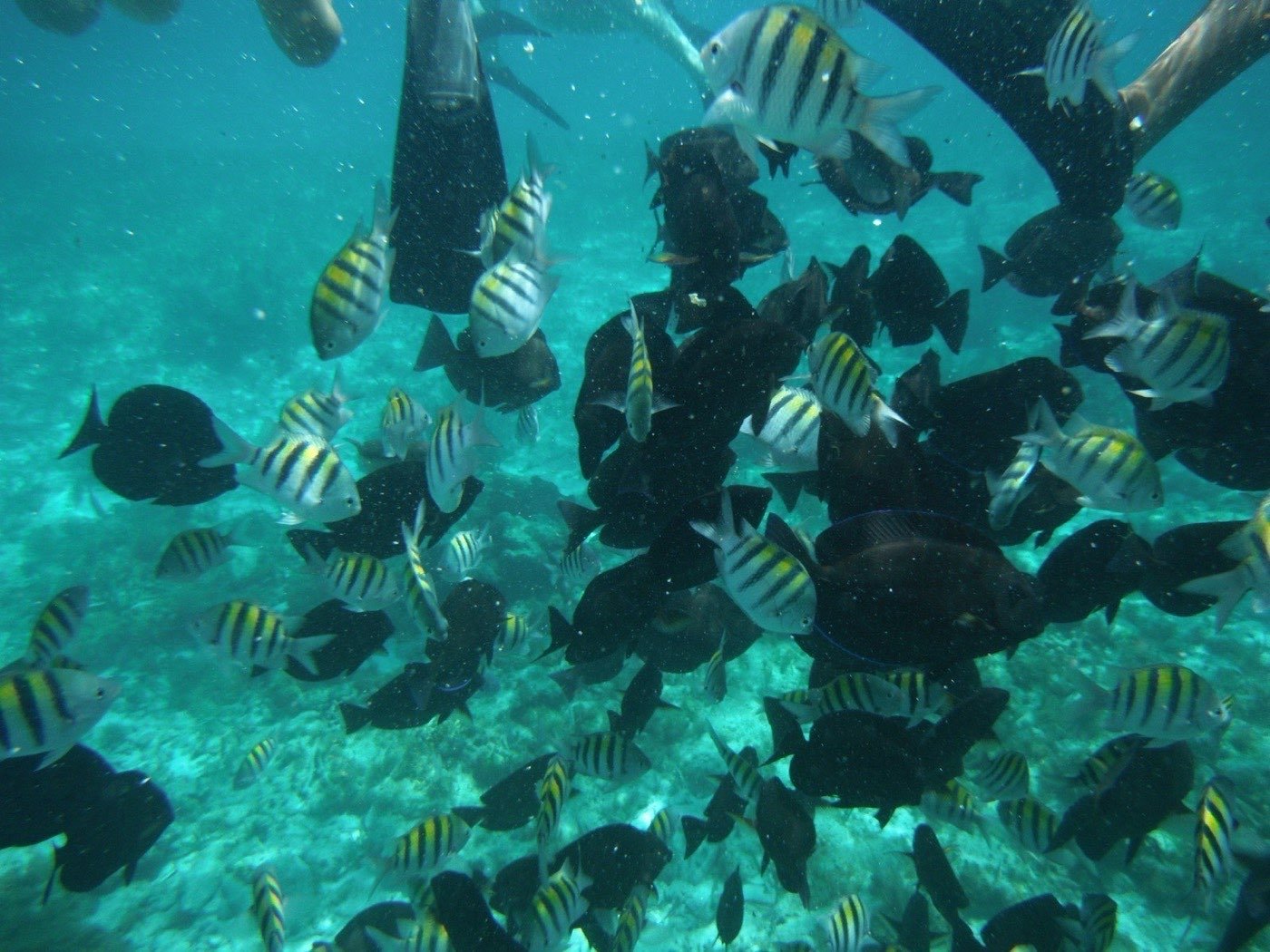
You wake up in a Hotel Zone hotel, walk five minutes to the marina, board a small-group boat at 9 am, and you're at MUSA (Museo Subacuático de Arte) by 9:45. You're in the water in a rash guard and board shorts — no wetsuit needed in any month. The visibility is high enough that you can see the bottom from the surface in 6–8 m of water. Below you are submerged sculptures with hard coral growing on them; around you are blue chromis, sergeant majors, queen angelfish, parrotfish, an occasional southern stingray on the sand.
You move on to Manchones reef — shallow, calm, the famous Cancún "turtle reef". One in two snorkels here you see a hawksbill or green turtle grazing. Lunch on Isla Mujeres, second snorkel at El Meco, back at the marina by 3 pm. Total cost $80–110 USD with a small-group operator (avoid the cattle boats — see our Cancún guide for the red/green flag breakdown).
The Caribbean experience is what most people imagine when they think "snorkeling in Mexico". It is warm, clear, gentle, and the marine life is the postcard-tropical kind. The Mesoamerican Reef has been hit by coral bleaching post-2023 heat events and by Stony Coral Tissue Loss Disease (the Healthy Reefs Initiative 2024 report card documents the impact), but the snorkeling is still very good and the operators do go to less-impacted sites.
What Cabo snorkeling actually feels like
You wake up in Cabo San Lucas, drive 15 minutes to Chileno Bay, walk onto the beach by 9 am. The water is colder than you expected — 23 °C in March feels chilly when you're used to 28 °C Caribbean. You wear a 3 mm shorty. The entry is sand; you're floating in 1–4 m of water within 30 seconds. Below you the reef is rocky, with encrusting hard coral and the fish are coloured differently from the Caribbean — the king angelfish is electric yellow with vertical bars, the Cortez angelfish has a different palette than its Caribbean cousin. The schools are denser than you expect.
Lunch on the beach, second site by boat — Santa María Bay, then a sea-lion encounter at Land's End in the afternoon. The sea-lion encounter is the moment most people remember from their Cabo trip; a juvenile spirals around your mask blowing bubbles, mothers and pups doze on the rocks, the bull patrols the perimeter. Back at the marina by 4 pm. Total cost $100–140 USD for the day.
If you're in Cabo from Nov–Feb, you'd add a separate day trip to La Paz for the whale shark encounter — a 2-hour drive each way, $200–250 USD, swim with juvenile whale sharks in 22 °C water. From Dec–Apr, you'd add another day for gray whales at Magdalena Bay. The trips stack.
The Cabo experience is different from the Caribbean in a way that's hard to describe until you've done both. The fish are smaller on average but there are more of them. The reef is less colourful but the megafauna is dramatically more abundant. The water is less inviting in winter but the visibility is often better. It feels like a wilder, less tame ocean.
Why Cabo is colder than Cancún (the physics in one paragraph)
Cancún sits on the western edge of the warm-water Caribbean current system. The Caribbean Sea is bordered by South America and the Antilles, and it has limited cold-water input — the result is a stable warm pool that ranges 26–30 °C across the year. Los Cabos sits on the Pacific side of Mexico, at the mouth of the Sea of Cortez. The Sea of Cortez is fed by the southward-flowing California Current, which brings cold water from the North Pacific, and by upwellings of even colder water along the canyon walls of Cabo. The result is a much wider seasonal temperature range — 21 °C in February, 29 °C in August — and a vastly higher nutrient load in the water. The nutrient load is what feeds the megafauna; the cold winter water is the price you pay for it. NOAA's ocean explorer pages have the basic oceanography if you want to dig in.
Cost reality — what you pay on each coast
The pricing structures are roughly comparable but slightly different in shape:
- Cancún half-day group snorkel (MUSA + Manchones, small-group operator): $70–95 USD per adult, $50–70 for kids 6–12. Two stops, gear included, lunch sometimes. Cattle-boat versions sell for $35–50 but you get what you pay for.
- Cabo half-day group snorkel (Pelican Rock + Lover's Beach + Chileno OR Santa María): $90–140 USD per adult, $70–100 for kids. Slightly higher than Cancún because operating costs in Cabo are higher and the marine park has stricter permit caps.
- Megafauna single-day trips:
- Whale shark Cancún (Isla Mujeres / Holbox): $180–250 USD, Jun–Sep only.
- Whale shark La Paz (from Cabo): $180–250 USD, Oct–Apr.
- Gray whale Magdalena Bay (from Cabo): $220–300 USD, Dec–Apr.
- Mobula aggregation (from Cabo): $150–220 USD, Apr–Jul.
- Private boat charter: $600–1,200 USD/day on either coast for 4–10 people.
For the same logic applied to diving on both coasts, see Los Cabos vs Cancún — Which Trip.
Honest recommendation by traveller type
First-time snorkel, with kids under 8
Cancún wins. Warmer water means no wetsuit hassle, gentler current, kids can stay in the water for two hours without getting cold. MUSA is a uniquely visual first-snorkel experience. Manchones gives a high probability of seeing a turtle.
Snorkel + wildlife, looking for the "wow"
Cabo wins. Sea lions alone justify it, but the seasonal mobula and whale shark stacking is a level of marine-life density the Caribbean doesn't match. Bring a 3 mm shorty in winter and you're fine.
Honeymoon, romantic boat day
Either works. Cancún for the warm-water swim-up-bar all-inclusive style; Cabo for the dramatic geology, sunset cruise after the snorkel, and the cape's sea-lions. We'd lean Cabo for couples with a snorkel-curious-but-not-obsessed partner because the day variety is higher.
Multi-stop Mexico trip
Do both. 4 days Cancún + 4 days Cabo gives you both oceans in one trip. The flight between is 4–5 hours direct. Most serious ocean travellers we work with do exactly this once and then pick a favourite coast for return trips.
Gear differences (the practical bit)
Cancún packing list
- UPF-50 rash guard (sun protection more than warmth)
- Board shorts or swimsuit
- Reef-safe sunscreen (mandatory in CONANP protected areas)
- Own mask if you have one
- Lifejacket for kids
- GoPro
Cabo packing list
- Everything from Cancún list, plus:
- 3 mm shorty wetsuit Dec–Apr (rentals available in Cabo for $15–20/day)
- Neoprene booties (optional but nice for the rocky entries)
- Layered top — Cabo mornings can be cool, especially at the marina at 7 am
- Reusable water bottle (Cabo boat trips are longer than Cancún ones on average)
Frequently asked questions
Which coast has better visibility?
On average, Cancún has slightly better visibility (20–30 m on the Caribbean reef) than Cabo (10–25 m on the Sea of Cortez). The reason is biology: the Sea of Cortez carries more plankton, which is what feeds the megafauna there, and plankton in the water reduces visibility. Cabo's best-visibility days (winter, calm wind, no recent swell) can hit 25 m at Santa María Bay, but Cancún hits 25 m+ as the routine baseline.
Is the Caribbean reef dying?
"Dying" overstates it; "under significant stress" is more accurate. The Mesoamerican Reef has been hit hard by warming-driven bleaching events (especially 2023–24) and by Stony Coral Tissue Loss Disease, documented annually by the Healthy Reefs Initiative. Many sites have lost 20–50% of live coral cover since 2015. Snorkeling is still excellent and reputable operators rotate to less-impacted reefs. The Sea of Cortez has had its own warming events but the reef structure there is less dependent on hard coral cover, so the visual impact is less stark.
Can I see whale sharks on both coasts?
Yes, but in different seasons. Cancún / Isla Mujeres has the Caribbean whale shark aggregation Jun–Sep; La Paz (accessible from Cabo) has the Pacific aggregation Oct–Apr. The species is the same (Rhincodon typus, listed Endangered on the IUCN Red List) but the populations are distinct and the season is opposite. If your dates are flexible, you can pick the coast based on when you can travel.
I get cold easily — should I just go to Cancún?
If you're snorkeling between May and November, no — Cabo water is 25–29 °C and a rash guard is enough. If you're snorkeling between December and April, yes — Cabo can be 21–22 °C and even with a 3 mm wetsuit some people find it uncomfortable. Cancún is 26–27 °C year-round and is the safer pick for cold-sensitive travellers in winter. We've had several clients who do Cabo summer + Cancún winter for exactly this reason.
Can I do both in one trip?
Yes, and it's one of our most-booked itineraries. Cancún → Cabo direct flights run 4–5 hours through Mexico City; you can split a 10-day trip as 4 days Cancún + 5 days Cabo (or vice versa) and see both oceans. The honest take after running this combo for clients for years: most travellers end up preferring one coast for their second visit, but doing both once is the only way to know which one is yours.
Want help picking which coast for your trip?
Tell us your dates, group, and what you most want to see — we'll give you the honest recommendation.