🔎 TL;DR
- Green sea turtles are present at Akumal year-round; nesting peaks May–October at X'cacel and Akumal.
- Spotted eagle rays show across the reef belt year-round, with bigger schools December–March.
- Juvenile whale sharks are rare on the Riviera reef line; the real season (June–September) happens off Isla Mujeres / Holbox, north of Cancún.
- Sargassum peaks June–August; offshore boat reefs (Puerto Morelos, Xpu-Ha) stay snorkelable on most heavy weeks.
- Best visibility window: March–May and October–November, when nortes have passed and sargassum is light.
- Sea temperature: 24–25 °C in January, 28–29 °C in August.
Why a calendar matters here
People book a Riviera Maya snorkel trip expecting a static, reliable experience: warm water, fish, maybe a turtle. The reality is that the reef changes month to month — different species show up, different ones leave, the water clarity swings 10 m between February and July, and the sargassum belt either rests offshore or carpets the beach depending on the wind.
According to NOAA's National Oceanic and Atmospheric Administration, the western Caribbean basin has well-documented seasonal patterns that drive what's possible at the reef each month. Sea-surface temperature, prevailing currents and storm cycles all shift on a predictable cadence. Add to that the biological calendars of resident species — turtles nest in summer, rays school in winter — and your "when to come" question gets specific.
This article gives you the honest month-by-month picture so you can match your trip dates to what you actually want to see.
Month-by-month snorkel calendar
| Month | Sea temp | Visibility | Sargassum | Turtles | Eagle rays | Whale shark* |
|---|---|---|---|---|---|---|
| January | 24–25 °C | 15–25 m | None | Resident (Akumal) | High — schools | — |
| February | 24–25 °C | 15–25 m | None | Resident | High — schools | — |
| March | 25–26 °C | 20–30 m | Trace | Resident | High | — |
| April | 26 °C | 20–30 m | Trace–light | Resident, pre-nesting | Medium | — |
| May | 26–27 °C | 15–25 m | Light–moderate | Nesting starts | Medium | Early reports (Cancún side) |
| June | 27–28 °C | 10–20 m | Moderate–heavy | Peak nesting | Lower | Season open |
| July | 28 °C | 10–20 m | Heavy | Peak nesting + hatching | Lower | Peak |
| August | 28–29 °C | 10–20 m | Heavy | Peak hatching | Lower | Peak |
| September | 28–29 °C | 10–20 m | Moderate | Hatching, late nests | Medium | Tail end |
| October | 27–28 °C | 15–25 m | Light | Late hatching | Medium | — |
| November | 26 °C | 20–30 m | None | Resident | High | — |
| December | 25–26 °C | 15–25 m | None | Resident | High — schools | — |
*Whale shark season runs north of Cancún (Isla Mujeres / Holbox), not on the Riviera Maya reef. The Riviera Maya reef tours do not include whale shark encounters — see the dedicated whale shark season guide.
Sea turtles — the year-round resident
The Riviera Maya hosts four of the seven world species of sea turtle. The State of the World's Sea Turtles report documents this coast as a globally significant nesting region. Reality check on what you actually see:
- Green turtle (Chelonia mydas) — the Akumal Bay residents. They graze seagrass and are visible year-round. Status: endangered (IUCN Red List).
- Loggerhead (Caretta caretta) — nests at X'cacel and Akumal, May–September. Less common in snorkel encounters. Status: vulnerable.
- Hawksbill (Eretmochelys imbricata) — reef-associated, occasional sightings off Puerto Morelos and Xpu-Ha. Critically endangered.
- Leatherback (Dermochelys coriacea) — rare nesting visitor. Vulnerable.
For snorkelers, the practical news is: Akumal greens are visible 12 months a year. Nesting season (May–October) does not change daytime snorkel sightings significantly — it changes beach access, with X'cacel partially closed and CONANP brigades patrolling at night.
Eagle rays and stingrays — the underrated winter show
The spotted eagle ray (Aetobatus narinari) is the unsung star of Riviera Maya winter snorkeling. From December through March, eagle rays form loose feeding aggregations along the reef belt — sometimes 5–15 individuals cruising the same stretch of sand channel. This isn't a guaranteed sighting from-shore, but on a Xpu-Ha or Puerto Morelos boat tour during the cool months, your odds are good.
Southern stingrays are around year-round, more visible on sandy bottoms — the channel between Akumal Bay's reef and seagrass beds is a reliable stingray neighborhood.
Time your trip to what you want to see. Book Riviera Maya reef snorkel →
The whale shark question — short answer, it's not here
This comes up every June. People plan a Riviera Maya trip hoping to combine reef snorkeling with the famous whale shark experience. The reality: the whale shark aggregation that draws tour boats from June through September is north of Cancún, off Isla Mujeres and Holbox, in deep offshore water — not on the Riviera Maya reef line.
If whale sharks are on your bucket list, you need a dedicated whale shark tour out of Cancún or Isla Mujeres. Two reads to plan: Whale shark season Cancún 2026 and Whale shark tour etiquette. The Riviera Maya reef snorkel is a different product entirely.
Sargassum — the honest seasonal picture
Sargassum (Sargassum natans and S. fluitans) is a free-floating pelagic seaweed that drifts in from the Sargasso Sea and the equatorial Atlantic. Since around 2014, recurring "Great Sargassum Belt" events have deposited heavy mats on Quintana Roo beaches between roughly May and October. NOAA's Ocean Service runs a sargassum monitoring system that tracks the belt in near real-time.
For snorkelers, the practical picture:
- Lagoons (Yal-ku): Fenced inlet, essentially unaffected.
- Offshore boat reefs (Puerto Morelos, Xpu-Ha): The reef itself is sargassum-free; you just have to push past floating mats getting in/out of the boat on the worst weeks.
- From-shore reef entries (Akumal, Tulum): Hit hardest. Some weeks the bay entry channel is choked.
Local operators monitor daily. On heavy weeks they relocate to whichever site is cleanest — often Puerto Morelos.
Resident reef species — what you see every visit
Beyond the seasonal headliners, the Mesoamerican Reef diving holds a deep cast of resident species that you'll find on basically every snorkel:
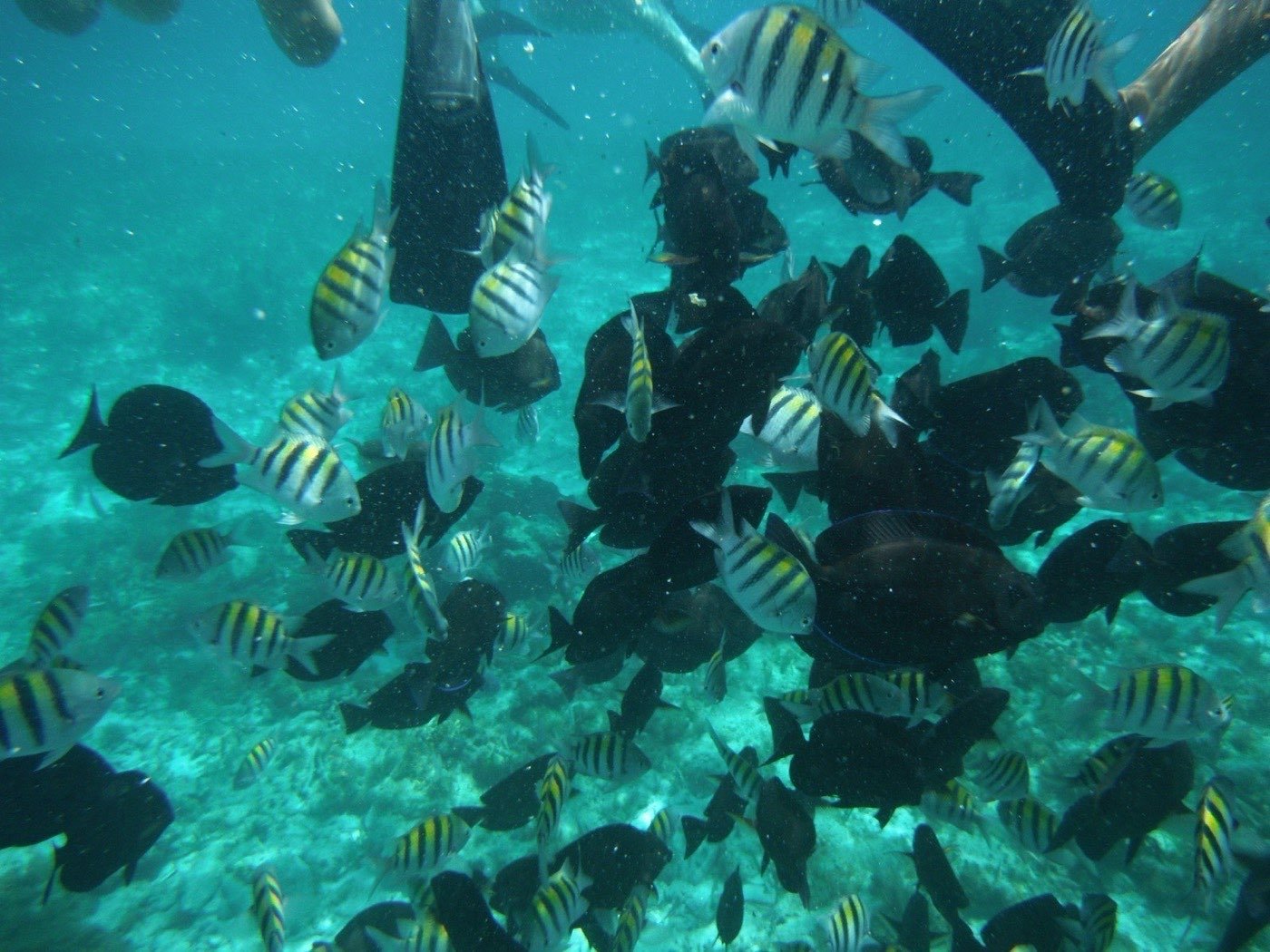
- Sergeant majors — the yellow-and-black striped fish that swarm snorkelers. Always present.
- Parrotfish — stoplight, rainbow, queen, princess. Multiple species at every site.
- Angelfish — queen, French, gray. Solitary or in pairs along reef walls.
- Blue tang — schooling, especially around Puerto Morelos.
- Spotted drum and high-hat — under ledges and overhangs.
- Barracuda — usually solo, often just sitting in mid-water.
- Nurse shark — uncommon but resident; X'cacel and Xpu-Ha are likeliest.
Best month for first-time snorkelers
If you can pick freely, late November through early April is the sweet spot. Reasons:
- Water clarity is at its highest (15–25 m typical, 25+ on calm mornings).
- No sargassum.
- Sea temperature still warm enough (24–26 °C) for unwetsuit snorkeling for most people.
- Eagle ray season overlaps.
- Akumal turtle viewing is as good as any other month.
- Hotel and tour pricing peaks during Christmas and Easter — book around those dates, or book early.
The trade-off: occasional nortes (northerly cold fronts) drop wind and chop for 2–3 days at a time November through February. Flexible itineraries handle this fine — boat days move; lagoons stay open.
Best month for "the most marine life"
If you want raw biodiversity in one trip — multiple species in one snorkel — aim for March or November. You get:
- Akumal greens still grazing.
- Tail end of eagle ray schools.
- Clear water (sargassum has not arrived in March; has left by November).
- Resident reef fish in full numbers (sergeant majors, parrotfish, angelfish).
- Lower tourist volume than December–February and June–August.
What's protected and where
All four flagship Riviera Maya snorkel sites sit inside federal protected areas administered by CONANP:
- Akumal Bay — Refugio de Pesca Bahía de Akumal (regulated since 2016).
- Yal-ku — Community-managed within the broader Akumal protected zone.
- Xpu-Ha and Tulum reef line — Parque Nacional Tulum / Arrecifes de Xcalak corridor.
- Puerto Morelos — Parque Nacional Arrecife de Puerto Morelos (1998).
The southern stretch of this coast is part of the Sian Ka'an UNESCO Biosphere Reserve — Mexico's largest coastal protected area and one of the more important seagrass / mangrove / reef complexes in the Mesoamerican system. Snorkel access inside Sian Ka'an itself is via permitted operators only.
Related guides on AquaCore
Frequently asked questions
What is the single best month to snorkel the Riviera Maya?
March. Clearest water of the year, no sargassum yet, eagle ray season overlaps, sea temperature comfortable at 25–26 °C, and tourist volume is lower than the December–February peak. November is the second-best month.
Can I see whale sharks while snorkeling the Riviera Maya reef?
No. Whale sharks aggregate off Isla Mujeres and Holbox from June through September — north of Cancún. The Riviera Maya reef snorkel is a separate product. If whale sharks are the goal, book a dedicated tour out of Cancún or Isla Mujeres.
When is turtle nesting season and does it affect snorkeling?
Nesting peaks May–October, with hatchings July–September. Daytime snorkeling at Akumal is unaffected — the resident greens are visible year-round. What changes is night beach access: X'cacel has partial closures and CONANP brigades patrol the nesting beaches at Akumal and Tulum from sunset to dawn.
How bad is sargassum, really?
Variable. Some weeks in June–August the beaches at Akumal and Tulum are heavily impacted; other weeks the wind shifts and they are clean. Lagoons (Yal-ku) and offshore boat sites (Puerto Morelos, Xpu-Ha) are largely insulated. Operators move trips to whichever site is cleanest — flexibility is the key.
What is the warmest water and is a wetsuit needed?
Sea temperature peaks at 28–29 °C in August. No wetsuit needed at any point in the year for most people. A rash guard or UPF shirt is recommended year-round for sun protection more than warmth. Cold-sensitive snorkelers may want a 1–2 mm shorty in January–February (24–25 °C).
Plan your reef trip around the calendar. See Riviera Maya snorkel tours →