🔎 TL;DR
- The Cancún wind belt serves three sports off the same lagoon: windsurf (classic, slowest learning curve to advanced), wingfoil (newest, fastest beginner curve, highest gear cost), kitesurf (highest top-end performance, biggest school ecosystem).
- Most existing comparisons stop at windsurf vs kite. This piece adds the third sport — wingfoil — which has grown from non-existent in 2019 to roughly 15% of Isla Blanca's beach population in 2026.
- Learn-to-stable-ride time: windsurf ~6–10 hours, wingfoil ~6–8 hours, kite ~8–14 hours (the kite-fly portion is the long tail).
- Gear cost (new, full quiver, 2026 USD): windsurf ~$4–5k, wingfoil ~$3.5–5k, kite ~$2.5–4k.
- For a one-week trip, our recommendation: try one of the three, not all three. Each has its own muscle memory and learning curve. The "three sports same wind" pitch is real for a year-long progression, not a seven-day vacation.
Why three sports, not two
For two decades, the question on any wind-sport beach was binary: windsurf or kitesurf. Then in 2019 the wing — a hand-held inflatable sail with no mast, no boom, no lines — became commercially viable. Combined with a hydrofoil board (the same kind of foil used by foiling sailboats and the America's Cup AC75 boats), wingfoiling became a third option that sits aerodynamically and ergonomically between the other two. It uses the same wind range as windsurf and kite, the same beaches, the same forecast tools — but a different muscle memory and a different progression curve.
At Isla Blanca specifically, you can stand on the southern launch on a 22 kn April afternoon and count windsurfs, kites and wings flying simultaneously over the lagoon. Five years ago you'd see one wing for every twenty kites. Today you'll see one wing for every five or six kites. The trend is real; the question for travellers is whether to add wingfoiling to your trip planning or treat it as a curiosity.
This article is the honest three-way comparison: cost, learning curve, gear logistics, what each sport feels like, and which one is right for you. For the older two-way comparison see our windsurf vs kitesurf learning curve guide, which still holds up but doesn't cover wings.
The three sports at a glance
| Dimension | Windsurf | Wingfoil | Kitesurf |
|---|---|---|---|
| Sail type | Rig + mast + boom, fixed to board | Hand-held wing, no lines | Tethered kite on 20–25 m lines |
| Beginner first ride | ~2–4 hours | ~3–5 hours | ~5–8 hours |
| Solid intermediate | ~25–40 hours | ~15–25 hours | ~20–30 hours |
| Wind range (planing) | 14–35 kn (size dependent) | 10–25 kn | 10–35 kn |
| Gear cost (new, full) | $4–5k | $3.5–5k | $2.5–4k |
| Travel kit weight | 40+ kg (oversize) | 15–20 kg (carry-on possible) | 20–25 kg (standard check-in) |
| Crash recovery | Easy (uphaul / waterstart) | Easy (wing floats, climb back) | Hard (relaunch wet kite) |
| School density in Cancún | Low (2–3 schools) | Growing (4–5 schools) | High (11+ schools) |
| Best wind in Cancún | 15–22 kn ENE trades | 10–18 kn (any direction) | 15–25 kn ENE trades |
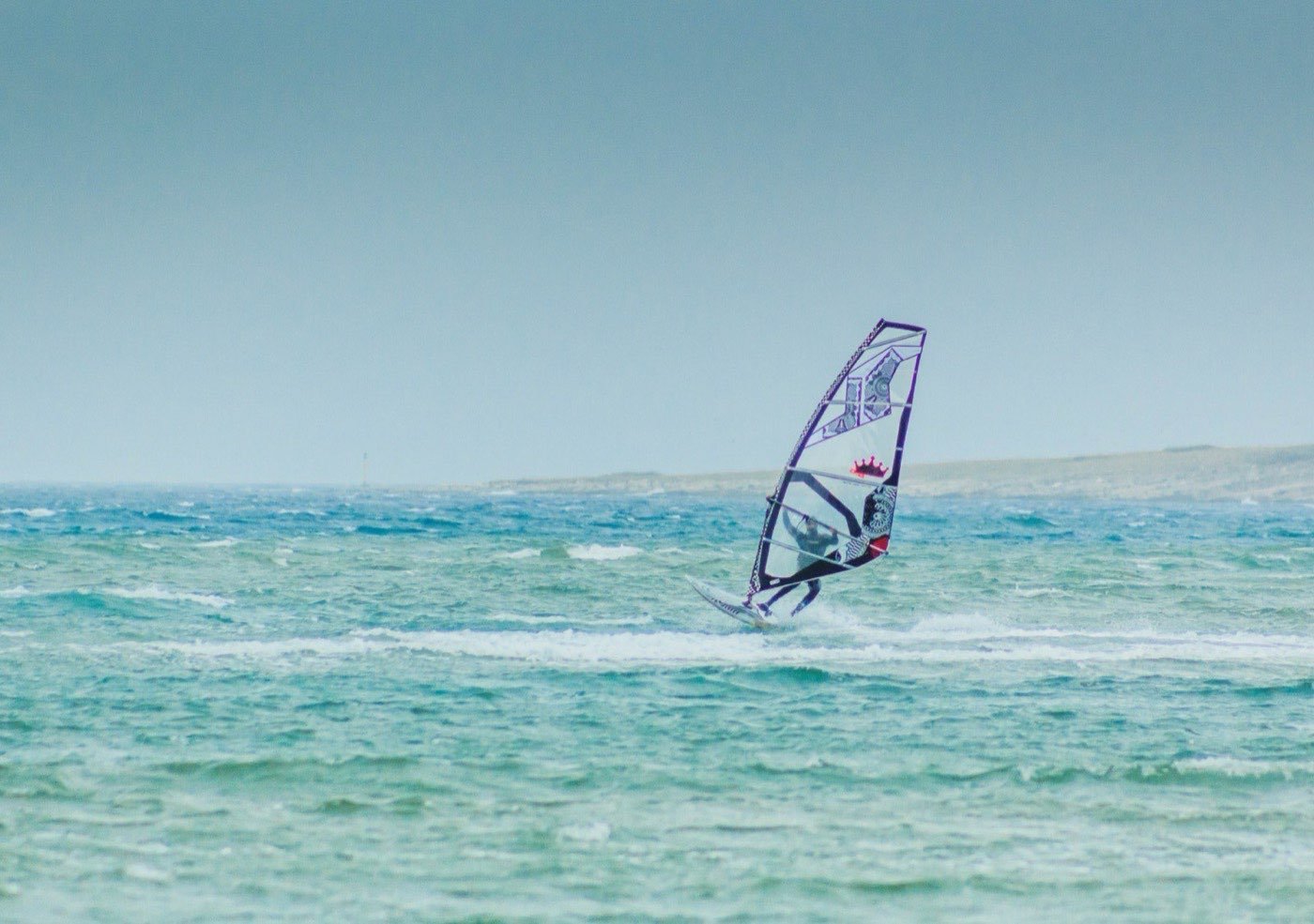
Windsurf — the classic, the longest learning curve to "advanced"
Windsurfing is the elder sport, invented in the late 1960s, peak popularity 1985–1995, then partly displaced by kitesurfing in the 2000s. It remains the most direct connection between wind and rider — you hold the boom of a sail attached by a flexible joint to a board, and the wind passes through that single rig directly to your hands and feet. There is no kite to fly, no line to manage, no foil to balance. Just sail, board, you.
What's good
- First ride is fast. Most learners are sailing in a straight line within 3–4 hours of instruction on a 150+ L beginner board with a 4–5 m² rig.
- Wind range is broad. With a quiver of 4–7 sails, you can sail in 12–35 kn comfortably. No other sport matches this range.
- Crash recovery is friendly. Fall, uphaul, go. No tangled lines, no wet kite to relaunch. In the Isla Blanca lagoon you stand up in waist-deep water.
- Tactile and intuitive. The connection from wind to board is direct. You feel everything.
What's hard
- Long road to "really good". Planing on the harness is around 25–40 hours. Carving jibes are 60+ hours. Forward loops are 100+. Compare this to kite, where similar tricks come faster because the kite does much of the work.
- Gear is the heaviest to travel with. A windsurf travel bag is 240+ cm long and 40+ kg. Airline oversize fees are real ($100–250 per flight each way).
- Rental options in Cancún are thinner than for kite — see our windsurf gear rental reality guide.
Wingfoil — the newest, the fastest curve to a foiling first ride
Wingfoiling combines two technologies that existed separately: the hand-held inflatable wing (a small inflated airfoil with handles), and the hydrofoil board (a board with a foil mast and wings that lift the board out of the water at speed). The wing is unconnected to the board — you hold it in your hands. The foil lifts you above the water surface, eliminating wave and chop drag. The combined effect is that you can ride in lighter wind than any other sport, with a quieter, almost frictionless glide once you're foiling.
What's good
- Foiling first ride is faster than learning to plane on a windsurf. Many learners are foiling in their first 6–8 hours of instruction, which compares favourably with the 25–40 hours to plane on a slalom windsurf.
- Lightest travel kit. The wing folds into a small bag (~5 kg), the foil board fits in a regular surf bag (~15–18 kg). You can travel as carry-on plus one checked bag.
- Lowest wind threshold for fun. A 5 m² wing and a 1500-cm² foil will lift a 75 kg rider at 10–11 kn. This means days that would be no-wind for windsurf or kite become foilable days.
- Crash is easy. The wing floats. You climb back on the board, grab the wing, restart. No kite-relaunch drama.
What's hard
- Foil-fall injury risk. The foil is a sharp underwater fin. Falling onto it cuts. Wear a helmet, impact vest and (some riders) shin guards.
- Top-end performance is lower. Wing top speeds (~25 kn) sit below windsurf slalom (~35 kn) and kite (~40 kn+). Wingfoiling is not a race-discipline replacement.
- Gear is expensive. A full wing + foil + board kit is $3.5–5k new. The foil itself ($1.5–2.5k) is the biggest line item.
- Smaller school ecosystem in Cancún, growing fast. 4–5 schools as of 2026.
Try the sport that fits your trip best. See Cancún windsurf →
Kitesurf — the highest top-end, the biggest ecosystem, the steepest entry
Kitesurfing reached commercial maturity in the early 2000s and is now the dominant wind-sport in tropical destinations. The kite is a large inflated wing flown on 20–25 m lines and controlled by a bar with depower system. It produces more power per square metre of wing area than any other rig, which means a single 9–11 m² kite covers a wider wind range than any single windsurf sail or wing.
What's good
- Highest performance ceiling. Top-end speed, biggest jumps (40 m+ kiteloops), longest hangtime. If you want airtime, kite is the sport.
- Best school ecosystem in Cancún. 11+ schools at Isla Blanca, IKO-certified instructors, group lessons available, social scene.
- Compact travel kit — three kites, a bar, a board fits in a regulation 158 cm bag.
- Broad wind range — different kite sizes (7 m² to 14 m²) cover 10–35 kn.
What's hard
- Long entry phase before first ride. 5–8 hours of kite-fly only (no board) before you can even attempt a body-drag, let alone a board-up. Compare this to windsurf where you're on the board hour 1.
- Higher consequence crashes. Tangled lines, deflated kite, downwind drift to mangroves. Self-rescue skills mandatory.
- Weather sensitive. Wind direction matters more for kite than windsurf — offshore wind kills a kite session more decisively than a windsurf session.
If kite ends up being your direction, the kitesurf Isla Blanca beginner guide covers the school ecosystem in detail.
Three-way decision tree — which sport for you?
Honest matching by trip profile:
- You have 7 days, you've never done a wind sport, you want fastest "I can ride". → Wingfoil. The 6–8 hour foiling first ride beats windsurf and kite. Caveat: gear rental availability and instructor density is lower than for kite.
- You have 7 days, you've never done a wind sport, you want most stable progression. → Windsurf. You'll be sailing across the lagoon by day 2, executing tacks and jibes by day 5. Plateaus exist but the first-week arc is satisfying.
- You have 7 days, you've never done a wind sport, you want the highest ceiling. → Kitesurf. Accept that days 1–2 are mostly kite-fly with no board. Day 3 onwards is when the magic happens.
- You already windsurf and want to add a sport. → Wingfoil. Your wind-reading translates directly. Skip the kite-fly hours; wing is closer to windsurf cognitively.
- You already kite and want to add a sport. → Wingfoil. The foil sensation is shared between kite-foil and wing-foil; you'll progress fast.
- You want top-end performance for a future competition path. → Kite (freestyle, big air, GKA tour) or windsurf slalom (PWA tour). Wingfoil race is growing but not yet a deep competition scene.
- You have a bad shoulder. → Wingfoil or kite. Windsurf uphauling stresses rotator cuffs; see our windsurf injury prevention guide.
- You have a bad back. → Kite (least back load) or wing (light wing weight). Windsurf rig is heavy on the low back during uphaul.
Cost over a 5-year horizon
Initial gear cost is one number; multi-year total-cost-of-ownership is the more honest metric.
- Windsurf: $4–5k initial (board + 3 sails + masts + booms). Gear lifespan ~7–10 years for boards, 3–5 for sails. Yearly maintenance: $100–200 in sail repairs, mast joints, fin replacement. 5-year TCO: ~$5–6k.
- Wingfoil: $3.5–5k initial (foil + board + 2 wings). Gear lifespan ~5–7 years for foils, 3–4 for wings (puncture risk on rocks). Yearly maintenance: $200–400. 5-year TCO: ~$4.5–6k.
- Kite: $2.5–4k initial (3 kites + bar + board). Gear lifespan ~3–4 years for kites (UV degrades canopy), 5–7 for boards. Yearly maintenance: $300–500 in kite repairs / bar service. 5-year TCO: ~$5–7k.
The "cheapest entry" sport is kite, but the ongoing kite lifecycle catches up after year 3. The cheapest TCO over 5 years is roughly equal across all three sports if you maintain gear.
Conditions cross-reference — which sport works which day in Cancún
Cross-referenced against iWindsurf daily reports, Windguru forecasts, the Windy model overlays and the synoptic earth.nullschool map:
- 10–14 kn ENE, summer thermal: wingfoil is the only sport that rides comfortably. Windsurf needs 7.0+ m² and a foil. Kite needs 12+ m² which most schools don't stock.
- 15–18 kn ENE, peak trade: all three sports work. Windsurf 5.5–6.5 m², wing 5 m², kite 9–10 m². This is the "everyone smiles" condition.
- 20–25 kn ENE, peak trade: windsurf and kite shine. Wing is at the top of its useful range (4 m² wing). The lagoon gets busy.
- 25–32 kn NE, winter Norte: kite (small 7–8 m²) and windsurf (4.0–4.5 m²) dominate. Wingfoil is risky — gusts overpower the wing.
- Variable / shifty winds: kite handles best because the kite's depower bar lets you spill gusts faster. Windsurf and wing struggle with rapidly shifting wind angles.
For more granular sea-state context (relevant if you sail the ocean side), the NOAA NDBC Yucatán buoys and the NOAA Caribbean SST data round out the picture. Local conservation rules under CONANP apply equally to all three sports — same dune respect, same no-fishing, same reef-safe sunscreen norms. The international racing class standards published under ISO sailing technical standards influence gear certification for all three sports.
Frequently asked questions
I have one week in Cancún. Should I try all three sports?
Honest answer: no. Each sport has its own muscle memory and a real learning curve in the first 5–8 hours. Splitting a week three ways means you finish the trip with three half-baked first-ride experiences instead of one solid foundation. Pick one based on our decision tree above, commit to it, and revisit the other two on a future trip.
Which sport is safest for a 50+ year old beginner?
Wingfoil and windsurf are both reasonable; kite is the harder choice. Windsurf has more shoulder load on the uphaul; wingfoil has the foil cut risk but a softer overall body load. For a 50+ rider in normal fitness with no shoulder injuries, windsurf on a 200 L beginner board in the Isla Blanca lagoon is the lowest-injury entry. With a prior shoulder issue, wingfoil with helmet and impact vest is the alternative.
Is wingfoil really faster to learn than windsurf?
To the "foiling first ride" milestone, yes — typically 6–8 hours vs 25–40 hours to plane on a windsurf. But "windsurf sailing across the lagoon at displacement speed" is faster than foiling (3 hours vs 6 hours). The comparison depends on which milestone you call success. If success is "sustained foil glide", wingfoil wins. If success is "I can sail back to the beach", windsurf wins.
Can I rent wingfoil gear in Cancún?
Yes, at 4–5 schools on Isla Blanca as of 2026, growing year on year. Inventory is thinner than for kite. Call ahead and confirm wing sizes (4 m² and 5 m² are the common rentals), foil size (1500–1900 cm² front wing) and board volume (75–100 L). Many schools that started kite-only now stock 2–4 wing setups; some are wing-specialised.
Which sport has the most Mexican professional-level competitors?
Kite has the deepest Mexican competition scene — multiple riders on the GKA World Tour, big-air contests at La Ventana, Los Barriles freestyle. Windsurf has a smaller but historic Mexican slalom/wave scene. Wingfoil competition is newer; first Mexican wing racing events were 2022–2023. If you're considering a long-term competitive path, kite has the most established federation support.
Help us match the right sport to your trip
Tell us your age, fitness, prior experience and dates — we recommend windsurf, wing or kite, and book the right school for your goals.