🔎 TL;DR
- Four days is the realistic minimum for a Cancún SUP yoga retreat that actually progresses you from "wobbling on a board" to "holding warrior II on a flat lagoon at sunrise." Less than four days is a sampler, not a retreat.
- Sunrise is non-negotiable. Cancún's easterly trade winds — modelled by Windguru at 10–15 knots most afternoons — turn the lagoon and the Caribbean coast into chop by 10 am. SUP yoga only works on glass water, and glass water in Cancún is a 6:00–8:30 am phenomenon.
- Hire a PYT-certified instructor (Paddle Yoga Teacher, the recognised SUP-yoga credential issued by US-based bodies aligned with American Canoe Association safety standards). Land-yoga teachers without SUP credentials are not a substitute — board balance is its own skill.
- Laguna Nichupté beats the Caribbean coast for daily practice. The lagoon is a literal mirror at sunrise; the Caribbean side is rarely glass for more than 30 minutes and the surf entry exhausts you before yoga starts.
- Accommodation: Punta Sam wellness boutiques (Mia Reef-style, Zoëtry) or a low-key Hotel Zone all-inclusive depending on whether you want quiet or amenities. Both work; pick by personality.
- Plant-based meals are easy in Cancún now — Yucatecan cuisine is naturally vegetable-heavy (chaya, tomatillo, hierba santa, jícama) and most wellness resorts run a parallel plant menu. We list five reliable downtown options below.
- The hard part is the board, not the yoga. If you can hold tree pose on land, you can hold it on a wide all-around board in 30 days of practice. The water is forgiving when you fall.
- Realistic budget for 4 days: USD $850–1,400 per person depending on accommodation tier, excluding flights.
Why sunrise glass is mandatory for SUP yoga in Cancún
SUP yoga only works on water that is genuinely flat — the kind of flat that lets you balance on one foot while you flow from chair pose to warrior III without the board pitching under you. In Cancún, that condition exists for a very specific weather window, and most visitors miss it because they treat SUP yoga as a midday beach activity. It is not. It is a pre-dawn discipline, and the difference between a 6:15 am session and a 9:30 am session is the difference between hitting the pose and falling in.
The reason is meteorological, not aesthetic. The Yucatán Peninsula sits in the tropical easterly belt — the same trade wind system that NOAA Ocean Service documents driving Caribbean circulation. At night the temperature differential between the warm Caribbean and the cooler interior land collapses, the easterly trades slow to under 5 knots, and the lagoon and inner-bay surfaces become genuinely glass. As the sun heats the peninsula's interior, thermal pressure rebuilds the breeze. By 9:30 am the wind is 8–10 knots; by 11 am it is 12–15 knots; by mid-afternoon it is 15–20 knots and you have to fight to stay upright on a board, never mind move into half-moon.
Sunrise times in Cancún vary across the year per the Servicio Meteorológico Nacional solar tables: roughly 6:15 am in June and 7:00 am in December, with civil twilight starting 20–25 minutes earlier. The practical "yoga window" is therefore 30 minutes before sunrise to about 8:30 am. Inside that window you have flat water, soft light, low UV index, and an empty lagoon. Outside it you have chop, glare, and four-stroke watercraft.
This is why every honest SUP yoga itinerary in Cancún starts at 5:30 am, not 9:00 am. If a wellness resort markets "10 am SUP yoga," they are either offering it in a swimming pool or they are about to disappoint a paying customer. Plan around the lagoon's actual physics.
Lagoon versus Caribbean coast — which water for which day
Cancún offers two completely different SUP environments inside a 12 km strip of land: the protected lagoon side (Laguna Nichupté) and the open Caribbean coast. They are not interchangeable. For a yoga retreat, you spend roughly 80% of your time on the lagoon and 20% on the Caribbean. Here is why.
The lagoon is a brackish enclosed body roughly 30 km² wrapped behind the Hotel Zone barrier island. It is shallow (1–3 m typical, 7 m in the central basin), it has zero ocean swell, and it is shielded from the easterly trade winds by the Hotel Zone itself. On a glass morning the surface is a literal mirror — you can photograph the reflection of mangroves on the water. This is the surface you want for any pose more complex than tabletop. The catch is that Nichupté is also the home range of Crocodylus moreletii, the Morelet's crocodile, listed by the IUCN Red List as Least Concern but locally protected. Crocodiles in Nichupté are real, they are mostly in the mangrove edges, and they are not interested in humans on boards. We cover the wildlife reality in detail in our Nichupté SUP wildlife and crocodile safety piece — read it before you sign up.
The Caribbean coast is the other side of the barrier island. It is genuinely open ocean — a 150 m beach gives way to a sand-bottom inner shelf, then to a reef line, then to the open Caribbean. On a calm dawn the inner shelf is paddleable; on most days it is not flat enough for yoga. The Caribbean has its own gifts (sunrise over the horizon, clear water, occasional rays passing under your board), and one Caribbean session in a four-day retreat is an experience worth having. But it is the dessert, not the main course. Build the retreat around Nichupté.
Hiring a PYT-certified instructor (and why this matters)
SUP yoga is a real credential, not a marketing label. The widely recognised certification is PYT (Paddle Yoga Teacher), typically a 25–40 hour course requiring both a registered yoga-teacher base credential (RYT 200+) and a SUP-instruction component aligned with the American Canoe Association standup paddleboard instructor framework. A PYT-certified teacher knows how to sequence poses for board stability (start with broad-base, build to one-leg, end with seated), how to anchor a class in a wind-protected line, and how to manage a rescue if a student falls in and the board drifts.
A land-yoga teacher without SUP credentials is not a substitute. The biomechanics are different — your base of support is not just smaller, it is also moving — and the safety considerations are different. Falls happen, boards pop up and hit faces, students panic in 1 m of water. A teacher who has only taught studio yoga is not equipped for any of that. We recommend asking three specific questions when you book: (1) Do you hold an RYT credential and where did you train? (2) Do you hold a SUP instructor certification — PYT, ACA, or equivalent? (3) Do you carry liability insurance covering water-based instruction? Any "yes / yes / yes" is acceptable. Anything else, walk away.
In Cancún, a PYT-certified private session runs USD $80–140 for 75 minutes (one teacher, up to 4 students). Group classes through wellness resorts run USD $40–60 per person per class. Multi-day retreat packages with the same teacher across 4 days run USD $400–650 per person. The teacher's transport is usually included only if the launch is in the Hotel Zone — Punta Sam and Costa Mujeres launches typically add USD $30–50 in transport.
Want us to pair you with a PYT-certified teacher on a glass morning? Book SUP yoga in Cancún →
Accommodation — Punta Sam wellness boutiques vs Hotel Zone luxury
Where you sleep matters because it dictates how early you get on the water. Two practical choices, depending on personality.
Punta Sam wellness boutiques. Punta Sam sits 6 km north of downtown Cancún and is the second car-ferry terminal to Isla Mujeres. The shoreline north of the ferry is a low-density wellness zone — Mia Reef Isla Mujeres (a short ferry hop), Zoëtry Paraiso de la Bonita, Excellence Playa Mujeres on the spectrum from boutique to all-inclusive. The water at Punta Sam is the calmest mainland Caribbean launch in the entire metro area (we cover it in our Cancún SUP hidden launches guide), and a 5:30 am wake-up gets you to the board by 5:45 am. Quiet, low-rise, almost no nightlife. Best for travellers who came to actually do a retreat.
Hotel Zone luxury. The classic Cancún experience — Le Blanc, Nizuc, Live Aqua, Ritz-Carlton. These resorts have direct lagoon access and most run their own SUP concession. You can walk from your suite to the lagoon in 5 minutes. The trade-off is noise (the Hotel Zone is built for tourism, not for sleep), price (typically USD $400–700 per night before peak), and the fact that you share the lagoon with a Hotel Zone full of people learning to paddle. For a retreat we prefer the south end of the Hotel Zone (km 16–22, around Nizuc and Punta Nizuc) over the busy central section (km 6–12).
A third option — and a strong one for budget-conscious retreats — is a downtown Cancún (El Centro) boutique like Hotel Krystal or one of the smaller Avenida Bonampak hotels at USD $80–150 per night, with daily transport to Punta Sam or to a Hotel Zone lagoon access point. You sacrifice the on-property concession but you keep the early-morning quiet and you save USD $200–400 per night.
Meal plan — plant-based with Yucatecan ingredients
Cancún's food scene has matured rapidly in the last five years and plant-based eating is now genuinely easy. The base layer is Yucatecan cuisine itself — heavy on local vegetables and herbs that pair well with a wellness mindset.
- Chaya — a leafy green native to the Yucatán, similar to spinach but with higher iron and protein content. UNESCO has documented chaya within the broader Maya food-heritage framework (see the UNESCO Intangible Cultural Heritage list for traditional Mexican cuisine, inscribed 2010). Cancún plant-based menus almost always feature a chaya smoothie or chaya tacos.
- Hierba santa — aromatic large leaf used to wrap steamed dishes. Pairs with grilled chayote and pumpkin-seed crumble.
- Jícama — crunchy root often shaved into salads with lime and chile piquín. Cooling, hydrating, ideal post-paddle.
- Pumpkin seeds (pepitas) — base of many Mayan sauces (sikil pak, papadzules). Plant-based protein source.
- Cacao — Maya domesticated cacao centuries before European contact. Several wellness resorts now offer cacao ceremonies before sunset.
For day-to-day eating we recommend a rhythm of: light pre-paddle (banana + dates + black coffee, 5:00 am), recovery breakfast post-paddle (chaya smoothie + avocado toast + papaya, 9:00 am), Yucatecan vegetable lunch (sikil pak with totopos, vegetable cochinita pibil with palm-heart, jícama salad, 1:00 pm), light dinner (grilled vegetables, agua fresca, no alcohol on retreat nights, 7:00 pm). The agua fresca tradition — fresh fruit blended with water, no sugar — is one of the easiest hydration habits to bring home.
Reliable plant-based or plant-friendly restaurants we send guests to: Greenmood Salads (Avenida Bonampak), Beewen Healthy Food (Hotel Zone), Habichuela Sunset (Hotel Zone — has a serious vegetable menu inside an otherwise traditional restaurant), La Habichuela Centro (downtown), and Casa Mission for Yucatecan vegetable dishes (Hotel Zone).
Day-by-day flow — poses progression across four mornings
This is the progression we recommend for an intermediate land-yoga practitioner who has never done SUP yoga. Adjust for absolute beginners by extending Day 1 to two sessions and pushing Day 4 to "static balance" rather than "inversion attempts."
Day 1 — board familiarisation and base poses
Launch: Laguna Nichupté south basin (lagoon-side Hotel Zone, km 18). Window: 5:45 am paddle out, 6:15 am yoga, 7:45 am paddle back.
Goal: Get comfortable on the board. The full session is about the feet, not about the poses.
Sequence: Seated breathwork (5 min). Tabletop. Cat-cow. Downward dog (the hardest one to hold first day — feet must be wide). Low lunge. Warrior II (both sides, holding for 5 breaths only). Standing forward fold. Mountain pose. Savasana (the easiest pose to nail on water — lying on your back, ocean and lagoon both rock you). Many students fall in once or twice during warrior II on Day 1. This is normal. The water is warm and 1.5 m deep.
Day 2 — building stability and standing flow
Launch: Same Nichupté south basin. Window: 5:30 am paddle, 6:00 am yoga, 7:45 am paddle back.
Goal: Build a standing sun salutation flow you can repeat without thinking.
Sequence: Warm-up flow (Day 1 sequence at half pace). Add: chair pose. Half-moon (one foot down, careful — many falls happen here). Tree pose (the indicator pose: if you can hold tree for 10 breaths on Day 2, you are ahead of the curve). Standing sun salutation: mountain → forward fold → halfway lift → high plank → cobra → downward dog → forward fold → mountain. Repeat 3 rounds slowly. Savasana.
Day 3 — Caribbean coast variation
Launch: Punta Sam mainland Caribbean side (calmer than Hotel Zone, see our hidden launches guide). Window: 5:45 am.
Goal: Experience open-water yoga and learn how to read swell.
Sequence: Same as Day 2 with two modifications. Start lying down to feel the swell rhythm. Hold each pose for 1 fewer breath (the board moves more, the muscles fatigue faster). Skip half-moon — too much falling risk on swell. Add: side plank on knees only (much harder on water than on land). Savasana with the sound of small waves under the board is the most memorable moment of most retreats.
Day 4 — inversion attempts and graduation
Launch: Back to Nichupté glass. Window: 5:30 am.
Goal: Attempt one inversion. Even one successful headstand attempt on water is a milestone.
Sequence: Full warm-up (Day 1 and 2 sequences combined). Reverse warrior. Triangle pose. Wide-legged forward fold. Then: prepare for inversion. Most students start with dolphin pose (forearm version of downward dog), then forearm stand attempt against the wind direction, board nose anchored to teacher's board. Expect 80% to land in the water. The 20% who hold for a breath remember it forever. Closing: long savasana with the sun fully up, lagoon turning from rose to teal, paddle back.
Itinerary at a glance
| Day | Launch | Window | Yoga focus | Afternoon |
|---|---|---|---|---|
| Day 1 | Nichupté south | 5:45–7:45 am | Board familiarisation, base poses, savasana | Rest, cenote (optional), Yucatecan lunch |
| Day 2 | Nichupté south | 5:30–7:45 am | Standing sun salutation, tree pose, half-moon | Cooking class (Yucatecan plant-based) |
| Day 3 | Punta Sam Caribbean | 5:45–8:00 am | Open-water variations, swell rhythm, side plank | Rest, beach walk, sunset cacao ceremony |
| Day 4 | Nichupté glass (or El Mirador if conditions) | 5:30–8:00 am | Inversions, full flow, long savasana | Closing circle, plant-based dinner, depart Day 5 |
Realistic fitness expectations — the board is the hard part
Here is the truth that most retreat marketing avoids. The yoga is not the difficult part of SUP yoga. If you have any consistent yoga practice — even six months of weekly studio classes — the poses themselves are well within your capacity. What is hard is the board.
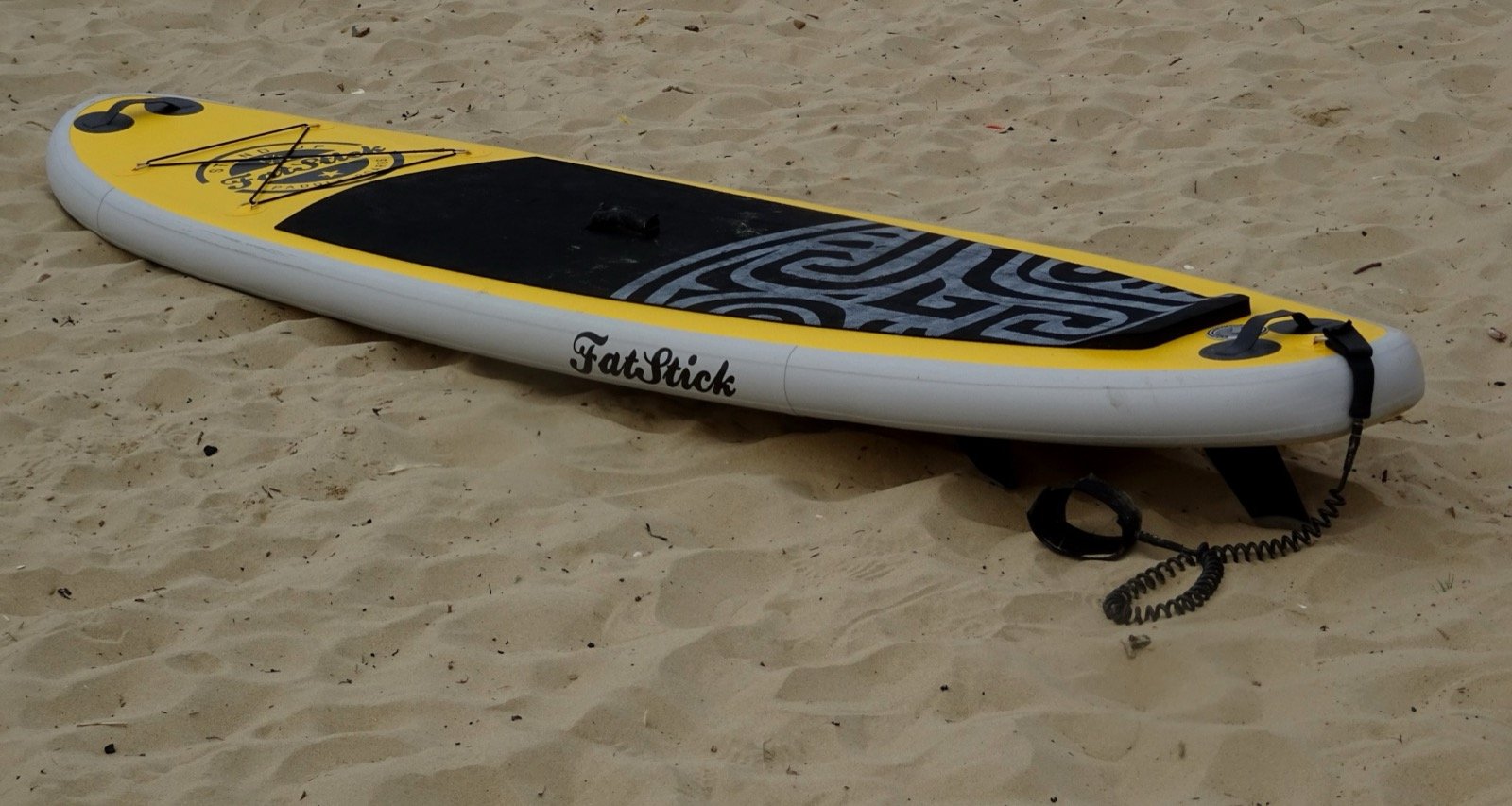
A standard SUP yoga board is wider than a touring board (32–34 inches wide instead of 28–30) and shorter (10'6" to 11'6") and has a flat deck pad designed for kneeling and standing. On a flat lagoon, this board is stable enough for most poses if your feet are wide and your weight is centred. The instant you narrow your stance — for warrior, for half-moon, for tree — the board becomes unstable and you must engage your core in a way that studio yoga rarely demands. Most students underestimate the core fatigue. By Day 2, abdominals and obliques will be sore in a way that surprises long-term yogis.
Two specific physical preparations help. First, single-leg balance training on land — three weeks of 60-second tree pose holds on each side, twice daily, makes a measurable difference. Second, paddle a board before the retreat — even one rental session at a local lake or bay establishes the proprioception you need. If neither is possible, accept that Day 1 will involve falling in repeatedly and that this is part of the curriculum.
One safety caveat. SUP yoga is not appropriate for absolute non-swimmers, for travellers with recent inner-ear surgery, or for people who panic in water. The lagoon is shallow (1–2 m where we practise) and the board is right there to grab, but falling in is part of the experience and you must be calm in water. PFDs are required by Mexican federal regulation per SEMAR — most retreats use coiled ankle leashes plus a deck-strapped Type III PFD.
Cost breakdown — what 4 days of SUP yoga actually costs
| Line item | Budget (USD) | Mid (USD) | Premium (USD) |
|---|---|---|---|
| Accommodation (4 nights, per person dbl occ) | $320 (downtown boutique) | $680 (Punta Sam wellness) | $1,800 (HZ luxury all-incl) |
| Board rental (4 sessions) or own board transport | $160 (4 × $40 rental) | $200 (4 × $50 rental incl. transport) | included |
| PYT instructor (4 sessions) | $200 (group classes) | $450 (semi-private, 2–3 students) | $650 (full private) |
| Meals (plant-based, 4 days) | $120 (mostly self-catered + casual) | $240 (mix of restaurant + resort) | included in all-incl |
| Local transport (taxis/Uber/transfers) | $50 | $80 | included |
| Extras (cenote day, cacao ceremony, cooking class) | $80 | $150 | $300 |
| Total per person, 4 days | ~$930 | ~$1,800 | ~$2,750+ |
These figures are 2026 reality based on direct operator quotes and resort published rates. Flights, travel insurance and pre-trip kit (board shorts, rash guard, reef-safe sunscreen, waterproof phone pouch) are extra. Group bookings of 6+ typically save 15–25% on the instructor and accommodation lines.
Wind, sargassum and seasonal fit
Not every month is equally good for a SUP yoga retreat in Cancún. The honest seasonal calendar — which we cover in long form in our Cancún SUP conditions month-by-month piece — breaks the year into three windows. December through April is the cool/dry season: lowest sargassum risk, mild morning temperatures (20–23 °C dawn), occasional north-wind ("norte") events that can blow out a single morning. May through October is the warm/wet season with peak sargassum risk (mats can wash ashore on east-facing beaches but rarely affect the lagoon side) and afternoon thunderstorm potential per NOAA NHC hurricane-season monitoring. September and October are the riskiest months for storm-related cancellations.
For a retreat, the sweet spots are February–March (cool, clear, almost no sargassum) and November (warm, calm, post-hurricane-season). Avoid Christmas/New Year (crowded and expensive) and avoid August/September (sargassum + storms). Sargassum forecasts are published weekly by SEMAR — check the week before your trip and have a Plan B (lagoon-only, no Caribbean day) if your dates fall in a heavy week.
Frequently asked questions
Do I need to be a yoga practitioner to do a SUP yoga retreat?
Helpful but not required. A six-month consistent practice — even a casual one — makes Day 1 substantially easier. Absolute beginners can do the retreat but should expect Day 1 to be 60% paddling-and-falling and only 40% yoga, and Day 4 to be where you finally feel like you can hold poses. We recommend three weeks of single-leg balance training on land before you arrive regardless of yoga level.
Can I do this if I am not a strong swimmer?
You must be a basic swimmer — able to tread water, calm in 1.5 m of water with no immediate footing. SUP yoga happens in shallow lagoon water with the board right there to grab, but falls are part of the experience and you must not panic. PFDs (Type III) are required by Mexican federal SEMAR regulations for all participants, and we use them on the board deck rather than worn during practice. Non-swimmers should pick a different retreat format (cenote yoga, beach yoga).
What is the best month for a SUP yoga retreat in Cancún?
February–March (cool, dry, low sargassum) and November (warm, calm, post-hurricane) are the two sweet spots. Avoid Christmas (crowded, expensive), avoid August–September (sargassum peak and hurricane risk). May–July is workable if you accept some sargassum on Caribbean-facing beaches; the lagoon is unaffected.
Are crocodiles a real concern in Nichupté at sunrise?
Real but very low. Morelet's crocodiles inhabit the mangrove edges of Nichupté and are listed as Least Concern on the IUCN Red List. They avoid open water and human activity, and there are no documented attacks on paddlers in the lagoon's recent history. We practise away from mangrove edges, in the open south basin, and we never launch students alone. Full safety detail is in our Nichupté wildlife guide.
Can I bring my own inflatable SUP for the retreat?
Yes, and many retreaters do. A wide all-around inflatable (32" wide+, 10'6"+) is ideal for SUP yoga. The teacher will still need to provide one yoga-specific deck-pad board if your inflatable does not have the right pad — most modern inflatables do. Bringing your own saves USD $150–200 in rental fees across 4 days and means you continue practising after you leave Cancún.
What should I pack specifically for SUP yoga?
Reef-safe mineral sunscreen (Mexican law restricts oxybenzone/octinoxate in protected areas — verify your sunscreen is compliant), rash guard with long sleeves for the cool dawn, board shorts that don't bunch, coiled SUP leash (most teachers provide), waterproof phone pouch if you want sunrise photos, a wide-brim hat for the after-session walk back. Skip the studio yoga mat — it does not work on a board.
How is this different from yoga at a regular wellness resort?
Two big differences. First, the venue is the water — the lagoon at 5:45 am is a sensory experience no studio can replicate. Second, the difficulty progression is real — you go from wobbling on Day 1 to attempting inversions on Day 4, which is a tangible skill arc most resort yoga programs cannot offer. The downside is the dawn schedule — if you cannot get up at 5:00 am for four mornings, this is not for you.
Plan your Cancún SUP yoga retreat
Tell us your dates, your yoga level and your accommodation preference — we build the 4-day itinerary, pair you with a PYT-certified teacher, and book the launches with the best glass forecast.