🔎 TL;DR
- SUP looks safer than kitesurf or scuba — and that perception kills people. The Caribbean off the Cancún Hotel Zone has tidal currents up to 1.5 kt, an offshore-running daytime sea-breeze of 10-20 kt, and reef-channel rip currents on the Riviera Maya side. A drifting SUP is a one-knot problem on the beach and a one-hour problem 800 m offshore.
- Three skills, drilled cold: prone-paddle rescue (lie on board, paddle with hands when wind beats you), board-leash use (coiled for flat water, straight for surf — never tangle on a fin), and the falling protocol (fall flat, away from the board, with your paddle behind you).
- Tides: the Caribbean is microtidal — typically 0.3-0.4 m range per NOAA Ocean Service tide stations near Cancún — but the diurnal cycle still moves water enough that an outflow at the Cancún inlet between the Hotel Zone and the open Caribbean can grab a board and pull it offshore. Read the tide before the session, not after.
- Currents at the Hotel Zone: a northbound longshore current sets along the Caribbean side most days, fed by the trade-wind drift. Speed varies 0.3-1.5 kt. The current is invisible from the beach. Test it by paddling 200 m offshore, stopping, and watching your relative position to a fixed landmark. If you drift, paddle in.
- Emergency comms: waterproof phone in a Pelican-style dry case, lanyard on your wrist; whistle on your PFD; one shore contact who knows your launch time and return time. Cellular coverage on the Hotel Zone Caribbean side is excellent. On Nichupté lagoon, signal degrades on the south end.
- Cross-referenced against American Canoe Association SUP safety standards, NOAA NWS Caribbean marine forecasts, Windguru hourly local wind, and CONANP protected-area rules where applicable. SUP self-rescue is closer to swift-water self-rescue than to ocean lifeguard rescue — own the drill before you launch alone.
Why SUP self-rescue is genuinely under-taught in Cancún
Walk into any Hotel Zone or Nichupté lagoon SUP rental concession and the safety briefing is roughly: "leash on your ankle, paddle goes blade-forward, life jacket optional." That is the briefing for a flat-water lagoon session inside a protected concession zone. It is not a briefing for an open-Caribbean session, and yet renters routinely paddle from Nichupté out through the lagoon mouth toward the Caribbean side, or rent at Playa Delfines, or launch from one of the hidden spots covered in our hidden launches guide. Once you are in open water, the assumptions change — and the rescue infrastructure thins out quickly. The Quintana Roo state lifeguard service patrols the bathing beaches; it does not chase a drifting SUP 800 m offshore.
The American Canoe Association, whose SUP instructor curriculum is the most widely used English-language standard, treats self-rescue as a separate competency rather than a sub-chapter of paddling technique. The four pillars they teach — falling, remounting, prone-paddle return, and emergency communication — are all skills that decay without drilling. Renters who learned to paddle on a calm Florida lake five years ago genuinely do not have the muscle memory for a Cancún Caribbean self-rescue. This article walks each pillar in the Cancún context, with the local current, tide and wind data that turns the generic ACA curriculum into a region-specific protocol.
One reframing before we start. SUP fatalities in the US (the only country that publishes structured data) are dominated by two scenarios per NOAA and US Coast Guard reports: (1) paddler swept offshore by wind or current with no PFD and no shore contact, and (2) paddler falls without a leash, cannot reach a wind-driven board, and drowns inside 200 m of shore. Both are leash and PFD problems. The fix is almost free.
Cancún Caribbean tides and longshore current
The Caribbean off Cancún is microtidal. NOAA Ocean Service tide-station data for nearby reference stations show a typical diurnal range of 0.3 to 0.4 m, with mixed semi-diurnal-diurnal character. In practical SUP terms, that means the water level changes maybe a hand-span over a 6-hour cycle. The tide itself does not push you around. What matters is the tidal-driven flow at the Cancún inlet — the narrow gap between the north end of the Hotel Zone barrier island and Punta Sam, through which the Nichupté lagoon exchanges water with the open Caribbean. During an outgoing tide, the inlet can flow 0.5-1.5 kt seaward; during an incoming tide, the reverse. A paddler who enters the inlet mid-tide without checking the flow direction can end up offshore in 15 minutes.
The dominant current along the Hotel Zone Caribbean beachfront is the northbound longshore drift, fed by the easterly trade winds documented in Windguru's Cancún station. Speed varies with wind strength — 0.3-0.5 kt on calm mornings, 1.0-1.5 kt on a 20-kt trade afternoon. The current is laterally invisible from the beach because it flows parallel to shore. Inexperienced paddlers underestimate it because they don't feel themselves drifting — until they look at the beach and realise the lifeguard tower they launched from is now 400 m behind them.
Test the current at the start of every session. Paddle 100-200 m offshore, stop paddling completely, set your stance, look at a fixed landmark on the beach (a hotel, a flag pole). After 30 seconds, see if your relative position has changed. If you have drifted noticeably north or south, the current is strong; plan to paddle home upcurrent before you are tired. The NOAA NWS Caribbean marine forecast publishes a daily current summary that is worth reading the morning of any open-water session.
The falling protocol — how to fall without losing the board
Most SUP injuries are not from drowning. They are from falling poorly onto your own board, your own paddle, or rocks. The American Canoe Association protocol is simple, drilled on the first lesson of every certification course:
- Fall flat, away from the board. When you feel yourself going, do not try to stay on — push off sideways with your feet. The goal is a horizontal back-flop onto the water surface, not a face-plant into the deck or a tangle with the board.
- Keep the paddle behind you. The paddle is the second-most-common injury source after the board. Lift the paddle behind your head as you fall — same way a windsurfer drops a sail safely. The shaft will not hit your face or chest.
- Surface quickly, locate the board. The leash will tell you where the board is. If you are wearing a coiled leash on your ankle, the board is within 3-4 m of you. Pull the leash hand-over-hand to bring the board to you. Do not chase a drifting board on a downwind day — it always wins.
- Remount. Standard remount: lie chest across the board, swim the legs to plane the board flat, pull yourself onto the deck on your stomach, then slide up to kneeling, then stand. Total move is 15-25 seconds with practice; in cold water it is faster. Practice remount in waist-deep clean water 10-20 times before your first open-water session.
Drill this on day one of any trip. Five remounts in chest-deep lagoon water before your first open-water paddle. The muscle memory matters because the open-water version happens with chop, wind, and possibly fatigue.
The prone-paddle rescue — when wind beats the standup
The single most useful self-rescue mode in Cancún is the prone-paddle return. You drop to your stomach on the board, the paddle stowed under your chest or tucked under a deck bungee, and you paddle with your hands — front-crawl arm motion alternating left and right. This is the technique that turns "I cannot stand up in this wind" into "I am going home, slowly but reliably."
The mechanics: lying prone reduces your wind-cross-section by ~90% compared to standing. A 20-kt headwind that makes standup-paddling impossible (you cannot make forward progress) becomes a 20-kt headwind that you can prone-paddle through at 0.5-1.0 kt of forward speed. That is enough to cover 400-800 m in 30 minutes, which is roughly the distance to shore from a typical Cancún SUP drift. The prone-paddle technique is taught in the ACA Level 1 SUP curriculum and is the same technique used by surfers paddling out through wind chop.
Drill prone-paddle return as part of your day-one practice. Twenty meters of prone-paddle in chest-deep water, with the board on a coiled leash, paddle stowed properly. Repeat both directions. The first time you try it in 20 kt of wind, you will be glad you drilled it.
The leash — coiled, straight, and when each one is wrong
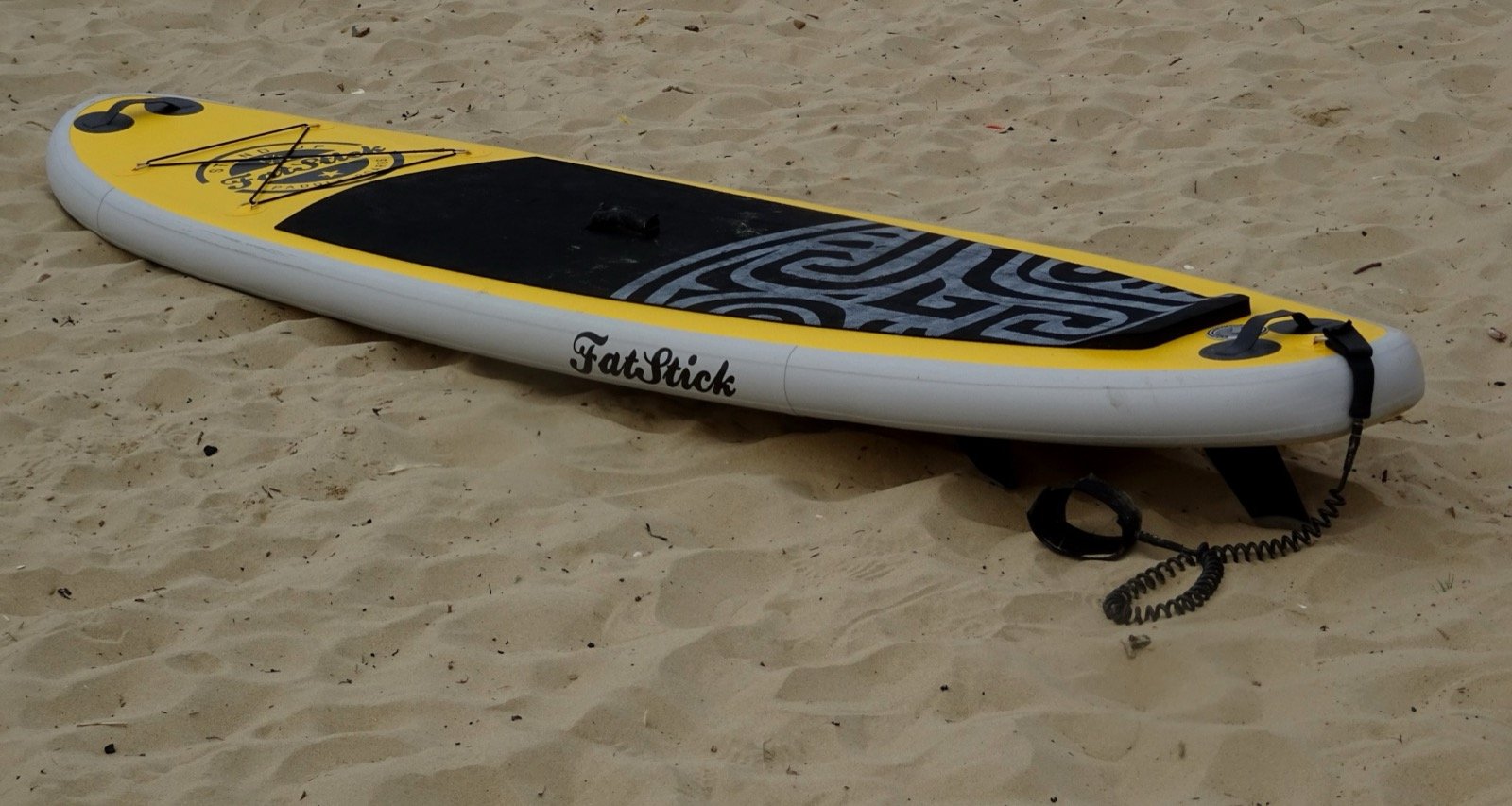
The leash is the single most important safety device on a SUP, and the most commonly misunderstood. The standard ACA guidance distinguishes between:
- Coiled leash on flat water or lagoon. The coil keeps the line out of the water, prevents drag, and reduces the entanglement risk if you fall. This is the default for Nichupté lagoon, Puerto Juárez bay, and any flat-water Caribbean morning session. Coiled leash on ankle.
- Straight leash on surf or breaking waves. A coiled leash in a breaking wave can recoil into your face during a wipeout. A straight leash absorbs the energy by stretching. For SUP-surfing at Playa Delfines or any spot with shore-break, switch to straight leash on the calf (not the ankle — calf placement is more comfortable when you crouch).
- Quick-release belt on rivers or strong-current sections. Not typically relevant for Cancún SUP but worth knowing. In a strong current, a leg-attached leash can pin you under the board if it snags. A waist-belt quick-release lets you fire the leash with one hand.
Do not paddle without a leash. The number of "I left the leash in the hotel" stories that end with "I had to swim 600 m back to the beach" is not zero. Schools that rent boards in Cancún typically include a leash; check it for fraying before you paddle. Replace any leash with visible wear at the rail-attachment loop — that is where they break.
Book a guided SUP session and drill self-rescue with an instructor before you paddle solo. Book Cancún SUP →
Paddle techniques specific to wind and current
The standard ACA forward-stroke — paddle planted ahead, pulled back to the foot, exit smoothly — is fine for flat water. Cancún open-Caribbean conditions reward two technique adjustments:
Sweep stroke for crosswind turning
When the wind hits your beam (sideways), the board weather-vanes — turns nose-into-wind on its own. To counteract, you need a wide sweep stroke on the upwind side: paddle out to a 45° angle from the rail, pull through a wide arc. This corrects the weather-vane and keeps the board tracking. Drilled on day one; useful every session.
Power stroke for upwind return
If you are paddling into 15-20 kt headwind to get home, switch to a short, fast cadence: paddle in front of the lead foot only, pull quickly to the leading foot's heel, exit, re-plant. Cadence 50-60 strokes per minute. This generates more thrust per unit time than the standard long stroke, at the cost of fatigue. Use it for the last 200-300 m of an upwind return when you are getting close to shore. Combine with the prone-paddle technique above for the long-distance offshore-recovery scenario.
Bracing stroke when sideswiped by chop
When a chop wave hits your rail sideways, the board destabilises. A brace stroke — paddle blade slapped flat onto the water on the downwind side, body weight transferred onto the blade momentarily — stabilises you in the moment of impact. ACA Level 1 drill. Twenty reps on the beach, twenty more in the water. Once it is a reflex, you will stay on the board through chop that would otherwise put you in.
Quick reference — scenario to action
| Scenario | First action | Then | Return mode |
|---|---|---|---|
| Standard fall, flat water | Fall flat away from board | Pull leash, remount | Standup paddle |
| Wind hits 20 kt, cannot stand | Drop to knees, then prone | Stow paddle, hand-paddle | Prone-paddle return |
| Drifted offshore mid-session | Test current direction | Paddle upcurrent, not direct | Diagonal upcurrent line |
| Caught in inlet outflow | Paddle 90° to current | Cross out of the flow, then in | Lateral exit then shore |
| Leash failure, board drifting | Front-crawl toward board | Remount as normal | Standup or prone |
| Storm building inland | Cut session, head to shore | Prone-paddle if wind ramps | Whatever is fastest |
| Total disability (cramp, sting) | Lie on board, signal with whistle | Call shore contact | Wait for rescue |
Cross-checked against ACA SUP safety curriculum and Cancún operator field experience. Each scenario is rehearsable on the beach in 10 minutes; rehearse before you depend on it.
Wildlife, sargassum and protected areas — the Cancún variables
The Nichupté lagoon system on the lagoon side of the Hotel Zone is home to a resident American crocodile population — Crocodylus acutus, classified Vulnerable on the IUCN Red List. Crocodile-SUP incidents are rare but not zero, especially at dusk near mangrove fringes. The practical rule: do not paddle Nichupté south of the marina at dusk, do not approach mangrove edges within 20 m, and if you see a crocodile turn 90° away calmly without splashing. Schools that run Nichupté tours brief this on every trip.
On the Caribbean side, the main seasonal variable is sargassum. The official SEMAR and CONANP sargassum monitoring services publish weekly forecasts. Heavy sargassum (April-October) can make beach launches and recoveries unpleasant and can affect fin-trip clearance on shallow takeoffs. Check the forecast the night before; if a heavy mat is forecast, switch to a Caribbean-immune launch like Puerto Juárez or Punta Sam (covered in our hidden launches guide).
Protected areas: most Cancún SUP launches sit outside CONANP protected zones, but the Yum Balam area around Holbox and the Sian Ka'an area south of Tulum require permits for organized groups. Solo recreational SUP is fine; commercial tours need authorization. The Nichupté Lagoon system is partially regulated by SEMARNAT under ZOFEMAT plus state-level rules.
Emergency communication and the pre-launch checklist
Self-rescue assumes you can communicate failure. The kit is small:
- Waterproof phone in a Pelican-style dry case with a lanyard around your wrist. The lanyard matters — a dry-cased phone at the bottom of the lagoon is the same as no phone.
- Whistle on your PFD or harness. Three short blasts = international distress signal. Audible from 500 m+. Cheap insurance.
- Personal Flotation Device (PFD) — required by the US Coast Guard for SUP in open water, recommended by ACA, and strongly recommended for any Cancún Caribbean session more than 200 m offshore. The compact "belt-style" PFDs that auto-inflate when you pull a cord are the unobtrusive option for confident paddlers.
- One shore contact who knows your launch time, expected return time and route. Text them on launch and on return. If the return text does not arrive within 30 min of expected, they call the local Capitanía de Puerto.
The morning-of checklist: Windguru hourly wind; NOAA NWS Caribbean marine forecast (storm cells, sea state); NOAA Ocean Service tide and current for the inlet; sargassum check; PFD on, leash on, whistle on, phone in case, shore contact texted. Five minutes total. Done.
Frequently asked questions
Do I really need a PFD on Nichupté lagoon?
Technically no for recreational use under 200 m from shore — Mexican federal law treats lagoon SUP as a recreational activity not subject to the international PFD rule. Pragmatically yes, especially if you are paddling alone, paddling at dawn or dusk, or paddling beyond the marina line. Belt-style auto-inflate PFDs are unobtrusive and do not interfere with paddling stance. They have saved lives. Wear one.
How do I know which leash style for Playa Delfines?
Straight leash, calf attachment, for any Playa Delfines or open-Caribbean session with shorebreak. The Hotel Zone Caribbean beaches all have 0.3-1.0 m shorebreak most mornings — small but enough to cause a coiled leash to recoil into your face on a wipeout. Switch to straight leash. We cover Playa Delfines specifics in our routes and conditions guide.
What if the wind picks up while I am offshore?
Drop to prone-paddle the moment you cannot make forward progress standing. The standup-to-prone transition takes 10 seconds: drop the paddle alongside you on the deck, lower to your knees, lie flat with the paddle under your chest, start hand-paddling. Aim for the closest shoreline, not your launch beach — getting on land first is the priority, then walking the board back to your launch.
Are jellyfish a problem at Cancún SUP spots?
Occasional but not chronic. The Caribbean Portuguese man-o-war (Physalia physalis) appears in small numbers especially in winter Norte conditions. The local box jellyfish is uncommon at Cancún latitude — much more of a Belize / Riviera Maya south issue. The bigger sting risk on the Hotel Zone Caribbean side is small jellyfish swarms in May-June. If stung, paddle to shore and use vinegar (most beachfront concessions have it). The standard SUP exposure of legs and feet is low-risk; you are not in the water long enough to be a major sting target.
How far offshore is safe at Hotel Zone?
The conservative rule is "as far as you can confidently prone-paddle back against the day's wind." For most paddlers on a typical Cancún day, that is 400-600 m. Beyond that, you are committing to a real-rescue scenario if the wind ramps. The Hotel Zone Caribbean lifeguard service patrols the inshore zone but is not equipped for offshore SUP rescue. The Capitanía de Puerto can be reached via phone for genuine emergencies.
Should I worry about boats and personal watercraft?
Yes — actively. The Hotel Zone Caribbean side has occasional jet-ski traffic and boat traffic from the marinas. SUP riders sit low on the water and are very hard to see. Wear a bright-coloured shirt or vest (high-vis orange is the standard), do not paddle in marina exit channels, and stay closer to shore than the marked navigation buoys. Inside Nichupté lagoon, the boat-lane is well marked and SUPs should stay clear.
Drill self-rescue before you paddle solo
Add a SUP safety drill morning to your Cancún trip
Tell us your level and dates — we book a dedicated self-rescue practice session before any open-water solo paddle.