🔎 TL;DR
- The Mesoamerican Barrier Reef sits 100–300 m off the Tulum coast — the second-largest reef system in the world. For kiteboarders, the reef is the single defining hazard of the Riviera Maya coast. It shapes the wind, the shore-break, the swell, and almost every incident report.
- Onshore-leaning trades are the silent killer. The east and east-south-east trade-wind direction in Quintana Roo arrives close to onshore on the Tulum beach line. A line break or a body-drag mistake puts you on the reef in minutes, not hours.
- Low tide exposes reef teeth. Most of the year the Tulum-area reef sits 30–80 cm below mean low water. At spring lows, sections of reef break the surface and a body-drag becomes physically dangerous, not just risky.
- Drift-rescue chase-boat is not optional on the Tulum coast for any rider beyond IKO Level 2. Schools that lack a chase boat are running the wrong risk model. See IKO rescue protocols for the standard.
- Tide reading + wind forecast = go/no-go. Cross-reference Windguru, Windy, earth.nullschool and the NDBC Caribbean buoy network with the local tide table the night before. Decision is made before you arrive at the beach, not when you have already rigged.
- This article is the safety layer above route choice. If you have not chosen a spot, start with our Riviera Maya kitesurf launch spots overview. Then come back here for the protocol.
Why reef-fronted kiteboarding is its own discipline
Most kiteboarding instruction worldwide is delivered in flat-water learning bays — Isla Blanca lagoon, La Ventana, Tarifa lagoon, El Gouna. The student progression is built around the assumption that downwind drift takes you onto more flat water, that a body-drag back to the beach is a 5–10 minute exercise, and that a failed self-rescue ends with a swim to a sandy shore. None of those assumptions hold on the Tulum coast of the Riviera Maya. Downwind drift takes you onto the Mesoamerican Reef diving. A body-drag back to the beach against onshore-leaning wind is sometimes impossible. A failed self-rescue can end with a swim into coral teeth at low tide.
This article is the safety primer for the Tulum-coast section of the Riviera Maya. It does not apply to Coba lagoon (inland freshwater classroom — see our spots guide) or to Holbox or Isla Blanca lagoons. It applies wherever you are riding open Caribbean with reef 100–300 m offshore: Tulum, Akumal coast outside the bay, Xpu-Há, Paamul, and parts of Puerto Aventuras. For wind-pattern context, the Riviera Maya wind calendar covers the trade-Norte seasonality this guide assumes.
The four sections below treat the four real hazards in operational order: reef geometry, onshore wind angles, tide states, and drift rescue. Each closes with a "do not" rule that exists because someone learned it the hard way.
Reef geometry — where the line actually sits
The Mesoamerican Barrier Reef is the second-largest coral reef system in the world, running approximately 1,000 km from the northern Yucatán to the Bay Islands of Honduras. The portion that affects Riviera Maya kiteboarding is the inner reef line parallel to the Quintana Roo coast, sitting between 100 and 300 m offshore depending on the bay. The reef is not continuous — it is a series of patch-reef heads, sometimes connected, sometimes broken by sandy channels. CONANP administers the marine portion of the reef as a protected area south of Cancún.
What this means for a kiteboarder on a typical Tulum-coast session:
- You launch from a 10–25 m wide sandy beach.
- You ride in 1–2 m of water for the first 50–80 m offshore.
- The reef line starts at roughly 100–200 m offshore. The reef top at high tide sits 30–80 cm below the surface; at low tide some heads break the surface.
- The reef channel zone behind the line (300–600 m offshore) opens to 5–15 m depth. Some operators teach here when the angle is clean.
- Beyond 800 m it is open Caribbean. Currents pick up, swell builds, and self-rescue back to the beach becomes a multi-hour effort.
The take-away: the rideable zone between beach and reef is narrow. The reef is not a distant feature — it is the bottom of your ride window. A downwind drift in onshore wind drops you onto it within minutes. A rider who is comfortable carving 200 m offshore at a flat-water spot is making a much bigger commitment on the Tulum coast.
For high-resolution reef maps, the Mexican federal agency SEMAR publishes nautical charts; earth.nullschool and Windy both overlay bathymetry that confirms the 100–300 m reef belt.
Why onshore-leaning trades are the silent killer
The trade winds that produce kiteable Caribbean season on the Tulum coast arrive from the east. In an ideal world the trade is true east-south-east (ESE), which gives the Tulum beach line a roughly side-shore wind — wind running parallel to the beach, which lets you ride a long line down the coast and use the beach as your safety. In practice the trade rotates over the day: a morning ESE veers to pure east by midday, and a late afternoon can swing to ENE. East at the Tulum beach line is close to onshore — wind pushing you out perpendicular to the beach, which means perpendicular to the reef.
The fail modes:
- Line break in onshore wind. A snapped front-line gives you a hard pull seaward. By the time you regain control or release the QR, you are 50 m closer to the reef.
- Body-drag in onshore wind. Without a board, you body-drag with the wind. Onshore wind means body-drag toward the reef. Without a chase boat, you reach the reef in 4–8 minutes depending on water-state.
- Self-rescue against onshore wind. Once the kite is depowered on the water, you cannot easily paddle a kite + board back to the beach against onshore wind. The wind keeps pushing the whole assembly seaward.
- Walk-of-shame becomes a swim. Riders who lose the board down-wind end up landed past the reef line. Walking back is impossible — they have to swim parallel to the reef to a known channel and then onshore. This is the longest 30 minutes of a kite trip.
The protocol on onshore-leaning days:
- If the angle is more onshore than 30° off the beach axis, do not launch unless you are advanced and the chase boat is on the water.
- Bring a kite line cutter / hook knife — mandatory equipment, not optional.
- Use a leash that releases under load (modern IKO-spec leashes do this) — never a fixed kite-to-rider tether.
- Helmet always on the Tulum coast. Not a fashion accessory; reef contact at speed is a head injury.
- Impact vest recommended — improves flotation in self-rescue, protects ribs.
- Phone in a dry case, plus a whistle attached to the impact vest. You may end up past the reef line and the only way to recall the chase boat is to signal.
The "do not": do not launch on a true east onshore day without a chase boat, regardless of how clean the wind looks on Windguru. Wind angle is more important than wind strength on this coast.
Tide reading — the spring-low trap
The Riviera Maya is microtidal — daily tide range rarely exceeds 50 cm — so kiters from macrotidal coasts (Tarifa, North Sea, Atlantic Canada) initially assume tide is irrelevant. It is not. A 30–40 cm drop is enough to expose reef tops on the Tulum line. The same reef that was a manageable 60 cm below the surface at midday high tide is a 10 cm-deep coral garden at the late-afternoon spring low. Body-dragging into that surface zone is a real injury risk.
The reading method:
- Consult the local tide table the night before. Mexican oceanographic institute CICESE publishes Quintana Roo tide predictions; NOAA Ocean Service tide education covers the cycle basics; tide apps cross-reference the same data.
- Identify whether the day is spring or neap. Spring tides occur near full and new moon, two days either side. The range nearly doubles on spring days — these are the dangerous reef-exposure days.
- Plan launches around tide. The best window for a Tulum-coast session is the 90 minutes either side of high tide, when the reef line sits deepest below the surface and the shore-break is gentlest at the launch.
- Avoid afternoon spring lows. The combination of afternoon onshore wind veer + spring low + tired late-session rider is the high-risk profile. Most reef-contact incidents in our logbook cluster in this window.
Cross-reference tide with swell. The NDBC Caribbean buoy network reports significant wave height for the western Caribbean; values above 1.5 m mean breaking surf on the reef line, which complicates any drift rescue attempt. Trade-wind generated wind chop is normal and manageable; a 2-m groundswell from a tropical system is a hard no for reef-fronted kiting.
Book a Riviera Maya kite session with chase-boat support. See Riviera Maya kitesurf →
Drift-rescue chase boat — the standard operating protocol
A drift-rescue chase boat is the single most important safety asset on reef-fronted kite coasts. The International Kiteboarding Organization training standard for Level 2 and above on this type of coast requires a chase boat in the water during instruction. Free-ride conditions for self-sufficient riders do not legally require a chase boat, but in practice every reputable Tulum-coast operator runs one and many independent riders rotate a "spotter on shore + standby boat" arrangement among themselves.
What the chase boat actually does:
- Recovers riders who drift past the reef. A rider with a depowered kite on the seaward side of the reef cannot easily get back inside; the chase boat tows them through a known channel.
- Recovers boards lost down-wind. Saves a 20-minute body-drag and avoids the temptation to body-drag toward the reef.
- Provides medical evacuation if a rider hits the reef. The boat is faster than walking up the beach to the nearest hotel.
- Marks the kiteable zone with a presence riders can orient on.
- Carries the radio / phone — the single point of comms with onshore emergency services.
What a real chase-boat protocol looks like, drawn from IKO instructor protocols and our own logs:
- Engine warm, on the water, in position during the session. Not parked on trailer at the launch.
- VHF radio on channel 16 monitored, plus a charged phone in dry pouch.
- Driver IKO Assistant or higher, with marine licence under Mexican regulations.
- Rescue kit on board: spare kite line, hook knife, flares, first-aid kit with reef-laceration supplies, drinking water, towel.
- Pre-session brief: every rider knows the chase boat's call sign and recall signal. Standard recall is a 6-blast whistle or kite waved overhead on the water.
- Session limit: max distance from boat per rider, max distance from beach. Riders who exceed are recalled before the wind shifts.
The "do not": do not pay for a Tulum-coast lesson at a school that does not have a chase boat on the water. The price difference between a chase-boat school and a no-chase-boat school is real (often 30–50% more per hour) and it buys you the single most important risk reduction on this coast.
Go/no-go matrix — the table we use every morning
The matrix below combines tide state, wind angle and wind strength into a single decision table for the Tulum coast. It is intentionally conservative — schools and free-riders both report better long-term outcomes when the threshold is strict. Wind strength figures are sustained, not gust. Cross-reference live conditions on Windguru, Windy, earth.nullschool and the regional NDBC buoys before applying the table.
| Wind angle | Wind strength | Tide state | Skill required | Chase boat | Decision |
|---|---|---|---|---|---|
| Side-shore (ESE ideal) | 14–22 kt | Mid-rising to high | IKO L2+ | Recommended | GO — clean conditions |
| Side-onshore (E) | 14–22 kt | High slack | IKO L2+ | Required | GO — chase boat live |
| Onshore (ENE) | any | any | Advanced only | Required | CAUTION — many cancel |
| Any angle | < 12 kt | any | — | — | NO GO — under-powered, reef drift risk on lulls |
| Any angle | > 28 kt | any | Advanced + chase | Required | EXPERTS ONLY |
| Any angle | 14–22 kt | Spring low | Advanced | Required | CAUTION — reef tops exposed |
| Norte / north swing | 20+ kt onshore | any | Advanced | Required | NO GO for most — sand-blast + shore-dump |
| Pre-tropical / squall passing | variable | any | — | — | NO GO — wind shifts unpredictable |
The single most-broken row is "Any angle, < 12 kt, no go". Under-powered riding on a reef-fronted coast is more dangerous than a strong-wind session because the kite cannot generate the line tension needed for a body-drag recovery. A drop to 8 knots mid-session strands the rider down-wind of the launch.
If it does go wrong — the post-incident protocol
This is the section you hope you never need. The reality of reef-fronted kiteboarding is that incidents happen — usually minor cuts and bruises, occasionally something more serious. The post-incident protocol is the same protocol IKO instructors use globally and that we run with our own riders.
- Rider down on the reef: chase boat reaches them within 2 minutes (operational target). Kite is QR-released, lines packed. Rider lifted into boat or assisted up to standing if injury allows.
- Reef-laceration first aid: rinse with fresh water on board, sterile gauze + pressure to stop bleeding, antiseptic, do not stitch in-field. Coral cuts get infected fast — a 1 cm cut needs medical attention within hours, not days. The Riviera Maya has English-speaking clinics in Playa del Carmen, Tulum and Akumal.
- Lost kite, lost rider in different directions: chase boat prioritises the rider every time. The kite can be recovered separately or written off.
- Recall all other riders: any reef-contact incident triggers a session end for the group. Wind keeps blowing; you do not need to keep riding.
- Document the incident: time, conditions, riders, gear involved. Schools log this for IKO compliance and insurance.
- Debrief: at the end of the day, the operator and rider review what went wrong. This is where actual learning happens — and where the next session's go/no-go calibrates.
For broader marine-safety standards, NOAA's national ocean safety guidance covers principles that apply to any coastal water sport. The Riviera Maya operates under Mexican federal maritime law (SEMAR) — riders should know that any incident involving rescue services may be subject to local reporting requirements.
Want chase-boat-backed Riviera Maya kite sessions? Plan your kite trip →
Frequently asked questions
Is Tulum safe for kiteboarding?
Conditionally — for intermediate+ riders with chase-boat support, on side-shore days with mid-rising-to-high tide, the Tulum coast is rideable and the experience is excellent. For beginners or on onshore-leaning days, the answer is no. The reef is the deciding variable.
How far offshore is the reef?
100–300 m depending on the bay. The closest reef-line is in front of central Tulum beach; the most distant in some Akumal-area zones. CONANP manages the marine portion as a protected area.
Should I bring a helmet?
Yes — non-negotiable for reef-fronted Caribbean kite. Helmets reduce traumatic-brain-injury risk if you body-drag onto reef. We require helmet use for all instruction. See IKO safety standards.
Is a chase boat really necessary?
For Tulum coast: yes for instruction, strongly recommended for free-ride. For Coba lagoon: no — it is shallow flat-water and shore-based rescue is sufficient. The chase boat is what separates a safe Tulum-coast operation from an aspirational one.
What is the worst month for reef hazard?
October–November when residual hurricane swell can break on the reef and Norte fronts add onshore wind components. See our wind calendar for monthly breakdown.
Can I kite-foil over the reef?
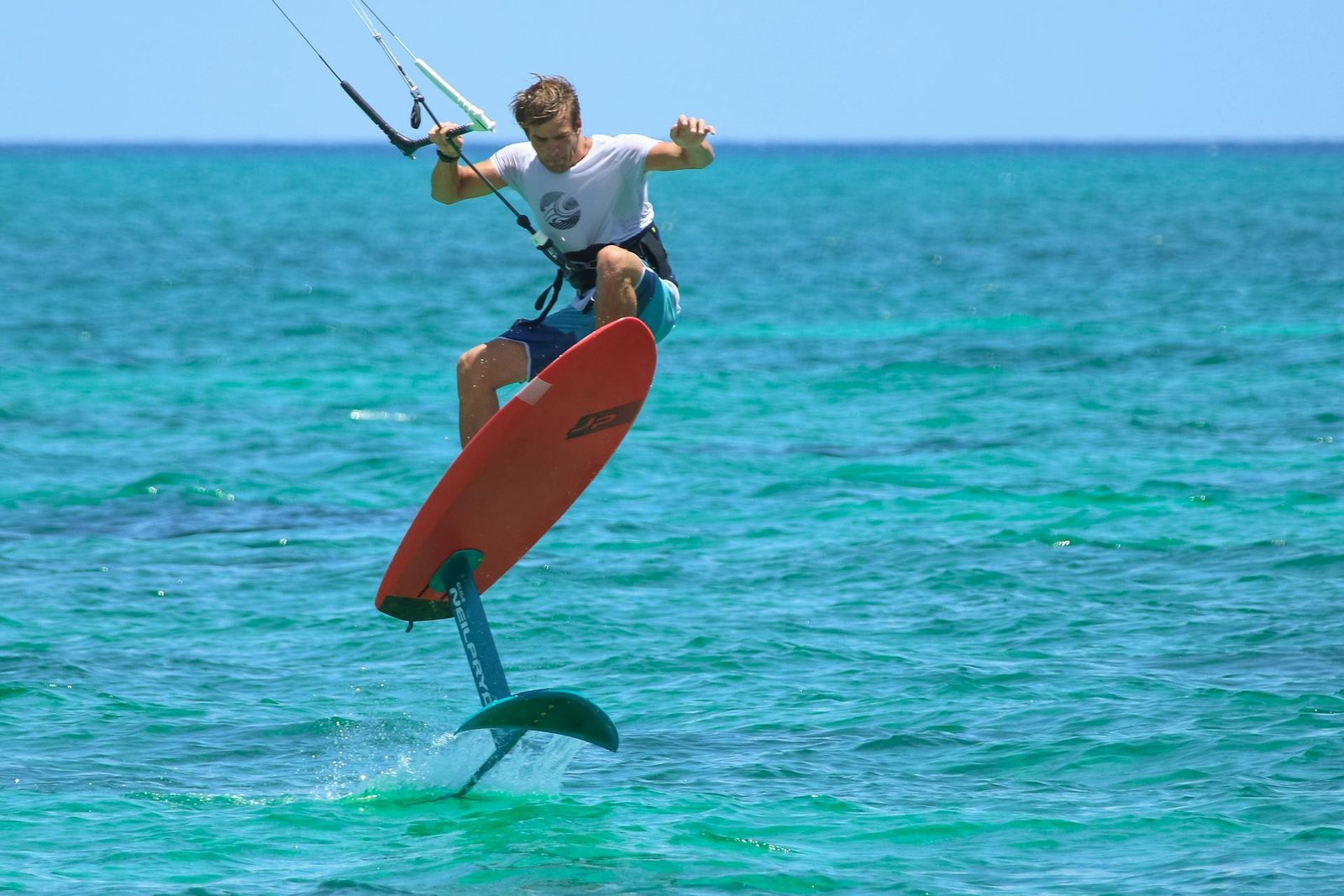
Technically yes at higher tide, but the consequence of a fall onto exposed coral with a hydrofoil board attached is severe. Reef-area foil sessions are for advanced foilers only, with chase boat. Most foil sessions on the Riviera move to Coba lagoon or Holbox.
Are there sharks?
Yes — multiple species including nurse, blacktip, occasional bull — but kite-shark interactions on the Riviera Maya are vanishingly rare. The reef is a higher risk than the wildlife. See NOAA shark guidance for general Caribbean context.
Riviera Maya kite — your safer paths
Plan a safer Riviera Maya kite trip
Tell us your level and dates — we book you with chase-boat operators and pick the right rotation.